
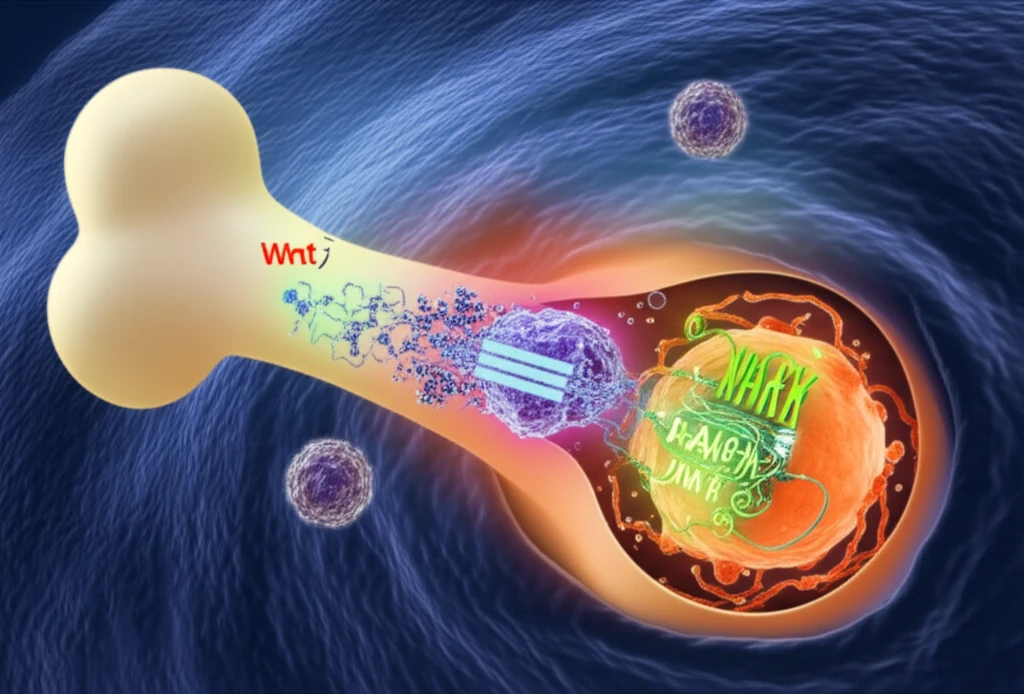
Unlocking Osteosarcoma: How Wnt1 and MAFK Could Pave the Way for New Treatments

"Research reveals a potential new pathway for osteosarcoma cell proliferation, offering hope for targeted therapies."
Osteosarcoma, a prevalent bone cancer affecting children and young adults, often presents a challenge due to tumor recurrence despite current treatments. While chemotherapy and surgery remain the standard, the need for more targeted and effective therapies is critical. This is where innovative molecular research steps in, offering the potential to revolutionize how we approach and treat this disease.
Recent advances in molecular research have turned the spotlight onto oncogene families, particularly musculoaponeurotic fibrosarcoma oncogene homolog K (MAFK), sparking interest in their roles in various human diseases. Understanding these roles could pave the way for innovative treatments that specifically target the underlying mechanisms driving cancer development.
This article dives into a recent study that explores the role of MAFK in osteosarcoma cell proliferation. The research uncovers a significant connection between MAFK and the Wnt signaling pathway, revealing how their interaction promotes cancer cell growth. We'll explore these findings and their potential implications for future osteosarcoma treatments.
MAFK and Wnt1: A Dangerous Duet in Osteosarcoma?
The study initially found that MAFK was present at lower levels in osteosarcoma cells compared to normal bone tissue. This prompted the researchers to investigate what factors might influence MAFK's activity and its role in cancer development. Through microarray analysis, they discovered a strong correlation between MAFK and the Wnt signaling pathway. The Wnt pathway is a crucial network of proteins involved in cell growth, proliferation, and differentiation. When this pathway goes awry, it can contribute to the development of various cancers, including osteosarcoma.
- Increasing MAFK levels alone led to increased cell proliferation.
- Co-expressing MAFK with Wnt1 resulted in even greater cell proliferation.
- Blocking the Wnt pathway with an inhibitor (IWR-1-endo) reduced the pro-growth effects of MAFK.
A New Hope for Osteosarcoma Treatment?
This research provides compelling evidence that the Wnt signaling pathway and MAFK play a significant role in osteosarcoma development. The finding that Wnt1 induces MAFK expression and promotes cell proliferation opens up new avenues for targeted therapies.
The study suggests that inhibiting either MAFK or the Wnt signaling pathway could be a promising approach to combat osteosarcoma. In fact, the researchers showed that blocking the Wnt pathway with an inhibitor reduced the growth-promoting effects of MAFK in osteosarcoma cells. This highlights the potential of developing drugs that specifically target these molecules to halt cancer progression.
While further research is needed to fully understand the complex interplay between MAFK and the Wnt signaling pathway in osteosarcoma, this study represents a significant step forward. By identifying these key players in cancer development, we can pave the way for more effective and targeted treatments for this challenging disease, offering hope for improved outcomes for patients with osteosarcoma.