
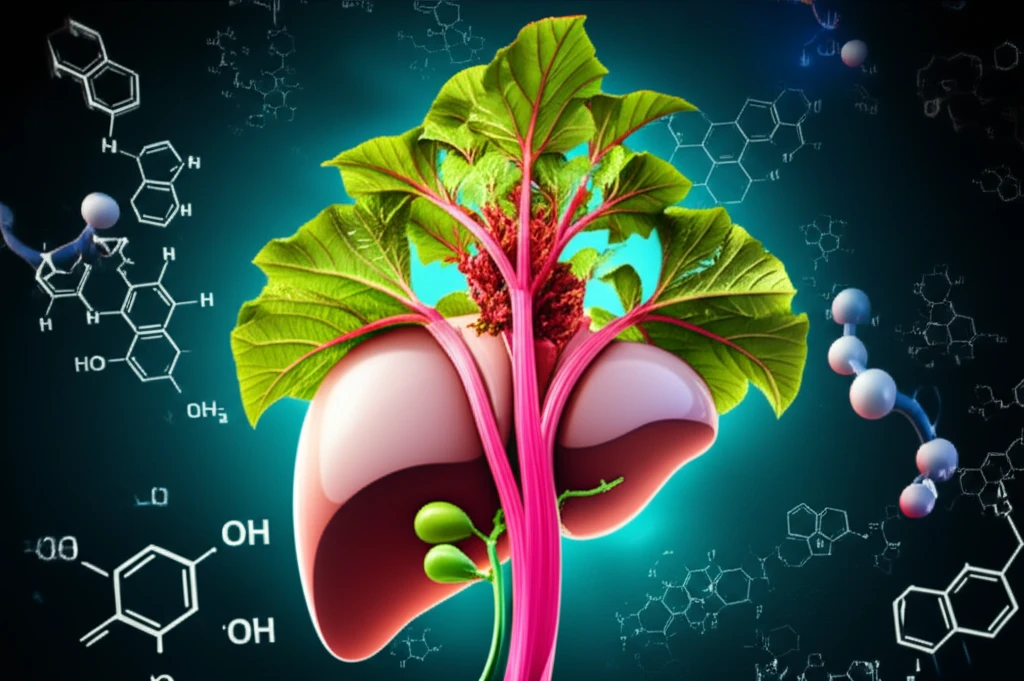
Unlocking Nature's Secrets: How a Traditional Herb Fights Liver Cancer

"Explore the promising research on Rheum palmatum extract and its potential to combat hepatocellular carcinoma."
Liver cancer, a formidable disease, presents a significant global health challenge. While advances in medical treatments have been made, the search for effective and safe therapies continues. Recent research has shed light on the potential of Rheum palmatum extract, a traditional Chinese medicine, in combating this disease. This article aims to explore the scientific findings on how this ancient remedy might offer new hope in the fight against liver cancer.
Rheum palmatum has a rich history in traditional Chinese medicine, where it has been used for centuries. The extract is known for its various health benefits, including anti-inflammatory and antioxidant properties. Current research highlights the potential of Rheum palmatum extract to act as an anti-cancer agent, specifically targeting the progression of liver cancer.
The study focuses on the extract's ability to inhibit specific pathways involved in cancer cell growth and spread. These findings offer a fresh perspective on how traditional medicines could contribute to modern cancer treatments. This article reviews the scientific evidence, making it easier for readers to understand the extract's potential and its implications for future research and treatment.
Traditional Use and Anticancer Interest
Rheum palmatum (RP), a traditional Chinese medicinal herb, has been used for gastrointestinal and liver diseases and is reported to have cathartic, anti-inflammatory, anticancer, hepatoprotective, and antioxidative effects. Research has examined RP extract for hepatocellular carcinoma (HCC), including its possible relationship with STAT3 signaling. Sennoside A, a bioactive component associated with Rheum species, has also been reported to have therapeutic potential in conditions including liver steatosis and several cancers.
Preclinical Testing and Chemical Profiling
The cited research evaluates Rheum palmatum root extract in a diethylnitrosamine (DENA)-induced HCC model in rats. The study uses methanol extraction and HPLC-PDA-MS/MS to characterize the extract's secondary metabolites while investigating potential anticancer properties. These sources describe experimental and analytical methods, but they do not establish clinical effectiveness in humans or define the extract's limitations in standard HCC care.
Chinese Rhubarb and Its Constituents
Rheum palmatum is a flowering plant in the Polygonaceae, or knotweed, family and is commonly known as Chinese rhubarb, ornamental rhubarb, Turkey rhubarb, or East Indian rhubarb. It is also known in Mandarin Chinese as dahuang, meaning “great yellow” or “big yellow,” a name associated with its large, yellowish rootstocks used in traditional medicine. The plant is known for producing anthraquinones such as emodin and rhein, while a 2024 review notes that its broader medicinal potential remains in an early stage requiring further research and careful observation.
The Science Behind Rheum palmatum Extract and Its Anti-Cancer Properties
The research indicates that Rheum palmatum extract has a multi-faceted approach in its fight against liver cancer. It works by inhibiting the activity of signal transducer and activator of transcription 3 (STAT3). This is important because STAT3 is a protein that plays a key role in the growth and spread of cancer cells. By targeting STAT3, the extract helps to slow down the progression of the disease.
- Reduced cell viability: The extract decreases the growth of cancer cells.
- Inhibition of migration and invasion: Prevents cancer cells from spreading.
- Angiogenesis reduction: Reduces the formation of new blood vessels that feed tumors.
- Targeted STAT3 signaling: Directly influences pathways that promote cancer growth.
Rhein and Liver-Related Research
A 2020 review examines rhein as a potential anticancer drug and summarizes literature on its cancer-preventing and therapeutic properties. The review presents further research as necessary to establish rhein's chemoprotective and therapeutic roles relative to conventional drugs. Separately, an Iranian Registry of Clinical Trials entry evaluates Rheum palmatum syrup combined with diet and exercise against diet and exercise alone for effects on liver enzymes in patients with non-alcoholic fatty liver disease (NAFLD).
Evidence Still Developing
The available material does not establish Rheum palmatum as a proven treatment for liver cancer. Findings described in these research areas may reflect early, experimental, or condition-specific evidence rather than confirmed clinical benefit. Further well-designed studies would be needed to clarify effectiveness, safety, dosing, and how the herb compares with established care.
Variation Within the Rheum Palmatum Complex
Recent research compares members of the Rheum palmatum complex through alternative-splicing analysis and differences in medicinal constituents. The studies use RNA-seq and weighted gene co-expression network analysis (WGCNA) to examine transcript variation and regulatory patterns. The 2025 report says newly identified isoforms may improve understanding of rhubarb's regulatory landscape and provide a resource for future genetic improvement of the R. palmatum complex.
The Future of Rheum palmatum in Cancer Treatment
The research on Rheum palmatum extract provides promising insights into its potential as a treatment for liver cancer. As scientists continue to study this ancient remedy, it could become a valuable addition to our arsenal against this disease. Future studies will focus on further understanding the extract's mechanisms and its clinical applications. This research highlights the potential of integrating traditional medicine with modern science to improve cancer care.
A Promising but Unsettled Direction
Rheum palmatum has a long medicinal history and has attracted modern interest because of reported anticancer activity. However, the available evidence does not by itself show that the herb can safely or effectively treat liver cancer in people. Its role should therefore be regarded as investigational until stronger clinical evidence is available.
From Laboratory Findings to Clinical Evidence
Future research could help determine whether findings associated with Rheum palmatum translate into meaningful benefits for patients. Important questions include which constituents or extracts are most relevant, what doses are appropriate, and how safety should be assessed. Progress will depend on studies that move beyond preliminary observations and evaluate outcomes in well-characterized human populations.
Understanding the STAT3 Connection
A cited report describes Rheum palmatum extract as producing anti-hepatocellular carcinoma effects by inhibiting signal transducer and activator of transcription 3 (STAT3) signaling. This places STAT3 among the biological mechanisms investigated in connection with the herb's potential activity. The source provides a mechanistic research direction, but it does not establish how such findings address the broader challenges of liver-cancer treatment or healthcare delivery.
Patient Relevance Requires Evidence
Interest in Rheum palmatum reflects the broader appeal of traditional medicines in health research. Yet laboratory or early clinical findings cannot automatically predict benefits for individual patients with liver disease or cancer. Real-world use would require reliable information about preparation, dosing, safety, and interactions with conventional treatment.