
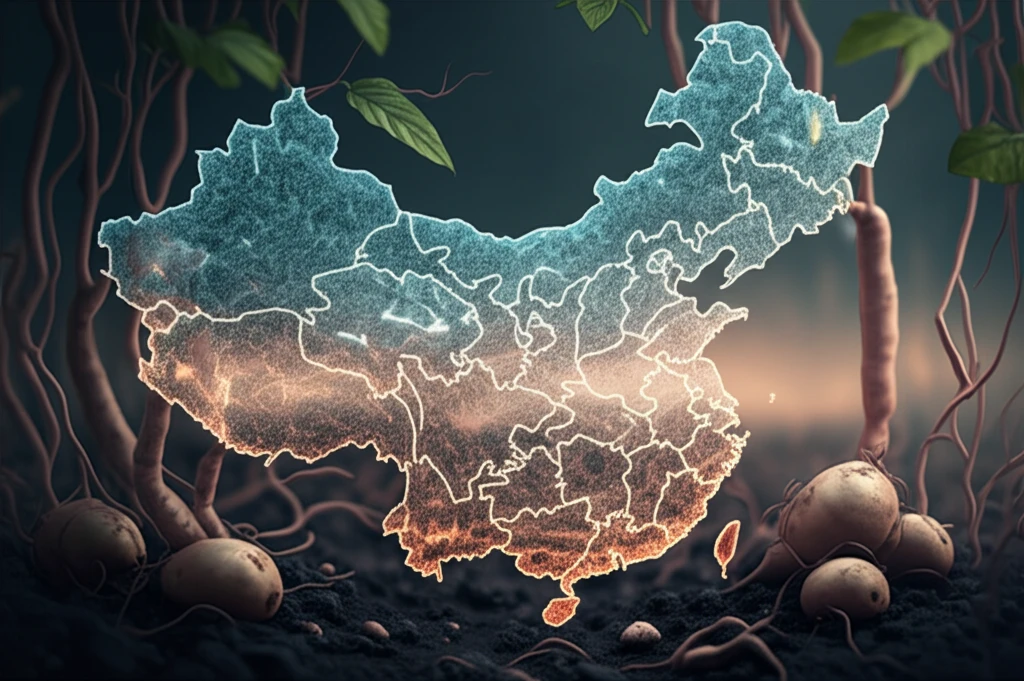
Unlocking Nature's Pharmacy: Finding the Perfect Spot to Grow Chinese Medicinal Yam

"Discover how ecological analysis is revolutionizing the cultivation of Chinese medicinal yam, ensuring both quality and sustainability for this vital herbal remedy. "
For centuries, Chinese medicinal yam (Dioscorea opposita Thunb.) has been a cornerstone of traditional medicine and a valued food source. As health awareness grows and living standards improve, the demand for this herbal remedy is soaring. This surge highlights the critical need to understand and optimize how and where this important crop is grown.
The key to successful yam cultivation lies in understanding its deep connection to the environment. Chinese medicinal yam is particularly sensitive to ecological factors, which profoundly influence its growth, yield, and overall quality. Therefore, it is essential to accurately identify the most suitable planting areas.
Recent shifts in economic structures and ecological conditions in prime yam-producing regions have underscored the urgency of this task. Without careful agro-ecological planning, the introduction of new yam varieties can disrupt established geo-authentic areas, leading to inconsistencies in product quality. A recent study has combined climate data, soil analysis, and GIS technology to pinpoint optimal growing regions, promising a more sustainable and high-quality yield.
A Crop Measured in Kilometers and Tons
In China, the annual planting area of medicinal yams is roughly 2,000 km², and about 20,000 tons of yam are used medicinally each year. The crop is well represented in the north of Henan Province by the Taigu Yam and Huai Yam varieties, underscoring its significance as a cultivated medicinal commodity.
Mapping Suitability Through Ecological Assessment
Suitability is typically judged through agro-ecological assessment frameworks that weigh climate, soil, and habitat conditions. Researchers also apply analytic hierarchy processes and spatial analysis, such as those used for ecological suitability assessments in basins and village sites, which help rank candidate growing areas.
A Thousand Years of Medicinal Food
Chinese Medicinal Yam has been prescribed as medicinal food for thousands of years by Traditional Chinese Medicine practitioners, valued for nourishing the stomach and spleen. Today it is extensively cultivated in the People's Republic of China, with modern science only beginning to confirm the health benefits long claimed by tradition.
Decoding the Ideal Yam Habitat: Climate, Soil, and Location
The study, published in 2018, focused on identifying the key ecological indicators that define the perfect environment for Chinese medicinal yam. Researchers analyzed climate data from 1981 to 2010, gathered from over 700 meteorological stations across China, along with soil data from the Harmonized World Soil Database (HWSD). This comprehensive approach allowed them to pinpoint the ideal conditions for yam cultivation.
- Relative humidity
- Annual precipitation
- Mean annual temperature
- Soil type, pH, organic carbon, and cation exchange capacity
New Science Behind an Old Root
A frontier review of the nutraceutical Chinese yam reports that modern research is finally beginning to confirm the plant's remarkable health benefits. Parallel work focuses on the agro-ecological suitability of Chinese Medicinal Yam, with key agro-meteorological indicators tracked across its major growth periods in the best-producing regions.
The Genome-Editing Gap
Despite its pharmaceutical importance, Dioscorea zingiberensis — a Chinese yam species that produces diosgenin, a raw material for steroidal hormones — has no reported genome editing approach to date. This absence of established CRISPR-Cas9 tools highlights a technological lag that can constrain efforts to improve cultivation traits and yields.
Wild Yam Versus Cultivated Common Yam
Chinese wild yam has traditionally been used across North and Central America and Asia for digestive issues, coughs, and morning sickness, and it differs from common yam in practical ways. For instance, Chinese wild yam only needs about 6–7 minutes of cooking to melt in the mouth, whereas a common yam generally requires more than double that time to soften.
Securing the Future of Chinese Medicinal Yam
This research offers more than just a map; it provides strategic guidance for establishing standardized planting bases for Chinese medicinal yam. By understanding the specific ecological requirements of the plant, we can ensure consistent quality, sustainable yields, and informed decision-making for government programming. As the demand for this vital herbal remedy continues to grow, this study provides a vital foundation for responsible and effective cultivation practices.
Converging Evidence on Where Yam Thrives
Expert assessment of agro-ecological suitability combines field-level indicators with regional modeling to pinpoint the best Chinese Medicinal Yam locations. Complementary conceptual work on ecological suitability, grounded in habitat suitability and food web characterizations, reinforces that matching a species to its environment is central to successful cultivation.
From Field Selection to Genetic Improvement
Future progress will likely pair refined agro-meteorological indicators with emerging biotechnology, addressing the fact that no genome editing method currently exists for species like Dioscorea zingiberensis. Establishing such tools could open new avenues for boosting diosgenin yields and tailoring varieties to their ideal growing sites.
Suitability Modeling at a Larger Scale
The methods used to judge where Chinese Medicinal Yam can best be grown sit within a broader movement toward data-driven suitability assessment. Approaches such as artificial intelligence-based multi-model integration for evaluating 413 traditional village sites in Jiangxi Province show how similar logic can be applied across different land-use decisions.
Sustaining a Medicinal Food Tradition
With thousands of tons of yam consumed medicinally each year, finding the right growing spots directly affects communities that depend on this crop. Because Chinese Medicinal Yam has nourished the stomach and spleen for generations of Traditional Chinese Medicine patients, secure, suitable cultivation is not just an agricultural goal but a public health one.