
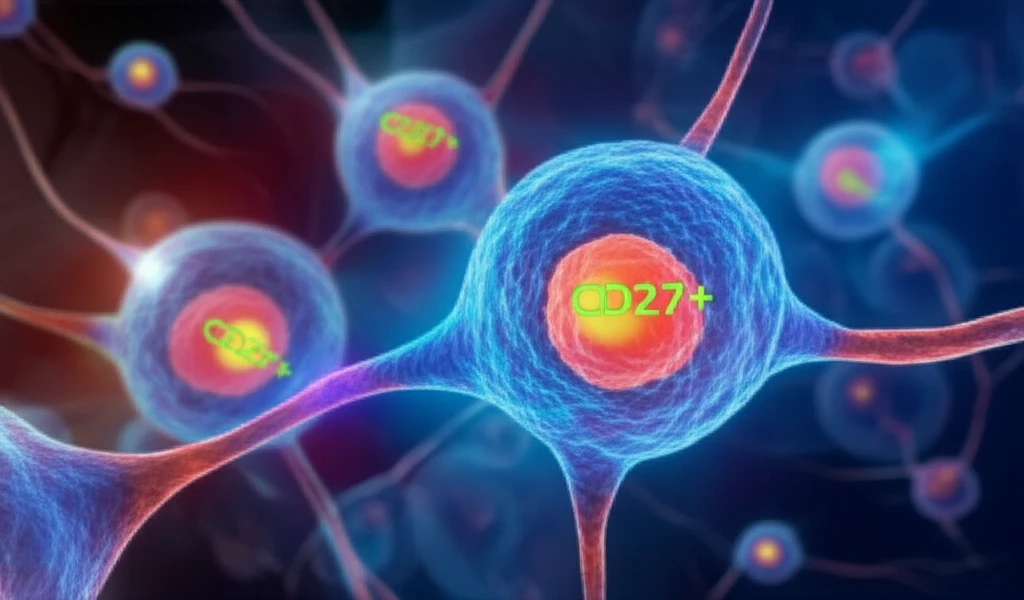
Unlocking Lupus Treatment: How Belimumab Reshapes B Cell Dynamics

"A Deep Dive into Belimumab's Impact on CD27+ and CD27- B Cells in Systemic Lupus Erythematosus"
Systemic Lupus Erythematosus (SLE) is a complex autoimmune disease, and finding effective treatments remains a challenge. Belimumab, a human anti-BAFF monoclonal antibody, has emerged as a promising therapy. By inhibiting soluble BAFF (B cell activating factor), Belimumab leads to a partial B cell depletion, but questions remain about which specific B cell subsets are most affected.
A recent study delved into the effects of Belimumab on B cells, focusing on the expression of BAFF receptors (BAFFR). The research tracked changes in BAFFR expression on B cells over a 12-month period of Belimumab treatment in SLE patients, correlating these changes with alterations in B cell subsets.
This article breaks down the key findings of the study, explaining how Belimumab impacts different types of B cells and what this means for the early clinical efficacy of the drug in treating SLE.
Belimumab's Two-Pronged Attack: CD27+ Increase, CD27- Decrease
The study involved twelve SLE patients (all female, average age 44) undergoing Belimumab therapy. Researchers collected and analyzed blood samples at baseline and at 3, 6, 9, and 12 months to assess changes in B cell subsets and BAFFR expression. All patients were on other immunosuppressants before starting Belimumab, and most continued to take them alongside Belimumab during the study.
- CD19+CD27+ Cells: Showed an increase at 3 and 6 months in 9/12 patients.
- CD19+ Cells: Showed a decrease from baseline to 12 months.
- CD27- B Cells: Decreased from baseline to 3 and 6 months, persisting to 12 months.
What This Means for Lupus Treatment
The study's findings suggest that Belimumab's effectiveness in treating SLE may be linked to its specific effects on B cell subsets, particularly the CD19+27+ and CD19+27- populations. The ability of CD19+27+ cells to increase BAFFR and transiently expand, coupled with the sensitivity of CD19+27- cells to BAFF deprivation, could explain the early clinical responses observed in patients.
These insights open avenues for further research. Understanding the precise mechanisms by which Belimumab modulates these B cell subsets could lead to more targeted and effective therapies for SLE. Monitoring CD27+ and CD27- B cell levels during Belimumab treatment could potentially help predict treatment response and personalize therapy.
Ultimately, this research highlights the importance of understanding the complex interplay of B cell subsets in SLE and how targeted therapies like Belimumab can reshape these dynamics to improve patient outcomes. The study is a step forward in the ongoing quest to find better treatments for this challenging autoimmune disease.