
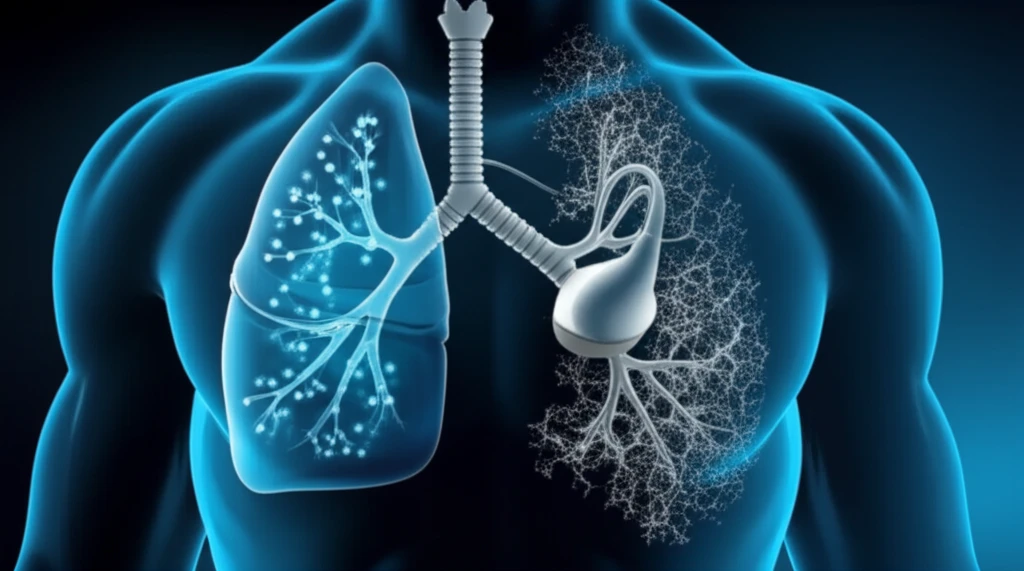
Illustration of a lung with healthy and diseased tissue, showing ultrasound waves.

Unlocking Lung Health: How Ultrasound and Early Detection Can Combat Interstitial Lung Disease in SSc Patients

"New research highlights the potential of chest ultrasound as a valuable tool for early detection of interstitial lung disease (ILD) in systemic sclerosis (SSc) patients, offering a safer alternative to traditional CT scans."


Systemic sclerosis (SSc) is a chronic autoimmune disease that can cause a variety of complications, including interstitial lung disease (ILD). ILD is a condition that affects the tissue around the air sacs in your lungs. This makes it difficult to breathe and get enough oxygen into your bloodstream.

Early detection of ILD is key to improving outcomes for SSc patients. The current gold standard for diagnosing and monitoring ILD is high-resolution computed tomography (HRCT), also known as CT scan. However, HRCT exposes patients to radiation, raising concerns about cumulative exposure over time, especially with repeated screenings.

Now, new research suggests that chest ultrasound could be a valuable alternative for detecting ILD in SSc patients. This article will dive deep into the study's findings, explain the potential benefits of ultrasound, and discuss what this means for the future of ILD management in SSc.

Chest Ultrasound: A Promising Tool for ILD Detection

Illustration of a lung with healthy and diseased tissue, showing ultrasound waves.

A recent study investigated the use of chest ultrasound to identify signs of ILD in 60 SSc patients. The researchers compared ultrasound findings with those from HRCT scans, looking for specific patterns that indicate lung damage. The study focused on identifying key ultrasound signs, including:

  • Lung comets: Also known as B-lines, these are vertical lines that appear on the ultrasound image, indicating fluid or thickening in the lung tissue.
  • Pleural line thickness: Measures the thickness of the membrane surrounding the lungs. An increased thickness can suggest inflammation or fibrosis.
  • Irregular pleural margins: Assesses the smoothness of the pleural line. Irregularities may indicate underlying lung disease.
  • Subpleural cysts: Identifies small, fluid-filled sacs beneath the pleural surface. Their presence can be a sign of honeycombing, a characteristic pattern of advanced ILD.

The study found that specific ultrasound signs correlated with patterns observed on HRCT scans, specifically ground glass opacities and honeycombing. For ground glass patterns, lung comets had the highest specificity (91%), sensibility (85.7%) and accuracy (88%). For honeycombing pattern, irregular pleural margins had the highest specificity (92%), sensibility (69.6%) and accuracy (82%). These results suggest that chest ultrasound can effectively detect ILD-related changes in the lungs of SSc patients.

The Future of ILD Monitoring in SSc: A Step Towards Safer, Earlier Detection

The study's findings offer a promising step towards safer and more accessible ILD monitoring for SSc patients. Chest ultrasound is a repeatable, low-cost, and radiation-free imaging technique.

While HRCT remains the gold standard for assessing ILD, incorporating chest ultrasound into routine SSc care could:

<ul><li><b>Improve the timing of HRCT scans:</b> Ultrasound can help identify patients who would benefit most from HRCT, reducing unnecessary radiation exposure for those with stable lung conditions.</li><li><b>Facilitate earlier detection:</b> Regular ultrasound screenings can detect subtle changes in the lungs, enabling earlier intervention and potentially slowing disease progression.</li><li><b>Enhance patient care:</b> By providing a readily available and safe monitoring tool, chest ultrasound can improve the overall management of ILD in SSc patients.</li></ul>

About this Article -

This article was crafted using a human-AI hybrid and collaborative approach. AI assisted our team with initial drafting, research insights, identifying key questions, and image generation. Our human editors guided topic selection, defined the angle, structured the content, ensured factual accuracy and relevance, refined the tone, and conducted thorough editing to deliver helpful, high-quality information.See our About page for more information.

Everything You Need To Know

1

What is systemic sclerosis (SSc), and how does it relate to interstitial lung disease (ILD)?

Systemic sclerosis, or SSc, is a chronic autoimmune disease that can lead to various complications. One of these complications is interstitial lung disease, referred to as ILD. ILD affects the tissue around the air sacs in the lungs, making it difficult to breathe and get enough oxygen into the bloodstream. The early detection of ILD is crucial for improving outcomes for SSc patients.

2

How does chest ultrasound help in detecting interstitial lung disease (ILD) in systemic sclerosis (SSc) patients?

Chest ultrasound is emerging as a valuable tool because it can identify key indicators of ILD in SSc patients. These indicators include lung comets (also known as B-lines) which indicate fluid or thickening in the lung tissue, pleural line thickness indicating inflammation or fibrosis, irregular pleural margins which may indicate underlying lung disease, and subpleural cysts which can signify honeycombing in advanced ILD. By identifying these signs, chest ultrasound can effectively detect ILD-related changes in the lungs.

3

What are lung comets, and why are they important in diagnosing ILD with chest ultrasounds?

Lung comets, also known as B-lines, are vertical lines that appear on ultrasound images. In the context of ILD, the presence of lung comets indicates fluid or thickening in the lung tissue, making them a key sign for detecting early lung damage. The study found that lung comets had a high specificity (91%), sensibility (85.7%) and accuracy (88%) for ground glass patterns.

4

How does chest ultrasound compare to high-resolution computed tomography (HRCT) in detecting ILD in SSc patients?

While chest ultrasound shows promise, HRCT remains the gold standard for diagnosing and monitoring ILD. However, HRCT exposes patients to radiation, raising concerns about cumulative exposure. Chest ultrasound offers a radiation-free and repeatable alternative, enabling more frequent monitoring. This is particularly important for SSc patients who may require ongoing assessment of their lung health. Combining both methods may provide the best approach for comprehensive ILD management.

5

What are the future implications of using chest ultrasound for early ILD detection in systemic sclerosis (SSc) patients?

The shift towards using chest ultrasound for early ILD detection in SSc has significant implications. Early detection of ILD through chest ultrasound and HRCT is key to improving outcomes for SSc patients because it allows for earlier intervention and management of the condition. This proactive approach can slow down the progression of ILD and improve the overall quality of life for individuals with SSc. Early interventions can dramatically improve the management of the disease.

Newsletter Subscribe

Subscribe to get the latest articles and insights directly in your inbox.