
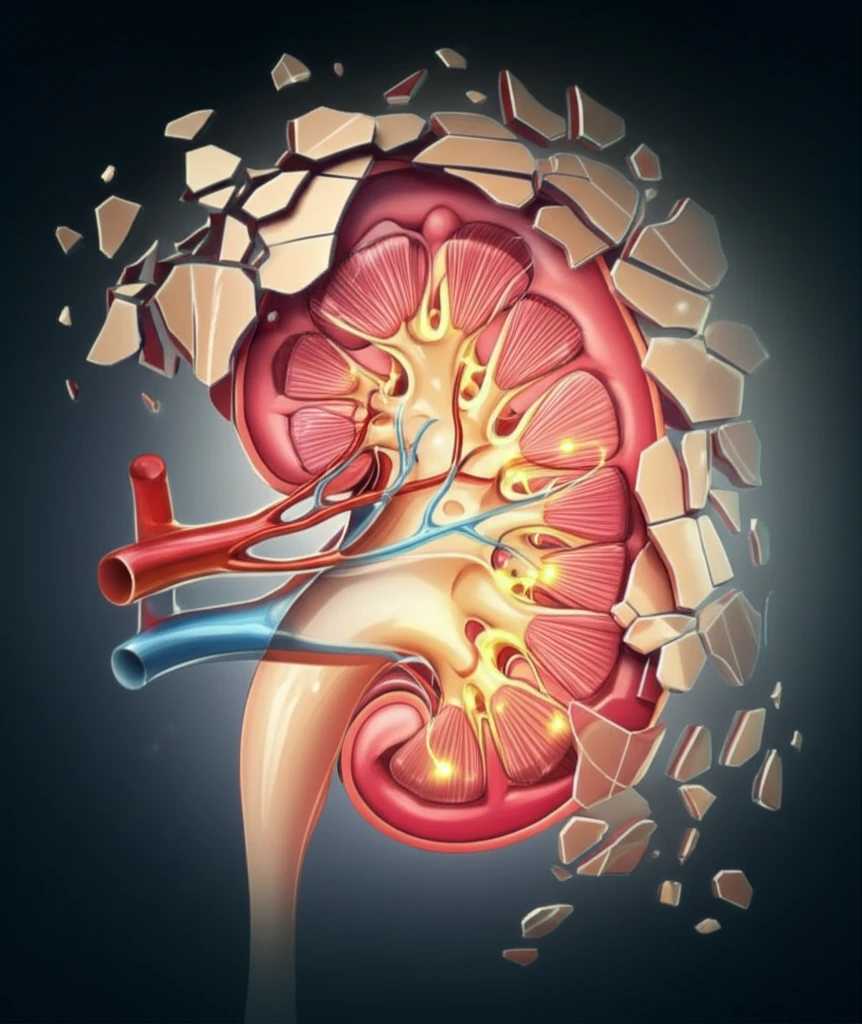
Kidney cell regeneration.

Unlocking Kidney Regeneration: How Blocking a Key Signal Could Revolutionize Treatment

"Groundbreaking research suggests that inhibiting CXCL12 signaling may awaken dormant cells to repair damaged kidneys, offering new hope for those with chronic kidney disease."


Chronic kidney disease (CKD) affects millions worldwide, often leading to kidney failure and the need for dialysis or transplantation. A major hallmark of CKD is the progressive damage to and loss of podocytes, highly specialized cells in the kidney's glomeruli. These cells are essential for filtering waste from the blood, and once damaged, they are notoriously difficult to regenerate, leading to a decline in kidney function.

For years, researchers have been exploring potential avenues for kidney regeneration, with a particular focus on parietal epithelial cells (PECs) found in Bowman's capsule, a structure within the kidney. The question has been whether these PECs can be coaxed into becoming new podocytes to replace the damaged ones and restore kidney function. The idea is similar to how stem cells work, by being dormant and activating in times of injury.

A fascinating new study by Romoli et al., sheds light on a promising pathway involving the inhibition of CXCL12 signaling. This groundbreaking research suggests that blocking this signaling pathway can activate PECs, prompting them to differentiate into podocytes and integrate into the glomeruli. This discovery has the potential to revolutionize the treatment of kidney disease, offering a new approach to regenerate damaged kidney tissue.

The Role of CXCL12 Signaling in Kidney Regeneration

Kidney cell regeneration.

The study's central finding revolves around the chemokine CXCL12, a signaling molecule known to play a role in various bodily processes, including immune cell trafficking and stem cell maintenance. Podocytes, the kidney's specialized filtration cells, constantly release CXCL12. This release was thought to maintain the quiescence of PECs, preventing them from spontaneously turning into new podocytes.

Researchers hypothesized that by blocking CXCL12 signaling, they could release PECs from this state of quiescence and encourage them to differentiate into podocytes. To test this, they used NOX-A12, a drug that specifically inhibits CXCL12. Here are key steps they followed:

  • Inhibition of CXCL12: Researchers administered NOX-A12 to models of kidney injury.
  • PECs Activation: Blocking CXCL12 activated parietal epithelial cells (PECs) in Bowman's capsule.
  • Podocyte Differentiation: Activated PECs began to express podocyte-specific markers and integrated into the glomeruli.
  • Functional Improvement: The study observed signs of improved kidney function.
The results were remarkable: blocking CXCL12 signaling with NOX-A12 led to increased activation of PECs, which then began to express markers specific to podocytes. Even more impressively, these activated PECs integrated into the glomeruli, the kidney's filtration units, suggesting that they were indeed differentiating into functional podocytes and taking on their role.

Implications and Future Directions

This research opens exciting new avenues for treating kidney disease. By targeting the CXCL12 signaling pathway, it may be possible to stimulate the regeneration of damaged podocytes, potentially reversing the course of CKD and preventing kidney failure. These results provide a rationale for clinical trials using CXCL12 inhibitors in patients with glomerular diseases. Future research will need to investigate the long-term effects of CXCL12 inhibition and identify potential combination therapies to maximize kidney regeneration.

About this Article -

This article was crafted using a human-AI hybrid and collaborative approach. AI assisted our team with initial drafting, research insights, identifying key questions, and image generation. Our human editors guided topic selection, defined the angle, structured the content, ensured factual accuracy and relevance, refined the tone, and conducted thorough editing to deliver helpful, high-quality information.See our About page for more information.

Everything You Need To Know

1

What is CXCL12 and why is it important in kidney regeneration?

CXCL12 is a signaling molecule, a chemokine, that plays a crucial role in various bodily functions, including the kidney. Specifically, in the context of kidney health, podocytes, which are specialized filtration cells in the kidney, release CXCL12. This release maintains the quiescence, or dormancy, of parietal epithelial cells (PECs), preventing them from spontaneously transforming into new podocytes. This mechanism is significant because controlling CXCL12 signaling could allow for the regeneration of damaged kidney cells.

2

What are parietal epithelial cells (PECs) and why are they important for kidney function?

Parietal epithelial cells (PECs) are cells found in Bowman's capsule within the kidney. They are significant because they have the potential to differentiate into podocytes, which are essential for filtering waste from the blood. Activating PECs to become new podocytes could help regenerate damaged kidney tissue and restore kidney function, offering a new approach to treating chronic kidney disease. The quiescence of PEC's are maintained via CXCL12 signaling.

3

What are podocytes and why is their regeneration important for treating kidney disease?

Podocytes are highly specialized cells located in the kidney's glomeruli and are critical for filtering waste from the blood. They are particularly important because, once damaged, they are difficult to regenerate, leading to a decline in kidney function and the progression of chronic kidney disease (CKD). Therefore, finding ways to protect and regenerate podocytes is essential for maintaining kidney health and preventing kidney failure. Stimulating parietal epithelial cells (PECs) to differentiate into podocytes represents a promising avenue for kidney regeneration.

4

What is NOX-A12 and how does it contribute to kidney regeneration research?

NOX-A12 is a drug that specifically inhibits CXCL12 signaling. It is significant because by blocking CXCL12, NOX-A12 can activate parietal epithelial cells (PECs), prompting them to differentiate into podocytes. This process can potentially reverse kidney damage and restore kidney function. The results observed through the introduction of NOX-A12 is the primary evidence for the study which observed increased activation of PEC's and differentiation into podocytes.

5

What are the implications of blocking CXCL12 signaling for treating kidney disease?

The inhibition of CXCL12 signaling shows that it may be possible to stimulate the regeneration of damaged podocytes. This has implications for reversing the course of chronic kidney disease (CKD) and preventing kidney failure. Future research will explore the long-term effects of CXCL12 inhibition, potential combination therapies to maximize kidney regeneration, and clinical trials using CXCL12 inhibitors in patients with glomerular diseases.

Newsletter Subscribe

Subscribe to get the latest articles and insights directly in your inbox.