
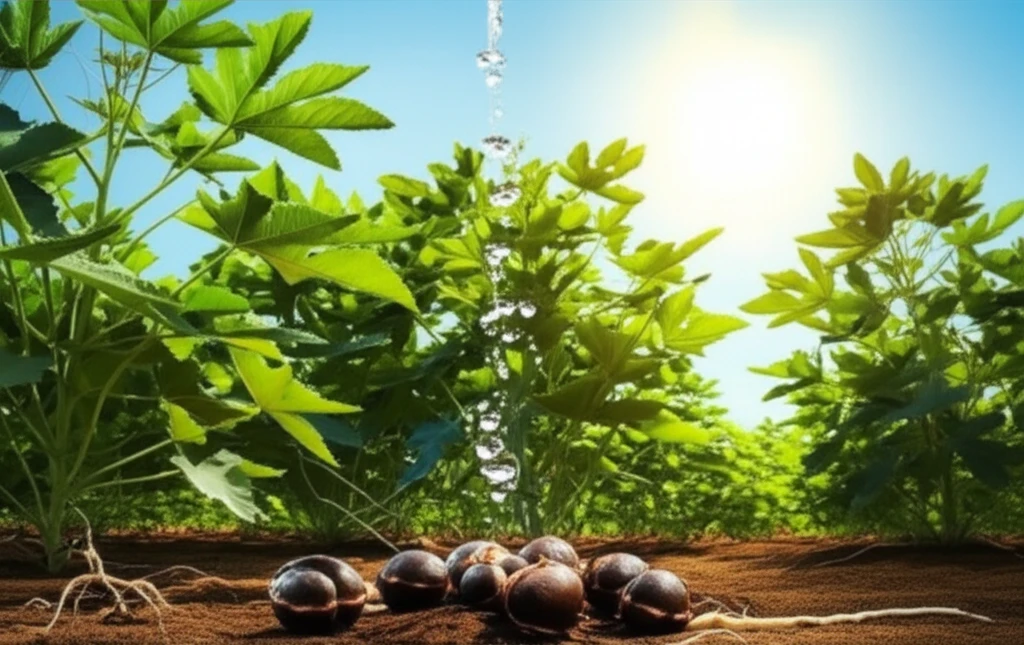
Jatropha seeds absorbing water

Unlocking Jatropha's Potential: How Seed Hydration Impacts Biofuel Production

"Understanding the critical first step in seed germination: optimizing water absorption for better yields."


In the quest for sustainable energy sources, Jatropha curcas L., commonly known as physic nut, has emerged as a promising candidate for biofuel production. Its ability to thrive in tropical and subtropical regions, coupled with its high oil content, makes it an attractive alternative to traditional fossil fuels. However, successful cultivation hinges on understanding the fundamental processes that govern seed germination, with water absorption playing a starring role.

The initial stage of seed germination is hydration, where the seed imbibes water to kickstart metabolic activities. The rate at which seeds absorb water can significantly influence their germination percentage and overall vigor. This is why understanding and optimizing the water absorption curve of Jatropha seeds is crucial for farmers and biofuel producers looking to maximize their yields.

A recent study investigated the water absorption patterns of Jatropha seeds, examining how different seed sizes and weights, along with varying temperatures, affect this critical process. The goal was to characterize the water absorption curve in seeds from four different batches, each with unique physical characteristics. By understanding these variables, growers can better manage seed hydration, improving germination rates and, ultimately, biofuel production.

Decoding the Water Absorption Curve: What Does It Mean for Jatropha?

Jatropha seeds absorbing water

The research team meticulously crafted an imbibition curve by observing four replicates of 25 seeds from each batch. These seeds were submerged in germitest paper rolls moistened with distilled water, using a ratio of 2.5 times the dry weight of the seeds. The seeds were then incubated at temperatures of 25°C and 30°C. During the first six hours, seeds were removed hourly, dried, and weighed. Subsequent weigh-ins occurred at longer intervals until visible germination, marked by radicle protrusion, was observed.

The study revealed that water absorption and subsequent weight gain in Jatropha seeds occur rapidly. In all treatments, there was a swift uptake of water within the first six hours, which followed a distinct triphasic pattern of imbibition.

  • Phase I: A rapid initial water uptake driven by matrix forces.
  • Phase II: A slower, more stable phase where metabolic activities prepare for germination.
  • Phase III: Resumption of rapid water uptake coinciding with radicle protrusion.
Interestingly, seed size and weight played a significant role. Smaller seeds, regardless of whether they were heavy or light, absorbed water more quickly than larger, heavier seeds. Temperature also had a notable effect, with absorption occurring more rapidly at 30°C. The duration of Phase II varied depending on the temperature: at 25°C, it ranged from approximately 7 to 11 hours, while at 30°C, it was significantly shorter, lasting only 1 to 4 hours.

Practical Implications: Optimizing Jatropha Cultivation for Biofuel

These findings offer valuable insights for optimizing Jatropha cultivation. By understanding how seed size and temperature influence water absorption, growers can tailor their planting strategies to maximize germination rates and seedling establishment. For example, soaking smaller seeds at slightly elevated temperatures may accelerate germination, leading to faster growth and higher yields. Further research and field trials will be essential to refine these strategies and unlock the full potential of Jatropha as a sustainable biofuel source. With strategic investments in research and development, Jatropha promises a path toward ecological balance and economic empowerment, enhancing energy accessibility while nurturing our planet’s health.

About this Article -

This article was crafted using a human-AI hybrid and collaborative approach. AI assisted our team with initial drafting, research insights, identifying key questions, and image generation. Our human editors guided topic selection, defined the angle, structured the content, ensured factual accuracy and relevance, refined the tone, and conducted thorough editing to deliver helpful, high-quality information.See our About page for more information.

This article is based on research published under:

DOI-LINK: 10.4067/s0718-34292014000200002, Alternate LINK

Title: Curva De Absorção De Água Em Sementes De Pinhão-Manso (Jatropha Curcas L.)

Subject: General Agricultural and Biological Sciences

Journal: Idesia (Arica)

Publisher: SciELO Agencia Nacional de Investigacion y Desarrollo (ANID)

Authors: Roberto F Araujo, João B Zonta, Eduardo F Araújo, Sérgio M.L Donzeles, Gabriel M Costa

Published: 2014-05-01

Everything You Need To Know

1

What makes Jatropha curcas L. a promising candidate for biofuel production?

Jatropha curcas L., also known as physic nut, is being explored as a source for biofuel production because it grows well in tropical and subtropical climates and has a high oil content. Understanding seed germination, especially how the seeds absorb water, is key to successful cultivation and maximizing yields.

2

What is the water absorption curve for Jatropha seeds, and why is it important?

The water absorption curve describes how Jatropha seeds take in water over time. It has three phases: Phase I involves rapid initial water uptake, Phase II is a slower phase for metabolic activities, and Phase III marks a resumption of rapid water uptake as the radicle protrudes. Understanding this curve helps growers manage seed hydration for better germination.

3

How do seed size and temperature affect water absorption in Jatropha seeds?

Seed size and temperature both impact water absorption in Jatropha seeds. Smaller seeds tend to absorb water more quickly than larger seeds. Higher temperatures, like 30°C, also speed up absorption compared to lower temperatures such as 25°C. These factors influence the duration of Phase II in the water absorption curve.

4

What are the practical implications of these findings for optimizing Jatropha cultivation?

These findings suggest that growers can improve Jatropha cultivation by considering seed size and temperature. For example, using smaller seeds and slightly warmer temperatures during soaking may lead to faster germination. This can lead to quicker growth and higher yields. Field trials are needed to fine-tune these methods.

5

How can optimizing Jatropha cultivation contribute to a more sustainable future?

Optimizing Jatropha cultivation can contribute to ecological balance and economic empowerment by promoting a sustainable biofuel source. Strategic investments in research and development are essential to fully realize Jatropha's potential. By enhancing energy accessibility and nurturing planetary health, Jatropha can serve as a vital component of our energy future.

Newsletter Subscribe

Subscribe to get the latest articles and insights directly in your inbox.