
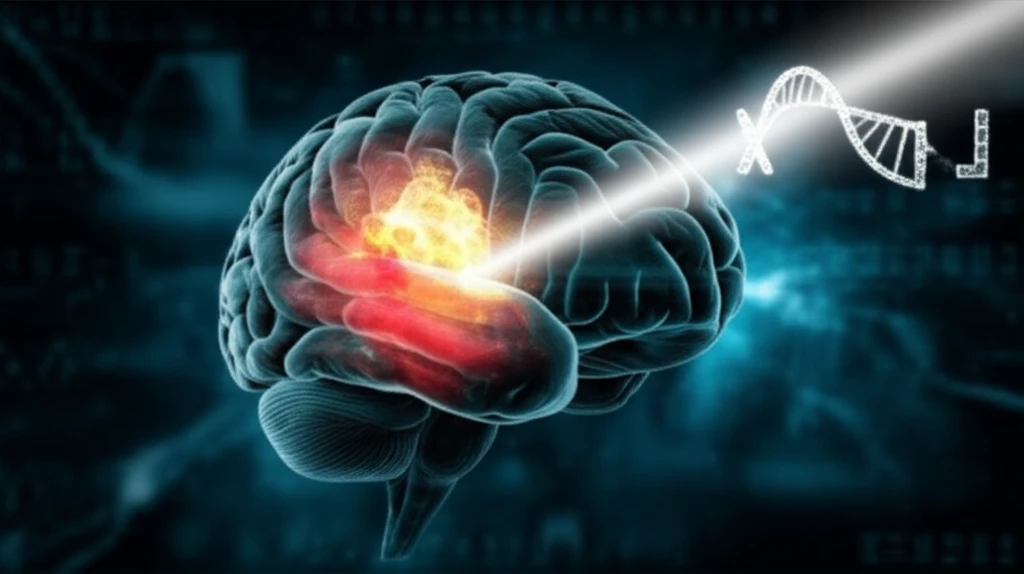
Illustration of a brain with a glowing tumor being targeted by a light beam representing the ASCL1 gene in glioblastoma treatment.

Unlocking Hope: New Research Reveals Promising Breakthroughs in Glioblastoma Treatment

"Scientists Discover a Key Gene That Could Revolutionize How We Fight Aggressive Brain Tumors"


Glioblastoma (GBM) is the most aggressive form of brain cancer, known for its rapid growth and resistance to treatment. It affects thousands of people worldwide each year, with a median survival rate of only 15 months after diagnosis. The disease is particularly devastating because of its location and the challenges it presents for surgical removal and targeted therapies. Despite advances in medical science, the prognosis for GBM patients has remained grim. However, recent breakthroughs are offering new hope.

At the heart of this new optimism is a recent study that identifies a specific gene, ASCL1, as a critical player in GBM's behavior. This discovery, which is the focus of new research, provides a deeper understanding of how GBM tumors develop, grow, and spread. By understanding the role of ASCL1, scientists are developing new strategies to target this gene and potentially slow or even stop tumor growth. This could lead to much more effective treatments.

This article explains the groundbreaking work, breaking down the complex science in a way that's easy to understand. We'll explore the role of ASCL1, how it impacts GBM, and what this means for the future of treatment. We'll also highlight the ongoing research that may help bring these promising new treatments to patients.

Decoding ASCL1: The Key to Understanding Glioblastoma

Illustration of a brain with a glowing tumor being targeted by a light beam representing the ASCL1 gene in glioblastoma treatment.

The ASCL1 gene is a crucial regulator of cell behavior, particularly in the development of the nervous system. The new research shows that ASCL1 plays a critical role in determining the type of cells that make up a GBM tumor. GBM tumors are not uniform; they are composed of a mix of cells that behave differently. Some have characteristics of aggressive, fast-growing cells, while others are less harmful.

The study reveals that ASCL1 acts like a switch, influencing how these cells behave. Specifically, ASCL1 helps to determine which "subgroup" a GBM tumor belongs to. The two main subgroups are the proneural (PN) and the mesenchymal (MES) types. The proneural type tends to be less aggressive, while the mesenchymal type is often more resistant to treatment and associated with a poorer prognosis. The research highlights that ASCL1 is a key factor in this process, indicating that it could be a potential target for new treatments.

  • ASCL1's dual role: The gene encourages the development of the less aggressive PN subtype.
  • The link to NDRG1: ASCL1 suppresses the expression of another gene, NDRG1, which is associated with the more aggressive MES subtype.
  • Impact on tumor behavior: The balance between ASCL1 and NDRG1 appears to dictate how fast the tumor grows, how it spreads, and how it responds to treatment.
The scientists found that ASCL1's impact on GBM cells is profound. When ASCL1 is active, it promotes the growth of less aggressive tumor cells, which slows down tumor growth. Conversely, when ASCL1 is less active, the tumors become more aggressive and resistant to treatment. This insight is leading to new avenues for therapeutic intervention, including the possibility of targeting ASCL1 directly or modulating the activity of the genes it influences.

A Brighter Future for Glioblastoma Patients

The research presented in this study marks a significant step forward in our understanding of GBM. By revealing the role of ASCL1, scientists have identified a promising new target for therapies. While more research is needed, these findings offer a real sense of hope for people affected by this difficult cancer. As scientists continue to unravel the complexities of GBM, they are moving closer to more effective treatments and improved outcomes for patients.

About this Article -

This article was crafted using a human-AI hybrid and collaborative approach. AI assisted our team with initial drafting, research insights, identifying key questions, and image generation. Our human editors guided topic selection, defined the angle, structured the content, ensured factual accuracy and relevance, refined the tone, and conducted thorough editing to deliver helpful, high-quality information.See our About page for more information.

This article is based on research published under:

DOI-LINK: 10.1038/s41418-018-0248-7, Alternate LINK

Title: The Proneural Gene Ascl1 Governs The Transcriptional Subgroup Affiliation In Glioblastoma Stem Cells By Directly Repressing The Mesenchymal Gene Ndrg1

Subject: Cell Biology

Journal: Cell Death & Differentiation

Publisher: Springer Science and Business Media LLC

Authors: Ashwin Narayanan, Filippo Gagliardi, Alberto L. Gallotti, Stefania Mazzoleni, Manuela Cominelli, Luca Fagnocchi, Mauro Pala, Ignazio S. Piras, Paola Zordan, Nicole Moretta, Elisa Tratta, Gianluca Brugnara, Luisa Altabella, Giuseppina Bozzuto, Petra Gorombei, Agnese Molinari, Rose-Ann Padua, Alessandro Bulfone, Letterio S. Politi, Andrea Falini, Antonella Castellano, Pietro Mortini, Alessio Zippo, Pietro L. Poliani, Rossella Galli

Published: 2018-12-11

Everything You Need To Know

1

What is Glioblastoma (GBM), and why is it such a difficult cancer to treat?

Glioblastoma (GBM) is the most aggressive type of brain cancer, characterized by its rapid growth and resistance to treatment. Its location in the brain presents challenges for surgical removal and targeted therapies, contributing to a poor prognosis with a median survival rate of about 15 months. The aggressive nature and the mix of different cell types within the tumor further complicate treatment strategies.

2

How does the ASCL1 gene impact the behavior of Glioblastoma tumors?

The ASCL1 gene acts as a key regulator of cell behavior within Glioblastoma tumors, influencing which subgroup the tumor belongs to—either proneural (PN) or mesenchymal (MES). ASCL1 promotes the growth of the less aggressive proneural subtype, while suppressing the expression of NDRG1, which is associated with the more aggressive mesenchymal subtype. The balance between ASCL1 and NDRG1 dictates the tumor's growth rate, spread, and response to treatment.

3

What are the proneural (PN) and mesenchymal (MES) subtypes of Glioblastoma, and why is understanding them important?

Glioblastoma tumors consist of two main subgroups: proneural (PN) and mesenchymal (MES). The proneural type is generally less aggressive, while the mesenchymal type is more resistant to treatment and associated with poorer outcomes. Understanding these subtypes is crucial because it allows scientists to tailor treatments more effectively. The activity of genes like ASCL1 determines which subtype dominates, thus influencing how the tumor responds to therapy.

4

If ASCL1 promotes a less aggressive form of Glioblastoma, could therapies be developed to enhance ASCL1 activity?

Yes, since ASCL1 encourages the development of the less aggressive proneural Glioblastoma subtype and suppresses NDRG1 (associated with the more aggressive mesenchymal subtype), enhancing ASCL1 activity is a promising therapeutic strategy. Scientists are exploring ways to target ASCL1 directly or modulate the genes it influences, potentially slowing tumor growth and improving treatment response. Further research is needed to determine the most effective methods for modulating ASCL1 activity in Glioblastoma tumors.

5

What role does NDRG1 play in Glioblastoma, and how is it connected to ASCL1?

NDRG1 is a gene associated with the more aggressive mesenchymal subtype of Glioblastoma, which is known for its resistance to treatment and poorer prognosis. ASCL1 suppresses the expression of NDRG1, meaning that when ASCL1 is active, it reduces the levels of NDRG1. This connection is significant because it highlights a direct regulatory relationship where ASCL1 can influence the aggressiveness of the tumor by controlling the expression of NDRG1. Therapeutic strategies might involve not only enhancing ASCL1 but also directly targeting NDRG1 to curb the growth and spread of the aggressive mesenchymal subtype.

Newsletter Subscribe

Subscribe to get the latest articles and insights directly in your inbox.