
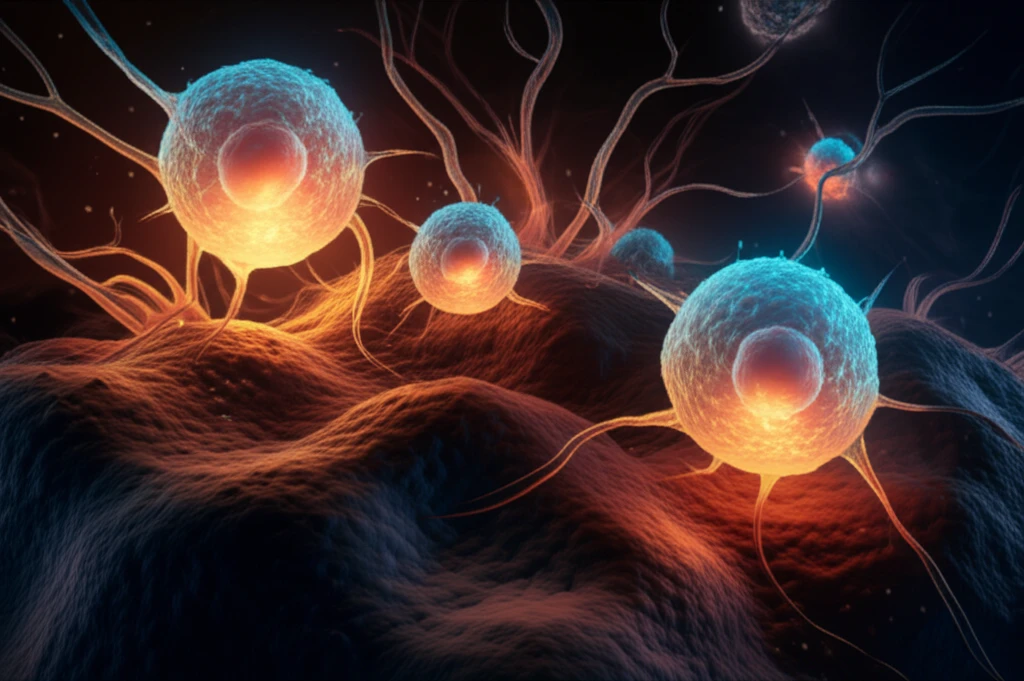
A digital illustration depicting MSCs attacking cancer cells.

Unlocking Hope: How Stem Cell Therapy Could Revolutionize Cancer Treatment

"From Lab to Life: A Deep Dive into the Promising World of Mesenchymal Stem Cells (MSCs) and Their Potential to Combat Cancer"


In the ever-evolving landscape of medical science, the fight against cancer has always been at the forefront, pushing the boundaries of what's possible. For decades, researchers have tirelessly sought innovative therapies, and now, a groundbreaking approach is emerging: mesenchymal stem cell (MSC) therapy. This innovative treatment strategy, also known as MSC-based cytotherapy, involves using the body's own regenerative cells to target and combat cancer.

This article dives deep into the world of MSCs, exploring their origins, unique properties, and their remarkable ability to interact with the tumor microenvironment. We'll unpack the science behind how these cells home in on tumors, the different strategies being employed, and the challenges and triumphs of this burgeoning field. We will explore the potential of MSCs to revolutionize cancer treatment and bring new hope to patients and their families.

This article is more than just an exploration of scientific concepts; it's a journey through the heart of medical innovation, providing insights into how cutting-edge research is shaping the future of cancer care. By understanding the role of MSCs in cancer cytotherapy, you'll gain a clearer picture of the potential breakthroughs that lie ahead and a renewed sense of hope for the future.

The MSC Marvel: Unveiling the Power of Mesenchymal Stem Cells

A digital illustration depicting MSCs attacking cancer cells.

Mesenchymal stem cells (MSCs) are a type of adult stem cell with extraordinary properties. Unlike embryonic stem cells, MSCs are readily available and ethically sourced, typically from sources such as bone marrow, adipose tissue (fat), and umbilical cord tissue. This makes them a promising candidate for cell-based therapies. Their ability to differentiate into various cell types, coupled with their unique immunomodulatory properties, sets them apart in the realm of regenerative medicine and cancer therapy.

MSCs possess a remarkable ability to migrate to areas of injury and inflammation, a phenomenon known as 'homing.' In the context of cancer, this homing ability becomes a powerful tool. Tumors often create a microenvironment that attracts MSCs. Once there, MSCs can interact with the tumor in multiple ways, potentially disrupting cancer growth, boosting the immune response, and even delivering therapeutic agents directly to the tumor site. This is the basis of MSC-based cancer cytotherapy.

  • Self-Renewal: MSCs have the capacity to divide and create more cells, ensuring a constant supply.
  • Differentiation: MSCs can transform into various cell types, essential for repair and regeneration.
  • Immunomodulation: MSCs can regulate the immune system, which can be crucial in battling cancer.
  • Homing Ability: MSCs naturally migrate to areas of damage, including tumors, making them effective delivery agents.
MSCs are not a one-size-fits-all solution. Different types of MSCs exist, each with unique properties and varying effectiveness. The source of the MSCs (bone marrow, adipose tissue, umbilical cord) can influence their characteristics, affecting their ability to fight cancer. Researchers are working to harness these differences to develop tailored therapies that maximize the benefits and minimize any potential adverse effects.

The Future is Now: Embracing the Potential of MSCs in Cancer Care

The journey of MSC-based cancer cytotherapy is still in its early stages, but the potential is undeniable. As research continues and clinical trials progress, we are on the cusp of a new era in cancer treatment. While challenges remain, the relentless pursuit of knowledge, combined with the innate properties of MSCs, offers a path towards more effective, targeted, and personalized cancer therapies. The future of cancer care is evolving, and MSCs are poised to play a vital role in this transformative process, bringing hope and healing to countless individuals affected by this devastating disease.

About this Article -

This article was crafted using a human-AI hybrid and collaborative approach. AI assisted our team with initial drafting, research insights, identifying key questions, and image generation. Our human editors guided topic selection, defined the angle, structured the content, ensured factual accuracy and relevance, refined the tone, and conducted thorough editing to deliver helpful, high-quality information.See our About page for more information.

This article is based on research published under:

DOI-LINK: 10.1186/s13287-018-1078-8, Alternate LINK

Title: Mesenchymal Stem Cells In Preclinical Cancer Cytotherapy: A Systematic Review

Subject: Cell Biology

Journal: Stem Cell Research & Therapy

Publisher: Springer Science and Business Media LLC

Authors: Ioannis Christodoulou, Maria Goulielmaki, Marina Devetzi, Mihalis Panagiotidis, Georgios Koliakos, Vassilis Zoumpourlis

Published: 2018-12-01

Everything You Need To Know

1

What are Mesenchymal Stem Cells (MSCs) and why are they considered a promising approach for cancer treatment?

Mesenchymal Stem Cells (MSCs) are a type of adult stem cell with unique properties that make them a promising avenue for cancer treatment. Unlike embryonic stem cells, MSCs are readily available and ethically sourced, commonly from bone marrow, adipose tissue, and umbilical cord tissue. Their potential lies in their ability to differentiate into various cell types and their immunomodulatory capabilities. In the context of cancer, MSCs' 'homing' ability, where they migrate to tumors, is particularly crucial. They can then interact with the tumor microenvironment, potentially disrupting cancer growth, boosting the immune response, and delivering therapeutic agents directly to the tumor site, which is the foundation of MSC-based cancer cytotherapy.

2

How do MSCs interact with the tumor microenvironment, and what makes this interaction significant for cancer treatment?

MSCs have a remarkable interaction with the tumor microenvironment, making them a powerful tool in cancer treatment. Due to their 'homing' ability, MSCs are attracted to tumors. Once there, they can interact in multiple ways: potentially disrupting cancer growth, boosting the immune response to target cancer cells, and even acting as delivery agents for therapeutic drugs directly to the tumor site. This targeted approach minimizes harm to healthy cells and maximizes the impact on the cancerous ones, making MSC-based cytotherapy a promising and innovative strategy.

3

What are the key properties of MSCs that make them suitable for cancer therapy?

MSCs possess several key properties that make them suitable for cancer therapy. These include self-renewal, the capacity to divide and create more cells; differentiation, the ability to transform into various cell types needed for repair and regeneration; immunomodulation, the ability to regulate the immune system, which is crucial in battling cancer by enhancing the immune response; and homing ability, where MSCs naturally migrate to areas of damage, including tumors, making them effective delivery agents. The combination of these traits allows MSCs to target tumors, modulate the immune response, and potentially deliver therapeutic agents directly to the cancer cells.

4

What are the different sources of MSCs, and how might these sources influence their therapeutic effects?

MSCs can be sourced from various locations, including bone marrow, adipose tissue (fat), and umbilical cord tissue. The source of the MSCs can influence their characteristics and affect their effectiveness in fighting cancer. Researchers are actively investigating how the origin of MSCs impacts their properties, such as their differentiation potential, immunomodulatory effects, and homing ability. The goal is to harness these differences to develop tailored therapies, maximizing the benefits of MSCs and minimizing potential adverse effects, ultimately leading to more personalized and effective cancer treatments.

5

What is the current state of MSC-based cancer cytotherapy, and what future developments can we anticipate?

MSC-based cancer cytotherapy is in its early stages, but the potential is vast. As research continues and clinical trials progress, we are on the cusp of a new era in cancer treatment. The journey of MSCs is marked by challenges, and ongoing research focuses on optimizing MSC properties, such as enhancing their homing ability or boosting their therapeutic effects. Future developments will likely include tailored therapies that leverage different MSC types based on their source and unique characteristics, along with combinations of MSC therapy with other cancer treatments to enhance efficacy. With continued advancements, MSCs are poised to play a pivotal role in transforming cancer care, offering hope and healing for those affected by the disease.

Newsletter Subscribe

Subscribe to get the latest articles and insights directly in your inbox.