
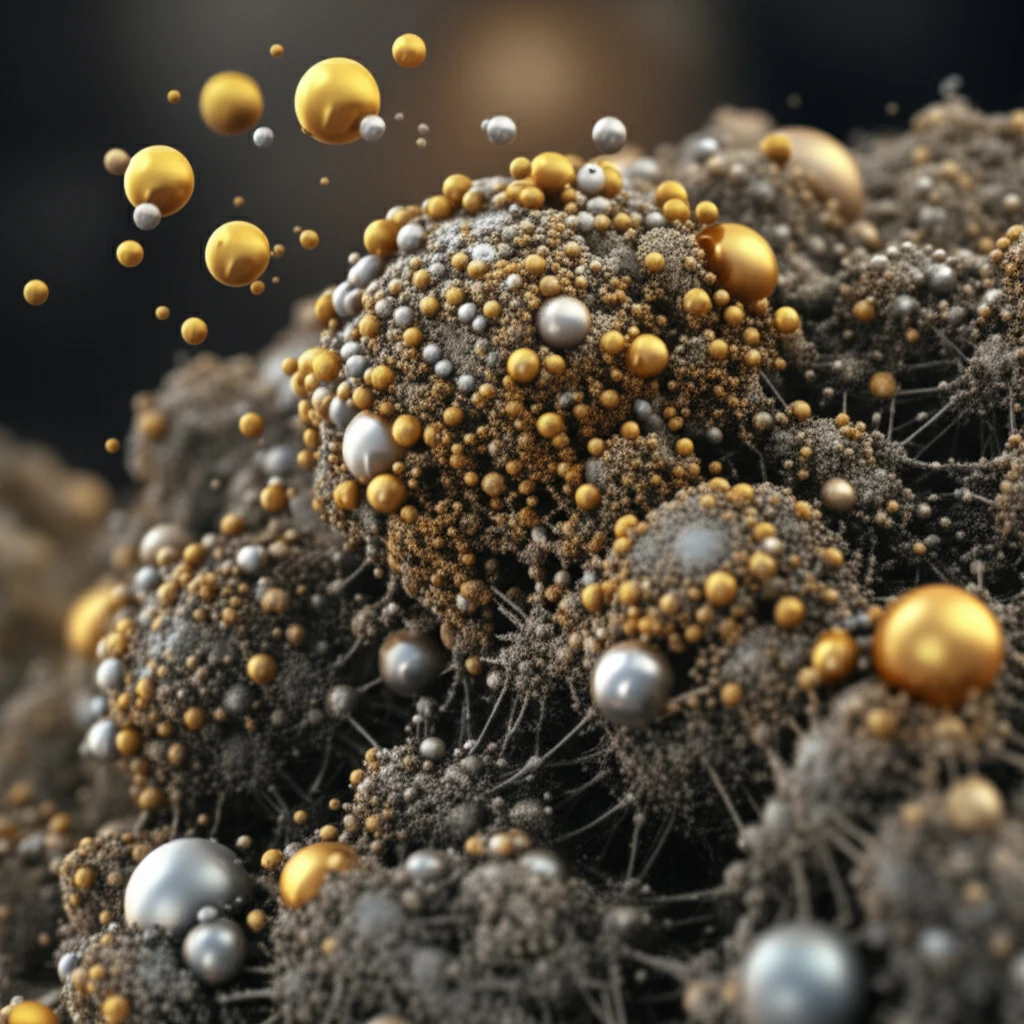
Microscopic view of gold and platinum being adsorbed by gibbsite.

Unlocking Hidden Value: How a Common Compound Could Revolutionize Metal Recovery

"Researchers explore the potential of calcined gibbsite to efficiently extract precious metals like platinum and palladium from waste, offering a sustainable solution for resource recovery."


Precious metals, renowned for their unique physical and chemical characteristics, are integral to numerous industries. From agriculture and biomedicine to jewelry, chemical catalysis, and electronics, these metals play a pivotal role. Platinum group metals (PGMs), particularly platinum (Pt(IV)) and palladium (Pd(II)), are vital in various industrial processes. The importance of these resources can not be overstated.

However, the availability of PGMs is far from evenly distributed. Eighty percent of the world's reserves of platinum and palladium are concentrated in South Africa and Russia. This geographical skew introduces economic and political vulnerabilities, highlighting the need for sustainable resource management.

Innovative solutions for extracting and recovering these metals from waste streams have become a focal point. Traditional methods like solvent extraction, ion exchange, and adsorption have limitations, including the production of toxic sludge, high costs, and lengthy processing times. Recent research has focused on developing effective, low-cost adsorbents to improve metal recovery, exploring materials such as charcoal ash, zeolite, sepiolite, and biosorbents.

Calcined Gibbsite: An Unexpected Hero in Metal Adsorption

Microscopic view of gold and platinum being adsorbed by gibbsite.

Researchers have turned their attention to calcined gibbsite, an aluminum compound, as a promising material for metal recovery. Gibbsite is a recyclable material that is both readily available from bauxite and inexpensive, making it attractive for widespread use. It is known for its ability to undergo anion exchange in aqueous solutions, suggesting it might effectively adsorb PGMs. While aluminum oxide has been previously explored for PGM recovery, the potential of gibbsite remained largely untapped.

A recent study investigated the adsorption capabilities of calcined gibbsite (GB) for platinum (Pt(IV)) and palladium (Pd(II)) in aqueous solutions. The gibbsite was subjected to calcination at temperatures ranging from 200°C to 1000°C (GB200-GB1000) to optimize its properties. The team then carefully assessed several characteristics:

  • Hydroxyl Group Content: The amount of hydroxyl groups on the gibbsite surface.
  • Specific Surface Area: The total surface area available for adsorption.
  • Mean Pore Diameter: The average size of the pores within the material.
  • Pore Volume: The total volume of the pores, indicating the material's porosity.
The study revealed that GB400, gibbsite calcined at 400°C, exhibited the most promising characteristics. It had the highest hydroxyl group content (0.46 mmol/g), the largest specific surface area (295.3 m²/g), and the greatest micropore volume (0.036 mL/g). These features correlated with the highest adsorption of both Pt(IV) and Pd(II), suggesting that the material’s adsorption capacity is linked to these physical properties.

A Promising Future for Sustainable Metal Recovery

This research highlights the potential of calcined gibbsite as an effective and sustainable adsorbent for recovering precious metals from waste. By optimizing the calcination temperature, it's possible to enhance the material’s physical properties, maximizing its adsorption capacity. As industries continue to seek eco-friendly and cost-effective solutions for resource management, calcined gibbsite emerges as a viable option for PGM recovery, offering both environmental and economic benefits.

About this Article -

This article was crafted using a human-AI hybrid and collaborative approach. AI assisted our team with initial drafting, research insights, identifying key questions, and image generation. Our human editors guided topic selection, defined the angle, structured the content, ensured factual accuracy and relevance, refined the tone, and conducted thorough editing to deliver helpful, high-quality information.See our About page for more information.

Everything You Need To Know

1

What is calcined gibbsite, and why is it being researched for metal recovery?

Calcined gibbsite is an aluminum hydroxide compound that has shown promise as an effective and sustainable adsorbent for recovering precious metals from waste. It is derived from bauxite and becomes particularly effective when calcined, or heated, at specific temperatures to optimize its physical properties for metal adsorption.

2

Why are platinum and palladium so important?

Platinum group metals (PGMs), specifically platinum (Pt(IV)) and palladium (Pd(II)), are important because they are used in many industries, including agriculture, biomedicine, jewelry, chemical catalysis, and electronics. They possess unique physical and chemical characteristics that make them vital components in various industrial processes.

3

What does calcination mean in the context of gibbsite, and why is it important?

Calcination is the process of heating gibbsite at high temperatures, typically ranging from 200°C to 1000°C. The study found that gibbsite calcined at 400°C (GB400) exhibited the most promising characteristics for metal adsorption. This optimization process enhances properties like hydroxyl group content, specific surface area, and micropore volume, which directly correlate with the material's capacity to adsorb platinum (Pt(IV)) and palladium (Pd(II)).

4

What are the critical physical properties of calcined gibbsite that make it effective for metal adsorption?

The critical physical properties of calcined gibbsite include hydroxyl group content, specific surface area, mean pore diameter, and pore volume. A higher hydroxyl group content and a larger specific surface area, as seen in GB400, correlate with enhanced adsorption of platinum (Pt(IV)) and palladium (Pd(II)). These properties determine the material’s porosity and available surface area for capturing metal ions.

5

What are the potential implications of using calcined gibbsite for recovering precious metals from waste?

The potential implications of using calcined gibbsite for metal recovery include a more sustainable and cost-effective approach to resource management. As industries look for eco-friendly solutions, calcined gibbsite offers a viable option for platinum group metal (PGM) recovery, reducing reliance on traditional methods that can produce toxic waste and require lengthy processing times. This is particularly important given the geographical concentration of PGM reserves, which introduces economic and political vulnerabilities.

Newsletter Subscribe

Subscribe to get the latest articles and insights directly in your inbox.