
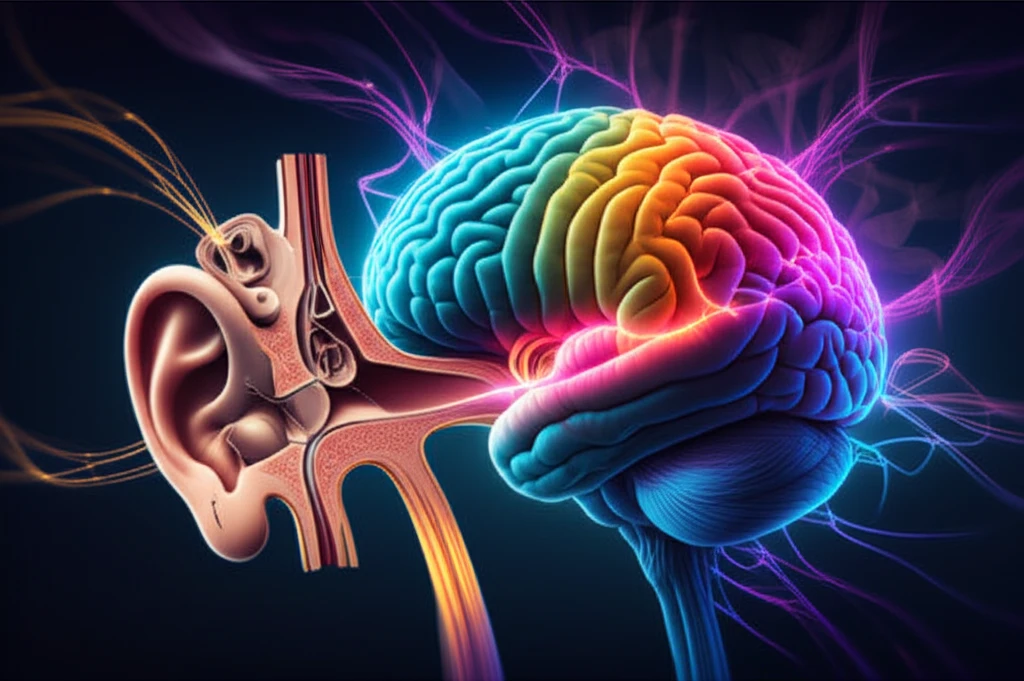
Illustration of inner ear and brain connectivity symbolizing hearing research.

Unlocking Hearing: How Brain Lesions Reveal Cochlea's Inner Workings

"Deciphering the link between brain activity and auditory health through groundbreaking lesion research."


For years, scientists have recognized the olivocochlear bundle (OCB) as a crucial player in our auditory system, acting as the primary efferent nerve supply to the cochlea. This bundle influences how we process sound, and understanding its function is key to unraveling the complexities of hearing.

The OCB originates on both sides of the brain from the superior olivary complex (SOC) and features lateral and medial efferent systems. The lateral olivocochlear (LOC) system consists of neurons located laterally in the SOC with thin, unmyelinated axons, while medial olivocochlear (MOC) neurons are found more medially and rostrally in the SOC with thicker, myelinated axons.

New research has shed light on how surgical lesions—precise injuries—affect choline acetyltransferase (ChAT) activity, a critical enzyme for acetylcholine synthesis in the cochlea. By studying these effects in cats, scientists are gaining a deeper understanding of the distribution and function of olivocochlear innervation.

The Crucial Role of ChAT in Auditory Function

Illustration of inner ear and brain connectivity symbolizing hearing research.

Choline acetyltransferase (ChAT) is the enzyme responsible for the synthesis of acetylcholine, making it a definitive marker for cholinergic neurons. The high ChAT activity within the OCB aligns with the understanding that all LOC and MOC fibers are cholinergic, further supported by the immunoreactivity of OCB fibers to ChAT.

Previous studies have quantitatively assessed acetylcholine metabolic enzymes in the cochleas of guinea pigs and rats, revealing high activities in the IHC and OHC regions. While the presence of ChAT in the cat cochlea has been linked to its OCB innervation, a detailed analysis of the hair cell regions within the organ of Corti was lacking. To address this gap, a study was undertaken to measure ChAT activity in microdissected samples from the organ of Corti in cats, some of which had surgical cuts affecting the olivocochlear system.

Key Objectives:
  • Map the distribution of ChAT activity across the three turns of the cat cochlea.
  • Investigate the impact of olivocochlear innervation removal via lateral cuts or medial cuts damaging the superior olivary complex.
  • Compare ChAT activity in the inner hair cell (IHC) region, outer hair cell (OHC) region, and outer supporting cell region.
The study involved analyzing ChAT activity in cats with different types of brain stem lesions. These included lateral cuts to transect the olivocochlear bundle (OCB) and more medial cuts that damaged the superior olivary complex (SOC). The researchers then meticulously measured ChAT activity in different regions of the cochlea to assess the impact of these lesions.

Implications for Future Research

This research underscores the intricate relationship between the brain and the cochlea. By mapping how specific brain lesions affect ChAT activity, the study enhances our understanding of the olivocochlear system and its role in hearing. These insights could pave the way for new treatments and therapies aimed at improving auditory function and addressing hearing disorders.

About this Article -

This article was crafted using a human-AI hybrid and collaborative approach. AI assisted our team with initial drafting, research insights, identifying key questions, and image generation. Our human editors guided topic selection, defined the angle, structured the content, ensured factual accuracy and relevance, refined the tone, and conducted thorough editing to deliver helpful, high-quality information.See our About page for more information.

This article is based on research published under:

DOI-LINK: 10.1016/j.heares.2017.09.014, Alternate LINK

Title: Effects Of Surgical Lesions On Choline Acetyltransferase Activity In The Cat Cochlea

Subject: Sensory Systems

Journal: Hearing Research

Publisher: Elsevier BV

Authors: Mark J. Frilling, Gregory J. Wiet, Donald A. Godfrey, Judy A. Parli, Jon D. Dunn, C. David Ross

Published: 2017-12-01

Everything You Need To Know

1

What is the olivocochlear bundle and why is it important?

The olivocochlear bundle (OCB) is a vital part of the auditory system, acting as the main efferent nerve supply to the cochlea. It's important because it influences how we process sound. Understanding its function is key to unlocking the complexities of hearing and potentially developing new treatments for hearing disorders. The OCB originates in the superior olivary complex (SOC) within the brain and features lateral and medial efferent systems.

2

What is Choline acetyltransferase (ChAT) and why is it relevant to this research?

Choline acetyltransferase (ChAT) is an enzyme that is responsible for synthesizing acetylcholine, a key neurotransmitter. Its high presence in the cochlea, specifically in the inner hair cell (IHC) and outer hair cell (OHC) regions, shows that the olivocochlear bundle (OCB) uses acetylcholine to communicate. By measuring ChAT activity, researchers can study how brain lesions affect the cochlea's function and understand the role of acetylcholine in hearing. This is crucial for understanding the entire hearing process.

3

What is the superior olivary complex and how does it relate to hearing?

The superior olivary complex (SOC) is where the olivocochlear bundle (OCB) originates. This complex is located on both sides of the brain. Lesions, or targeted surgical cuts, in the SOC can damage the OCB and affect how the cochlea receives signals. This enables researchers to understand the specific functions of different parts of the auditory pathway. Damage to the SOC helps to understand the relationship between brain function and auditory health.

4

What are lateral and medial cuts, and how do they help researchers?

Lateral cuts and medial cuts are two different types of surgical lesions used to study the auditory system. Lateral cuts are designed to sever the olivocochlear bundle (OCB) directly. Medial cuts target the superior olivary complex (SOC). These cuts allow scientists to see how different parts of the brain's auditory pathways contribute to hearing. By observing the impact of these specific injuries, scientists can determine the importance of specific pathways.

5

What are the implications of this research for future studies and treatments?

By mapping the distribution of choline acetyltransferase (ChAT) activity, the impact of olivocochlear innervation removal, and comparing ChAT activity in various cochlear regions, researchers gain crucial insights. These insights reveal how brain lesions affect the olivocochlear system and its role in hearing. This understanding could pave the way for novel treatments to improve hearing function, like those targeting the olivocochlear bundle or the superior olivary complex, and address hearing disorders.

Newsletter Subscribe

Subscribe to get the latest articles and insights directly in your inbox.