
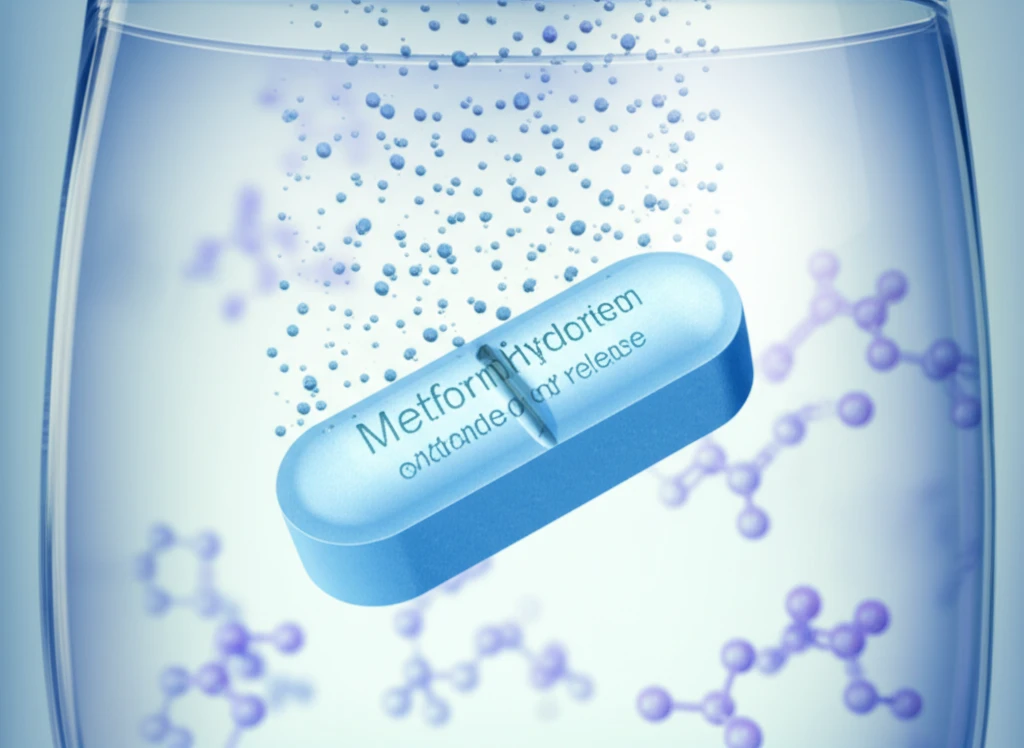
Illustration of an extended-release Metformin tablet, highlighting its controlled drug release mechanism, with the key polymers and chemicals that make the medication successful.

Unlocking Extended Relief: A Deep Dive into Metformin Hydrochloride Matrix Tablets

"Explore the Science Behind Extended-Release Metformin and How Innovative Formulations Are Improving Diabetes Management."


Type 2 diabetes, a prevalent metabolic disorder, necessitates effective management strategies to control blood glucose levels and mitigate long-term complications. Oral medications play a crucial role in this, with Metformin Hydrochloride (HCl) standing out as a cornerstone treatment. This article explores the innovative formulation of extended-release Metformin HCl matrix tablets, focusing on how specific techniques and materials are used to enhance its therapeutic efficacy.

Traditional Metformin HCl formulations often lead to rapid drug release, necessitating multiple daily doses. This can impact patient adherence and potentially lead to fluctuations in blood glucose levels. Extended-release formulations offer a solution by providing a more consistent and prolonged release of the drug, thereby improving treatment outcomes and patient convenience. This is achieved through advanced techniques and materials that control the drug's release rate.

This research investigates how combining a hydrophobic carrier, like stearic acid, with a hydrophilic polymer, such as polyethylene oxide, can effectively create a matrix tablet. Furthermore, it compares different formulation techniques, specifically melt granulation and direct compression, to determine their impact on drug release and overall tablet performance. The aim is to develop an optimal formulation that ensures sustained drug release, aligning with the goals of efficient diabetes management.

The Science of Extended-Release: Polymers and Granulation Techniques

Illustration of an extended-release Metformin tablet, highlighting its controlled drug release mechanism, with the key polymers and chemicals that make the medication successful.

The foundation of an extended-release tablet lies in its ability to slowly and consistently deliver the active pharmaceutical ingredient (API). In the case of Metformin HCl, the release rate is carefully managed to ensure a therapeutic effect over an extended period. This involves the strategic use of both hydrophobic and hydrophilic materials. Hydrophobic substances, like stearic acid, create a barrier that slows down the drug's release, while hydrophilic polymers, such as polyethylene oxide, swell in the presence of water, creating a gel-like matrix from which the drug slowly diffuses.

The manufacturing process is another critical factor. Two primary techniques are evaluated: melt granulation and direct compression. Melt granulation involves melting the hydrophobic carrier and mixing it with the drug to form granules, which are then combined with the hydrophilic polymer. Direct compression, on the other hand, involves mixing all ingredients and compressing them into tablets. The choice of technique influences the drug release profile and the overall quality of the tablets. Different methods will impact the effectiveness of the drug in the long run.

  • Hydrophobic carriers (e.g., stearic acid): Act as a barrier to slow drug release.
  • Hydrophilic polymers (e.g., polyethylene oxide): Create a gel-like matrix for controlled drug diffusion.
  • Melt granulation: Involves melting the carrier and mixing with the drug.
  • Direct compression: Simplifies the process by directly compressing the mixed ingredients.
  • Process influences drug release: The choice of manufacturing technique affects how the drug is released from the tablet.
The study also involves a comprehensive analysis of the tablets' physical and chemical properties. Parameters such as hardness, friability, and drug content uniformity are meticulously evaluated to ensure that the tablets meet the necessary quality standards. Furthermore, the release kinetics are analyzed to understand the mechanisms behind drug release. These insights are essential for optimizing the formulation and predicting its performance in vivo. This information can then be utilized to predict the effectiveness of the medication over time.

The Future of Metformin: Advancing Diabetes Care

The research findings highlight the potential of advanced tablet formulations in enhancing the therapeutic effectiveness of Metformin HCl. By combining specific materials and manufacturing techniques, it is possible to create tablets that provide sustained drug release, improving patient outcomes and adherence. The study underscores the significance of a comprehensive approach, encompassing both formulation and manufacturing processes, in the development of effective and patient-friendly medications. The future of diabetes care hinges on these advancements, which aim to offer better control and improve quality of life for those affected by this condition.

About this Article -

This article was crafted using a human-AI hybrid and collaborative approach. AI assisted our team with initial drafting, research insights, identifying key questions, and image generation. Our human editors guided topic selection, defined the angle, structured the content, ensured factual accuracy and relevance, refined the tone, and conducted thorough editing to deliver helpful, high-quality information.See our About page for more information.

Everything You Need To Know

1

Why is extended-release Metformin Hydrochloride beneficial compared to traditional formulations for managing type 2 diabetes?

Extended-release Metformin Hydrochloride offers a more consistent and prolonged drug release compared to traditional formulations. This reduces the need for multiple daily doses, improving patient adherence and minimizing fluctuations in blood glucose levels. Traditional formulations often lead to rapid drug release, which can be less effective in maintaining stable blood glucose levels throughout the day. Extended-release formulations utilize advanced techniques such as hydrophobic and hydrophilic polymers to control the rate at which the medication is released into the body. This approach enhances treatment outcomes and patient convenience.

2

How do hydrophobic carriers and hydrophilic polymers work together in extended-release Metformin Hydrochloride matrix tablets?

In extended-release Metformin Hydrochloride matrix tablets, hydrophobic carriers, such as stearic acid, act as a barrier to slow down the drug's release. Conversely, hydrophilic polymers, such as polyethylene oxide, swell in the presence of water, creating a gel-like matrix. The Metformin Hydrochloride slowly diffuses from this gel matrix, resulting in a controlled and sustained release of the drug. The combination of these two types of materials ensures that the drug is released over an extended period, providing a therapeutic effect for a longer duration. Without both hydrophobic and hydrophilic elements, controlling the drug release effectively would not be possible.

3

What are the key differences between melt granulation and direct compression techniques in manufacturing Metformin Hydrochloride extended-release tablets, and how do they impact drug release?

Melt granulation and direct compression are two distinct manufacturing techniques for Metformin Hydrochloride extended-release tablets. Melt granulation involves melting the hydrophobic carrier (like stearic acid) and mixing it with the drug to form granules, which are then combined with the hydrophilic polymer (like polyethylene oxide). Direct compression, on the other hand, involves simply mixing all ingredients together and compressing them into tablets. The choice of technique significantly impacts the drug release profile and the overall quality of the tablets. Melt granulation can lead to a more homogenous mixture and potentially better control over drug release due to the carrier being melted. The method chosen greatly determines the drug's effectiveness over time.

4

What quality control measures are essential in the production of Metformin Hydrochloride extended-release tablets, and why are they important?

Several quality control measures are essential in the production of Metformin Hydrochloride extended-release tablets. These include assessing parameters such as tablet hardness, friability (resistance to crumbling), and drug content uniformity. Hardness ensures the tablets can withstand handling, while friability indicates their durability. Drug content uniformity guarantees that each tablet contains the correct amount of medication. Additionally, analyzing the drug release kinetics helps to understand and predict the drug's behavior in the body. These measures are crucial to ensure that the tablets meet the required standards for safety and efficacy, and to predict the medication's long term effectiveness. Failing to meet these standards can result in ineffective or unsafe medication.

5

Beyond formulation, what are the broader implications of extended-release Metformin Hydrochloride in improving diabetes care and patient outcomes?

The implications of extended-release Metformin Hydrochloride extend beyond just the formulation. By providing sustained drug release, these tablets improve patient adherence due to reduced dosing frequency. This can lead to better control of blood glucose levels and, consequently, a reduction in long-term diabetes complications. Furthermore, the convenience of extended-release formulations enhances the overall quality of life for patients. Continued advancements in formulation and manufacturing techniques, such as those involving hydrophobic carriers like stearic acid and hydrophilic polymers like polyethylene oxide, will continue to drive improvements in diabetes management. The goal is always to offer better control and improve the quality of life for individuals with diabetes.

Newsletter Subscribe

Subscribe to get the latest articles and insights directly in your inbox.