
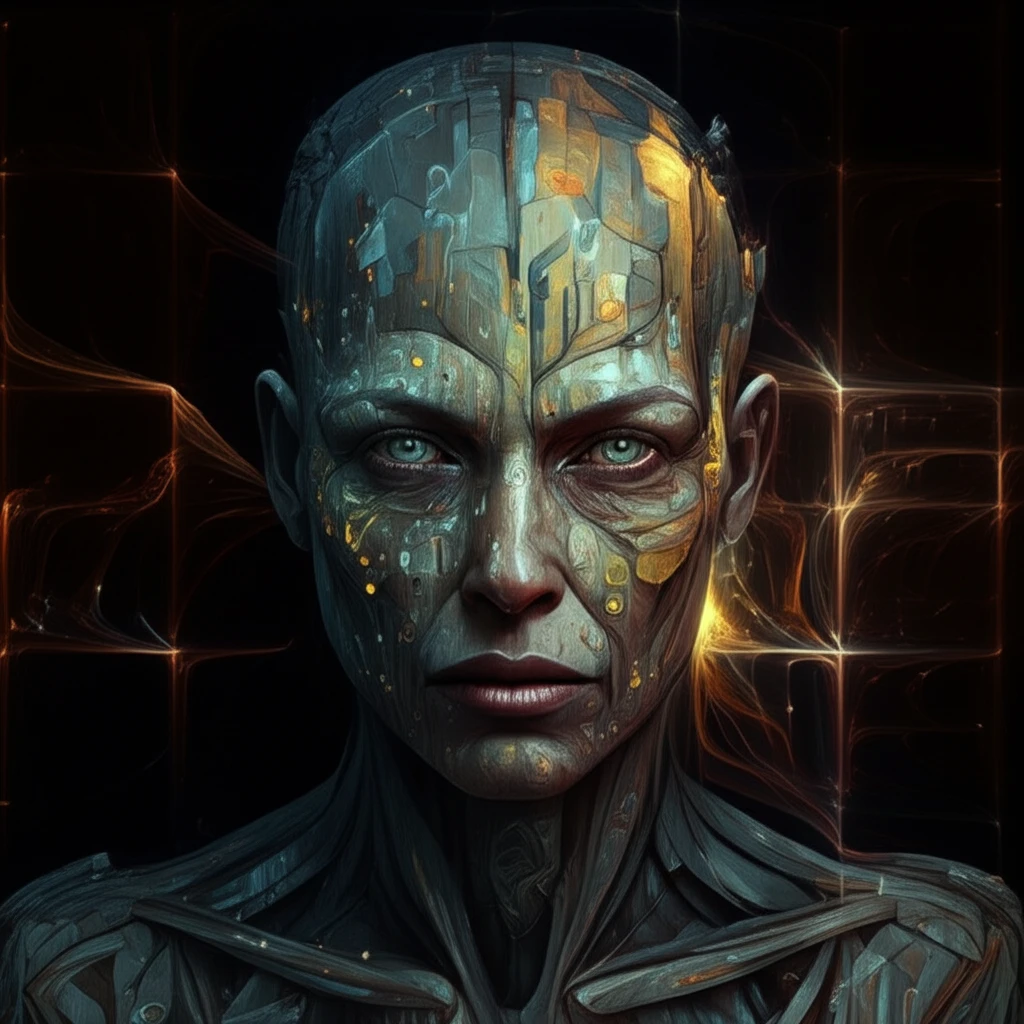
Unlocking Emotions: How AI Facial Recognition Reads Your Feelings

"Dive into the groundbreaking world of AI-driven facial expression analysis and discover how this tech is changing human-computer interactions."
In an increasingly digital world, the quest to bridge the gap between human emotion and artificial intelligence has led to remarkable innovations. One of the most intriguing is facial expression recognition (FER) technology, a field within computer vision and machine learning that seeks to decode the complex tapestry of human emotions through facial cues. From automated access control to enhancing human-computer interactions, the potential applications of FER are vast and transformative.
Facial Expression Recognition is not just about identifying a smile or a frown; it involves a deep dive into the nuances of facial muscle movements, texture variations, and edge patterns. These subtle changes, often imperceptible to the human eye, hold the key to unlocking a person's emotional state. Extracting and interpreting these features accurately is a significant challenge, requiring sophisticated algorithms and computational power.
The journey to create an effective FER system involves several critical stages: acquiring facial images, preprocessing them to enhance clarity, extracting relevant features, and classifying those features into distinct emotional categories. Among these stages, feature extraction stands out as particularly crucial. The accuracy of emotion recognition hinges on the ability to identify and optimize the features that best represent different emotional states.
Machines That Read Our Emotions
AI systems that can read human emotions are transforming how we interact with machines, with implications that extend from enhancing mental health support to making customer service feel more human-like. The ability to detect and respond to emotional states is being positioned as a revolutionary shift in human-machine interaction.
Facial Recognition and Other Cues
AI robots recognize human emotions primarily through facial recognition technology, which analyzes facial expressions to infer emotional states. Beyond the face, systems draw on other cues such as body language and voice to improve accuracy in recognizing and responding to emotions.
A Quest to Replicate Emotional Intelligence
Emotion recognition and emotion recognition machine learning stand as testaments to an ongoing quest to understand and replicate human emotional intelligence. This pursuit spans academic research, with students and researchers developing emotion recognition models in coursework, reflecting a growing interest in making machines adept at reading the emotions humans express so naturally.
Decoding the Science: Gabor Filters and Feature Optimization
Traditionally, Gabor filters have been a cornerstone in facial feature extraction. These filters excel at capturing edge patterns and texture variations, making them ideal for analyzing facial expressions. However, Gabor filters come with their own set of challenges, primarily the generation of high-dimensional and redundant feature sets, which can bog down processing and reduce accuracy.
- Gabor Filtering: Initial feature extraction using Gabor filters to capture edge and texture information.
- Averaging: Optimizing Gabor features by averaging to reduce redundancy.
- DWT (Discrete Wavelet Transform): Applying DWT to decompose the averaged features into different frequency bands.
- DCT (Discrete Cosine Transform): Further refining the low-frequency components to extract the most salient features.
The State of Visual Emotion AI
AI emotion recognition is a field of computer vision focused on facial emotion detection and automatic sentiment analysis from visual data. Current research examines the datasets used for facial emotion recognition, the range of emotions AI can detect, and the state-of-the-art techniques driving the field forward.
The Difficulty of Distinguishing Expressions
Training for facial expression recognition has proven much more difficult than expected, as some expressions are fairly similar to one another and tend to create more error when the system attempts to recognize certain expressions. These confusions highlight the technical challenges that remain in building reliable emotion detection.
Comparing Deep Learning Architectures
Researchers have conducted comparative studies evaluating different deep learning architectures for facial expression recognition, such as DenseNet161 and ResNet152. These comparisons explore how different model designs perform on the task and reveal where errors are most likely to occur given the similarity between certain expressions.
The Future of Emotion AI: Applications and Ethical Considerations
The advancements in facial expression recognition technology are paving the way for a new era of human-computer interaction. As AI becomes more adept at understanding and responding to human emotions, the potential applications are limitless. From personalized education and healthcare to enhanced security systems and customer service, emotion AI promises to transform the way we interact with technology.
Understanding and Replicating Emotional Intelligence
Emotion recognition and the machine learning approaches behind it stand as testaments to our ongoing quest to understand and replicate human emotional intelligence. This framing positions the technology not merely as a classification task but as part of a deeper effort to bridge the gap between human feeling and machine comprehension.
Emotive Interfaces and Adaptive GenAI
Future research is exploring how generative AI can learn and adapt to the intricate aspects of human emotion, opening the door to emotive GenAI interfaces. At the same time, emotion recognition systems are expected to expand into areas like targeted advertising, with such tools anticipated to become mainstream in the future.
Privacy and Surveillance Concerns
While emotion recognition is sure to evoke a lot of privacy concerns, innovations like targeted advertising built on emotional data appear likely to become mainstream. Facial expression recognition systems are also being applied to virtual recruitment screening, raising systemic questions about how such monitoring is deployed in the workplace.
From Mental Health Support to Human-Like Service
The ability of AI to read emotions is transforming how we interact with machines, with profound implications for enhancing mental health support and making customer service more human-like. The field is being advanced through crowdsourced benchmarks and competitions, with millions of builders, researchers, and labs evaluating models to see what actually works in AI.