
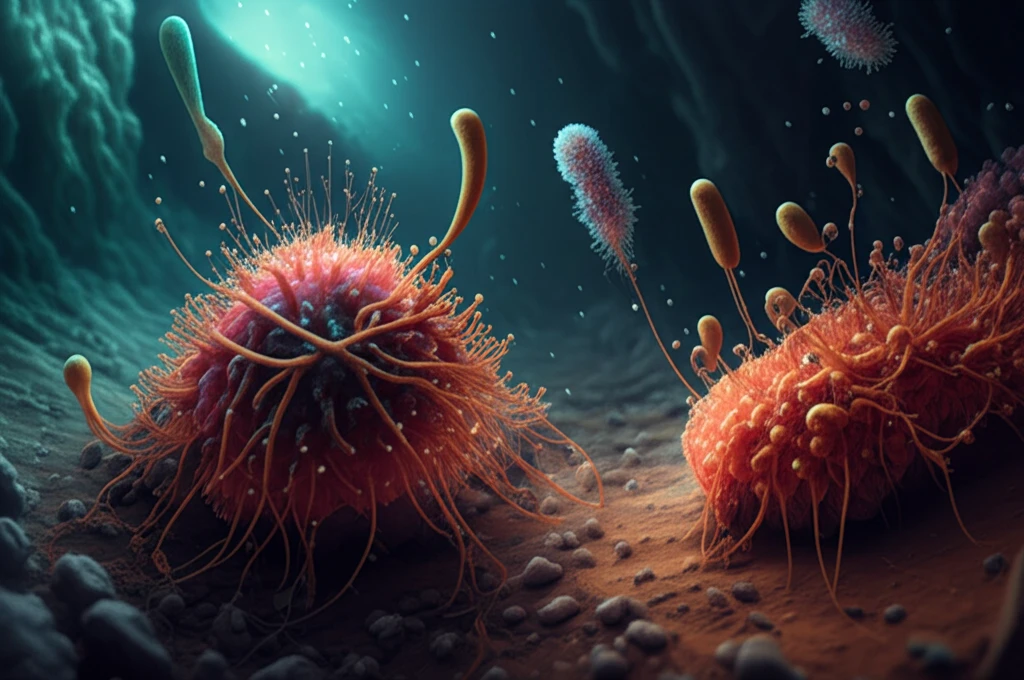
Unlocking Earth's Hidden Potential: How Bacteria Are Mining Metals From Marine Sediments

"Dive into the groundbreaking research revealing how marine bacteria can transform toxic tellurite into valuable tellurium, offering a sustainable solution for green technology and resource recovery."
In an era defined by the urgent need for sustainable solutions, scientists are increasingly turning to nature for innovative approaches to resource recovery. Recent research has illuminated the remarkable capabilities of certain marine bacteria to transform toxic metallic compounds into valuable resources. This groundbreaking work, focusing on the biomineralization of tellurium, promises to revolutionize how we approach resource management and green technology.
Tellurium, a rare metalloid, is crucial for manufacturing solar cells and other advanced electronic components. However, its scarcity and the environmental challenges associated with traditional mining methods necessitate the exploration of alternative extraction techniques. Enter the world of marine bacteria, tiny organisms with the extraordinary ability to convert tellurite, a toxic form of tellurium, into its pure metallic form. This biomineralization process not only detoxifies the environment but also provides a sustainable pathway for tellurium recovery.
Researchers have successfully isolated and identified several strains of bacteria from marine sediments off Niigata, Japan, that exhibit a high affinity for tellurite reduction. These bacteria, including novel strains of Shewanella algae, Pseudomonas pseudoalcaligenes, and Pseudomonas stutzeri, demonstrate remarkable resistance to tellurite's toxicity and efficiently convert it into tellurium nanorods. This discovery marks a significant step forward in harnessing nature's power for sustainable resource management.
Measuring the Reach of a Microbial Mineral Machine
Biomineralization spans both large-scale geologic transformation and tightly controlled cellular processes. Research on fungal-mediated biomineralization of magnesium describes a complex biogeochemical interface in which metabolic activity drives the transformation of geologic materials, while work on the bacterium Bacillus subtilis J2 shows how microorganism-induced precipitation is being explored in carbonate sedimentology. Experimental studies, such as those tracking developing rat lower incisors, estimate the timing of biomineralization across developmental stages by measuring eruption length and identifying distinct stages of development. Together these lines of work illustrate the breadth of impact, from organismal development to the formation of minerals in sedimentary environments.
Green Synthesis, Protective Films, and the Gap to Wide Adoption
In environmental engineering, biomineralization has become a promising approach for addressing a range of challenges, including the containment of contaminants and the treatment of waste and CO2. On built surfaces, a proposed biomineralization method forms a protective film on concrete to inhibit microbially induced corrosion, though currently developed concrete corrosion-protection strategies remain limited in wide application. For materials synthesis, biomineralization offers a green route to a variety of metal nanoparticles, with directed-evolution experiments on silicatein conducted in buffered solutions such as 0.1 M Tris buffer at pH 7. Underlying all these applications is the same elegant principle: organisms do not fight heavy metals so much as trap them, controlling how minerals form.
From the Biomineralization Toolkit to the Cambrian Explosion
The study of biomineralization is deeply tied to evolutionary history, with researchers integrating mechanistic understanding with the fossil record. The 'biomineralization toolkit' concept links the origin of animal skeletons to the biological capacity for controlled mineral production. The Cambrian diversification of life remains a central milestone in this narrative, though debate continues over whether the diverse body plans appearing in latest Proterozoic and Cambrian rocks record the rapid origin of animal phyla or clades that diverged during an earlier interval of animal prehistory. The field's ongoing vitality is reflected in dedicated gatherings such as the Gordon Research Conference on Biomineralization.
The Marvel of Marine Biomineralization
The research detailed the isolation and characterization of three facultative anaerobe mesophilic bacteria from marine sediment collected off Niigata, Japan. These bacteria were identified as strains of Shewanella algae, Pseudomonas pseudoalcaligenes, and P. stutzeri, showcasing 99% homology in their 16S ribosomal DNA. What sets these strains apart is their ability to reduce tellurite (TeO32-) into elemental tellurium (Te0), a process known as biomineralization.
- Unique Strains: Identification of novel strains of Shewanella algae, Pseudomonas pseudoalcaligenes, and Pseudomonas stutzeri.
- Tellurite Resistance: High resistance levels enable survival and function in toxic environments.
- Nanorod Formation: Intracellular aggregation of tellurium nanorods with a minimum unit size of 60 nm.
- Sustainable Recovery: Potential for environmentally friendly tellurium extraction.
Silicates, Carbonates, and the Eve of Mineralized Skeletons
Recent reviews describe biomineralization as the process by which living organisms produce minerals, often to harden or stiffen existing tissues, yielding what are known as mineralized tissues. This includes the formation of silicates in algae and diatoms, carbonates in invertebrates, and calcium phosphates and carbonates in the hard tissues of vertebrates. Active research lines examine the controls on skeletal mineralogy, including studies of the 'eve of biomineralization,' as well as the macroevolutionary trends of metazoan calcium carbonate biomineralization across many phyla. Reviews in the field emphasize both the great diversity of mineral-forming mechanisms and the ancient evolutionary events that shaped this important biological process.
The Vital Effect, Energy Costs, and Interpretive Pitfalls
Biomineralization research also confronts persistent challenges. A foundational concern is the 'vital effect,' the problem of disentangling organism-controlled mineral growth from purely physico-chemical processes when interpreting biominerals. Bioenergetic analyses of fish otoliths show that biomineralization can control element concentrations for elements linked to somatic growth, though not for elements that substitute directly for calcium in the crystal lattice, complicating the interpretation of ecological signals from field samples. Active calcium metabolism also requires energy, of which metabolic CO2 is a natural by-product. These constraints remind researchers that biological mineral formation is neither free nor fully predictable.
Same Process, Radically Different Biological Machines
Comparative studies highlight how differently organisms build minerals. A review comparing protein-driven mineralization in plants, diatoms, and sponges (phylum Porifera) finds that the cellular mechanisms of biomineralization in these organisms are inherently different. In bacteria, experiments comparing biomineralization across two bacterial strains demonstrate the value of bacteria as a simpler starting point for studying the process, even as multicellular organisms add further layers of complexity. In subsurface and engineered settings, extracellular bacterial biomineralization is sensitive to external heterogeneity, and research is mapping the pore-scale processes that control microbial mineralization in natural and engineered porous media.
A Sustainable Future Powered by Bacteria
The discovery of these tellurite-reducing marine bacteria opens up exciting possibilities for sustainable resource recovery and environmental remediation. By harnessing the natural capabilities of these microorganisms, we can develop innovative bioprocesses for extracting valuable metals from waste streams and low-grade ores, reducing our reliance on traditional mining practices. Further research into the genetic and metabolic mechanisms underlying tellurite reduction will pave the way for optimizing these bioprocesses and unlocking the full potential of bacterial biomineralization. As we continue to face resource scarcity and environmental challenges, these tiny organisms may hold the key to a more sustainable and prosperous future.
Crystals and Life: An Interdisciplinary Consensus
Expert consensus emphasizes the deep interrelation between crystals and life. The landmark volume Biomineralization: From Nature to Application brings together 36 internationally recognized experts across 18 chapters to examine how living organisms shape mineral formation, with the introductory chapter 'Crystals and Life' setting the scene for the entire book. Ongoing expert commentary spans an unusually wide range of disciplines, from carbon sequestration, carbonate biogeochemistry, and ocean acidification to paleobiology and paleoceanography. Research on organisms such as the iron-reducing Firmicutes Orenia metallireducens strain Z6 extends these discussions into questions of how broad environmental conditions control iron reduction and biomineralization.
New Model Systems, Bioinspired Crystallization, and Live Monitoring
Future work is expanding both the tools and the organisms available for biomineralization research. A novel in vivo system using the sea anemone Nematostella vectensis has been developed to study the molecular mechanisms that drive coral biomineralization, with the goal of assisting future conservation efforts, and is described as the first attempt to induce biological mineralization in such a system. Reviews of bryozoans point forward by linking skeletal ultrastructures, mineralogy, and chemistry to changes in seawater chemistry over evolutionary history. Trends also include bioinspired crystallization mediated by hydrophilic polymers, and growing attention to monitoring biomineralization in vivo as a dynamic process with distinct phases that require detection of both chemical and physical changes over time.
The Molecular Orchestration and Scientific Legacy of Mineral Formation
At a molecular level, biomineralization is the result of the orchestration of a series of protein-protein, protein-mineral, and protein-cell interactions, and identifying unfolded functional domains in cell signaling may have major implications for both tissue regeneration and biomineral formation. The field also has a substantial intellectual legacy, exemplified by Benjamin Elazari Volcani's co-edited volume Silicon and Siliceous Structures in Biological Systems (Springer, 1981), which represented a landmark synthesis of global research on silicon's biological roles. Classic texts such as Heinz A. Lowenstam's On Biomineralization anchor the discipline's foundations. Together these threads show that understanding biomineralization requires integrating molecular biology, geochemistry, and the history of scientific discovery.
A Global Community Building Shells, Science, and Solutions
Biomineralization research is sustained by a large, globally distributed community; the IntechOpen editorial network alone reports more than 103,000 authors and editors from 3,291 institutions spanning 160 countries, including Nobel Prize winners and some of the world's most-cited researchers. The process has been instrumental in shaping the world both physically and scientifically, from forming shells and skeletons to inspiring new materials. Real-world impact is visible in fields such as shellfish science, where the mantle tissue that secretes matrix proteins for shell formation remains central - even though the mechanisms regulating matrix protein secretion are still poorly understood, largely because of a lack of cellular tools for in vitro study and techniques to evaluate the process.