
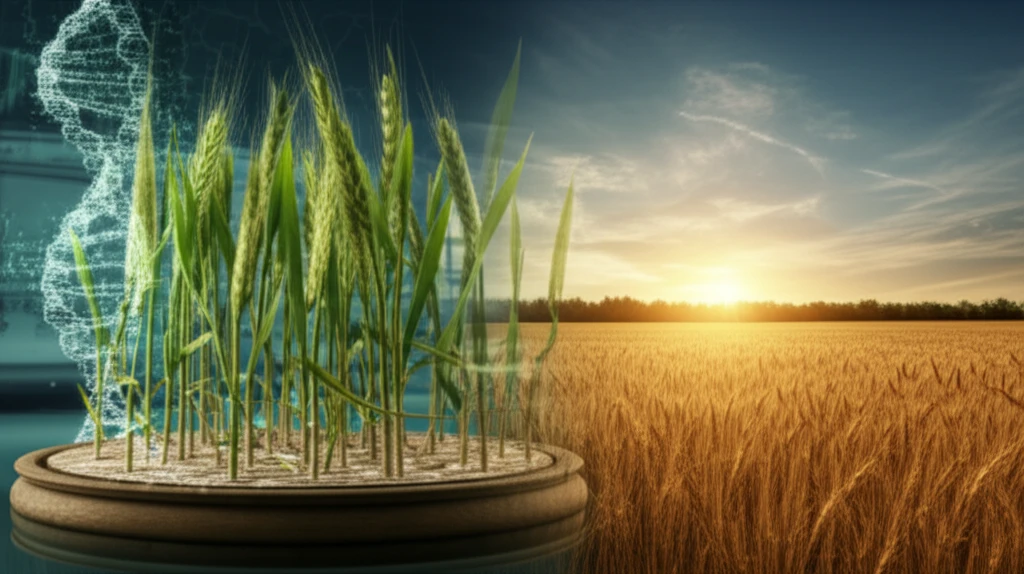
Durum Wheat Seedlings with DNA Strands

Unlocking Durum Wheat's Potential: How Seedling Traits Can Revolutionize Crop Production

"Dive into the groundbreaking research that explores the genetic secrets of durum wheat seedlings, paving the way for stronger, more resilient crops."


Wheat stands as a cornerstone among the world's essential cereal crops, with durum wheat playing a vital role in global food security. Primarily cultivated in the Mediterranean region and West Asia, durum wheat faces numerous environmental challenges that impact its yield and quality. Understanding the early development stages of this crop is crucial for enhancing its resilience and productivity.

Traditional methods of crop improvement are often time-consuming and labor-intensive. However, advancements in molecular biology and genetics offer new avenues for accelerating the breeding process. Association analysis, which links phenotypic variations to genetic markers, has emerged as a powerful tool for identifying desirable traits in crops. Single nucleotide polymorphisms (SNPs), the most abundant type of genetic marker, are now widely used to map genes and enhance breeding efforts.

Recent studies emphasize the importance of seedling traits in predicting the overall success of wheat crops. Seedling vigor, which includes factors like root and shoot development, directly correlates with better crop establishment, especially under stressful conditions. This article explores how a detailed analysis of seedling traits, combined with SNP markers, can revolutionize the breeding of durum wheat, leading to varieties with enhanced seedling vigor and improved yields.

The Science Behind Seedling Traits: What Makes Them So Important?

Durum Wheat Seedlings with DNA Strands

Seedling traits are the characteristics a plant exhibits in its early stages of development. These traits include root length, shoot height, number of leaves, and overall biomass. For durum wheat, these early characteristics are particularly important because they influence the plant's ability to establish itself in the field, withstand environmental stresses, and ultimately produce a high yield.

Researchers have found that seedling vigor is not just a matter of chance; it's deeply rooted in the plant's genetics. By identifying the specific genes and genetic markers (like SNPs) associated with strong seedling traits, breeders can selectively breed plants to amplify these desirable characteristics. This process, known as marker-assisted selection (MAS), allows for more efficient and precise crop improvement.

  • Root Length and Architecture: A well-developed root system allows the seedling to access water and nutrients more effectively.
  • Shoot Height and Leaf Development: Robust shoot growth ensures the seedling can capture sunlight for photosynthesis.
  • Biomass Accumulation: Higher biomass indicates a strong start, setting the stage for a productive life cycle.
Traditional breeding methods rely on observing these traits in mature plants, which can take a long time. Analyzing seedling traits, however, allows for earlier selection, accelerating the breeding cycle and bringing improved varieties to market faster. Furthermore, understanding the genetic basis of these traits enables breeders to target multiple characteristics simultaneously, creating more resilient and high-yielding crops.

The Future of Durum Wheat: How This Research Impacts You

The insights gained from this research have far-reaching implications for the future of durum wheat production. By leveraging marker-assisted selection, breeders can develop new varieties that are better adapted to challenging environments, leading to more stable and higher yields. Ultimately, this translates to a more secure and sustainable food supply for communities around the world. As climate change continues to pose challenges to agriculture, understanding and harnessing the genetic potential of crops like durum wheat will be essential for ensuring global food security.

About this Article -

This article was crafted using a human-AI hybrid and collaborative approach. AI assisted our team with initial drafting, research insights, identifying key questions, and image generation. Our human editors guided topic selection, defined the angle, structured the content, ensured factual accuracy and relevance, refined the tone, and conducted thorough editing to deliver helpful, high-quality information.See our About page for more information.

This article is based on research published under:

DOI-LINK: 10.1270/jsbbs.16074, Alternate LINK

Title: Snp-Based Association Analysis For Seedling Traits In Durum Wheat (≪I≫Triticum Turgidum≪/I≫ L. ≪I≫Durum≪/I≫ (Desf.))

Subject: Plant Science

Journal: Breeding Science

Publisher: Japanese Society of Breeding

Authors: Salih A. I. Sabiel, Sisi Huang, Xin Hu, Xifeng Ren, Chunjie Fu, Junhua Peng, Dongfa Sun

Published: 2017-01-01

Everything You Need To Know

1

Why is durum wheat so important?

Durum wheat is a crucial cereal crop, especially in regions like the Mediterranean and West Asia, playing a vital role in global food security. It's essential because it's a staple food source. Environmental challenges can severely impact its yield and quality, thus understanding and improving durum wheat is critical for a stable food supply.

2

What are seedling traits and why do they matter?

Seedling traits include root length, shoot height, number of leaves, and biomass. These characteristics are vital because they directly influence the durum wheat plant's ability to establish itself, withstand environmental stresses, and produce high yields. A robust root system allows for efficient water and nutrient uptake, while strong shoot development ensures effective sunlight capture for photosynthesis, impacting the overall yield.

3

What is marker-assisted selection, and how does it benefit durum wheat breeding?

Marker-assisted selection (MAS) is a method that uses genetic markers, such as Single Nucleotide Polymorphisms (SNPs), to identify and select plants with desirable traits, like enhanced seedling vigor in durum wheat. MAS accelerates the breeding cycle because breeders can select for traits earlier, and more precisely. This leads to quicker development of improved varieties that are better adapted to challenging environments.

4

How do seedling traits relate to Single Nucleotide Polymorphisms (SNPs)?

The connection between seedling traits and SNPs lies in association analysis. Researchers link variations in seedling traits (like root length) to specific genetic markers (SNPs). By identifying these associations, breeders can use the presence of certain SNPs to predict and select for durum wheat plants that will exhibit superior seedling vigor. This allows for more targeted and effective breeding efforts.

5

How does this research influence the future of durum wheat production?

This research impacts durum wheat production by enabling the development of new varieties that are better suited to withstand environmental challenges. By using marker-assisted selection to improve seedling traits, breeders can create durum wheat that establishes better, grows stronger, and ultimately yields more. This leads to more sustainable and higher yields, crucial for food security. As climate change continues, this research becomes even more critical in ensuring the global food supply.

Newsletter Subscribe

Subscribe to get the latest articles and insights directly in your inbox.