
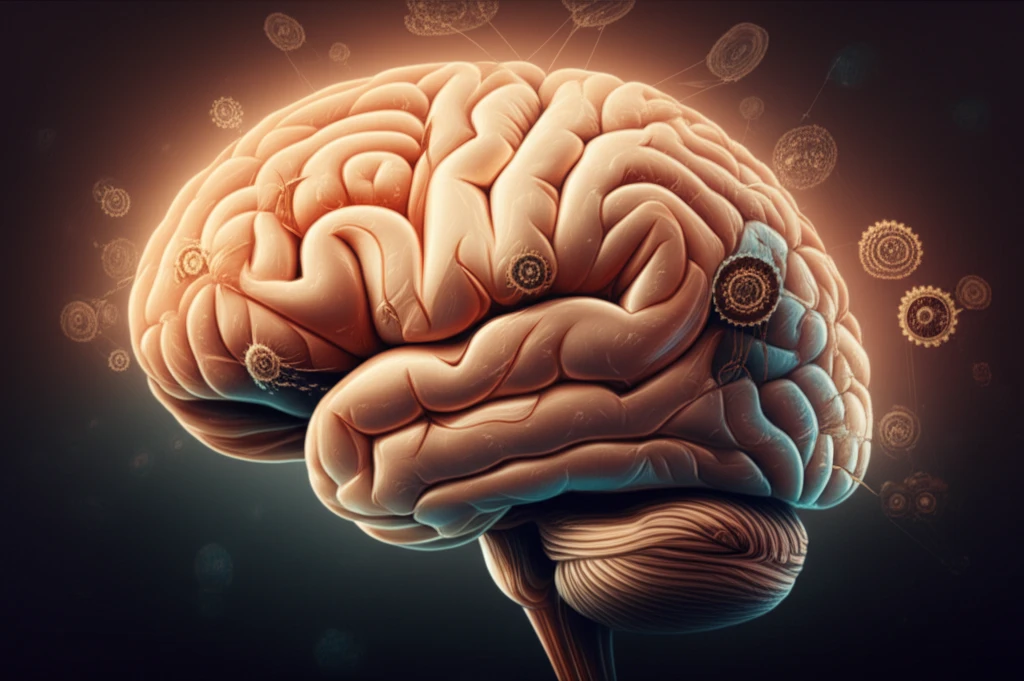
Brain with dopamine pathways stabilized by tiny gears, symbolizing Parkinson's treatment.

Unlocking Dopamine: How MAO-B and COMT Inhibitors Offer Hope in Parkinson's Disease

"A deep dive into how these inhibitors boost brain dopamine levels and improve the lives of those with Parkinson's."


Parkinson's disease shakes the lives of millions, impacting movement, control, and overall well-being. At the heart of this condition lies a disruption in the brain's dopamine levels, a critical neurotransmitter for motor function and coordination.

Fortunately, medical science has developed targeted strategies to combat this imbalance. Among these, inhibitors of monoamine oxidase B (MAO-B) and catechol-O-methyltransferase (COMT) stand out as crucial players. These inhibitors work by slowing down the enzymes that break down dopamine, effectively increasing its availability in the brain.

This article explores how MAO-B and COMT inhibitors function, examining their role in dopamine regulation, their effects on Parkinson's symptoms, and their potential to improve the quality of life for those living with this challenging condition.

MAO-B and COMT Inhibitors: A Powerful Partnership for Parkinson's Relief

Brain with dopamine pathways stabilized by tiny gears, symbolizing Parkinson's treatment.

MAO-B and COMT inhibitors each tackle dopamine deficiency from a unique angle, working in tandem to enhance dopamine levels in the brain. By understanding their specific actions, we can better appreciate their combined impact on managing Parkinson's symptoms.

Here's a closer look at each type:

  • MAO-B Inhibitors: These block monoamine oxidase B, an enzyme that breaks down dopamine in the brain. By inhibiting this enzyme, MAO-B inhibitors help preserve dopamine, easing motor symptoms. Key examples include selegiline and rasagiline.
  • COMT Inhibitors: These target catechol-O-methyltransferase, another enzyme involved in dopamine breakdown, but also metabolizes L-DOPA, a common Parkinson's medication before it can reach the brain. By blocking COMT, these inhibitors not only boost dopamine levels but also extend the effectiveness of L-DOPA. Common COMT inhibitors include entacapone and tolcapone.
The effectiveness of MAO-B and COMT inhibitors isn't just theoretical; clinical trials and real-world applications have demonstrated their ability to reduce motor fluctuations, improve 'on' time (periods of good symptom control), and enhance overall motor function in Parkinson's patients. They also have applications for reducing off time and dyskinesia.

Navigating the Future: What's Next for Parkinson's and Dopamine Therapies?

MAO-B and COMT inhibitors have significantly advanced Parkinson's treatment, offering hope and improved quality of life. Yet, they are not a cure, and managing Parkinson's requires a comprehensive approach. The future of Parkinson's therapy is likely to involve:

<ul><li><b>Combination Therapies:</b> Tailoring treatment plans that combine MAO-B and COMT inhibitors with other medications to maximize benefits.</li><li><b>Innovative Delivery Systems:</b> Exploring new methods, such as transdermal patches or continuous infusions, to maintain stable dopamine levels and reduce fluctuations.</li><li><b>Neuroprotective Strategies:</b> Developing therapies that protect and preserve dopamine-producing neurons.</li></ul>

As research continues, the journey toward better treatments and a potential cure for Parkinson's disease remains filled with promise. By staying informed and proactive, individuals with Parkinson's and their families can navigate this journey with resilience and hope.

About this Article -

This article was crafted using a human-AI hybrid and collaborative approach. AI assisted our team with initial drafting, research insights, identifying key questions, and image generation. Our human editors guided topic selection, defined the angle, structured the content, ensured factual accuracy and relevance, refined the tone, and conducted thorough editing to deliver helpful, high-quality information.See our About page for more information.

This article is based on research published under:

DOI-LINK: 10.1007/s00702-018-1952-7, Alternate LINK

Title: Inhibitors Of Mao-B And Comt: Their Effects On Brain Dopamine Levels And Uses In Parkinson’S Disease

Subject: Biological Psychiatry

Journal: Journal of Neural Transmission

Publisher: Springer Science and Business Media LLC

Authors: John P. M. Finberg

Published: 2018-11-01

Everything You Need To Know

1

What is the primary issue in Parkinson's disease that these inhibitors address?

Parkinson's disease is a condition where dopamine levels in the brain are disrupted. Dopamine is a crucial neurotransmitter for motor function and coordination. The disruption in dopamine leads to the motor symptoms that characterize Parkinson's disease, impacting movement and overall well-being.

2

How do MAO-B inhibitors work to help with Parkinson's symptoms?

MAO-B inhibitors work by blocking the enzyme monoamine oxidase B. This enzyme is responsible for breaking down dopamine in the brain. By inhibiting MAO-B, these drugs slow down the breakdown of dopamine, which increases the amount of dopamine available in the brain. This, in turn, helps alleviate motor symptoms associated with Parkinson's disease. Key examples include selegiline and rasagiline.

3

What does a COMT inhibitor do in the context of Parkinson's disease?

COMT inhibitors target the enzyme catechol-O-methyltransferase, another enzyme involved in dopamine breakdown. COMT inhibitors also prevent the metabolism of L-DOPA, a common Parkinson's medication, before it can reach the brain. By blocking COMT, these inhibitors increase dopamine levels and also extend the effectiveness of L-DOPA. Common examples of COMT inhibitors include entacapone and tolcapone.

4

Why are MAO-B and COMT inhibitors considered significant in Parkinson's treatment?

MAO-B and COMT inhibitors are important because they work in tandem to enhance dopamine levels in the brain, thereby managing Parkinson's symptoms. MAO-B inhibitors help preserve dopamine, while COMT inhibitors prevent its breakdown and extend the effectiveness of L-DOPA. These inhibitors improve motor function, reduce motor fluctuations, and enhance overall well-being for those with Parkinson's.

5

What is the overall significance of MAO-B and COMT inhibitors in the long-term management of Parkinson's disease?

The combination of MAO-B and COMT inhibitors has significantly improved Parkinson's treatment, but managing the disease requires a comprehensive approach. These inhibitors are not a cure, and further research and innovative therapies are continually being developed to offer more hope and improve the quality of life for people with Parkinson's. Future therapies may involve additional approaches to address this complex condition.

Newsletter Subscribe

Subscribe to get the latest articles and insights directly in your inbox.