
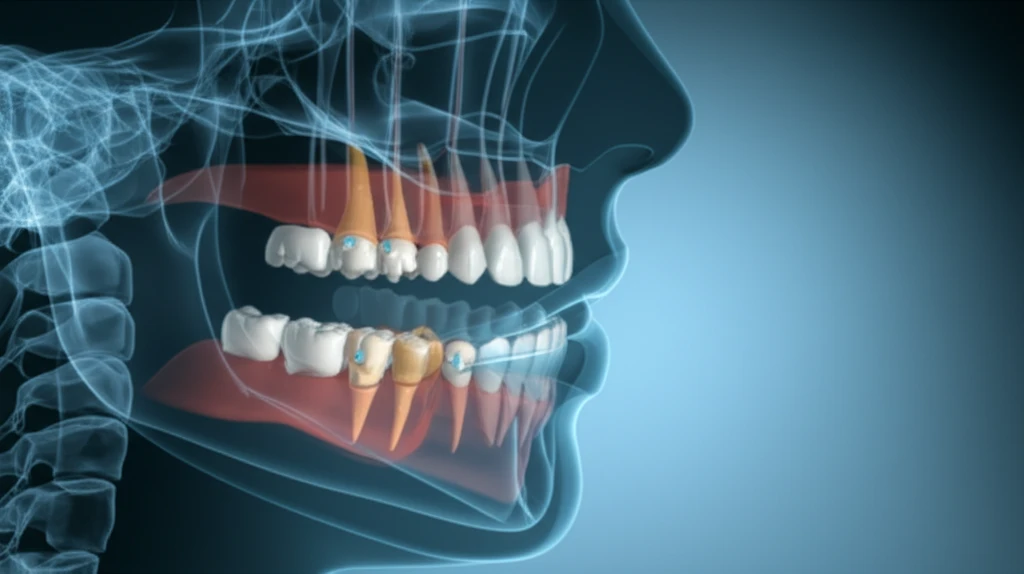
Unlocking Dental Secrets: How 3D Scans Revolutionize Tooth Development Analysis

"Cone-beam computed tomography (CBCT) offers unprecedented insight into the hidden world of tooth development, paving the way for more accurate diagnoses and treatment plans."
Understanding how permanent teeth develop is crucial for effective dental care, influencing diagnosis, treatment strategies, and overall outcomes. Traditionally, dental professionals have relied on two-dimensional X-ray images to assess tooth development. However, these images only provide a limited view of complex three-dimensional structures.
Now, advancements in imaging technology, particularly cone-beam computed tomography (CBCT), are changing the game. CBCT delivers detailed, high-resolution, three-dimensional images of the oral structures, allowing for earlier and more precise detection of any abnormalities.
A recent study published in the Dental Press Journal of Orthodontics investigates the use of CBCT for measuring tooth development. The study aims to determine the standard linear measurements of permanent teeth at various developmental stages, providing a valuable resource for dental professionals.
CBCT: A New Dimension in Dental Development Assessment
The study leverages CBCT technology to analyze the development of permanent teeth in 18 patients aged 3 to 20. CBCT images were acquired using the i-CAT system, and measurements were taken using the i-CAT software. The study focused on analyzing 238 teeth at varying development stages in both coronal and sagittal planes.
Implications for Diagnosis and Treatment
The study's findings align with previous research, confirming the reliability of CBCT for assessing tooth development. The measurements of dental crowns and roots acquired through CBCT imaging have significant clinical and research applications, providing a non-invasive method for in vivo studies.
CBCT images can significantly improve diagnosis, treatment planning, and outcome prediction in various dental specialties. The three-dimensional visualization allows for a more comprehensive understanding of tooth structures and potential abnormalities.
While the study provides valuable insights, the authors recommend further research to minimize methodological variables and refine the CBCT imaging process for even greater accuracy.