
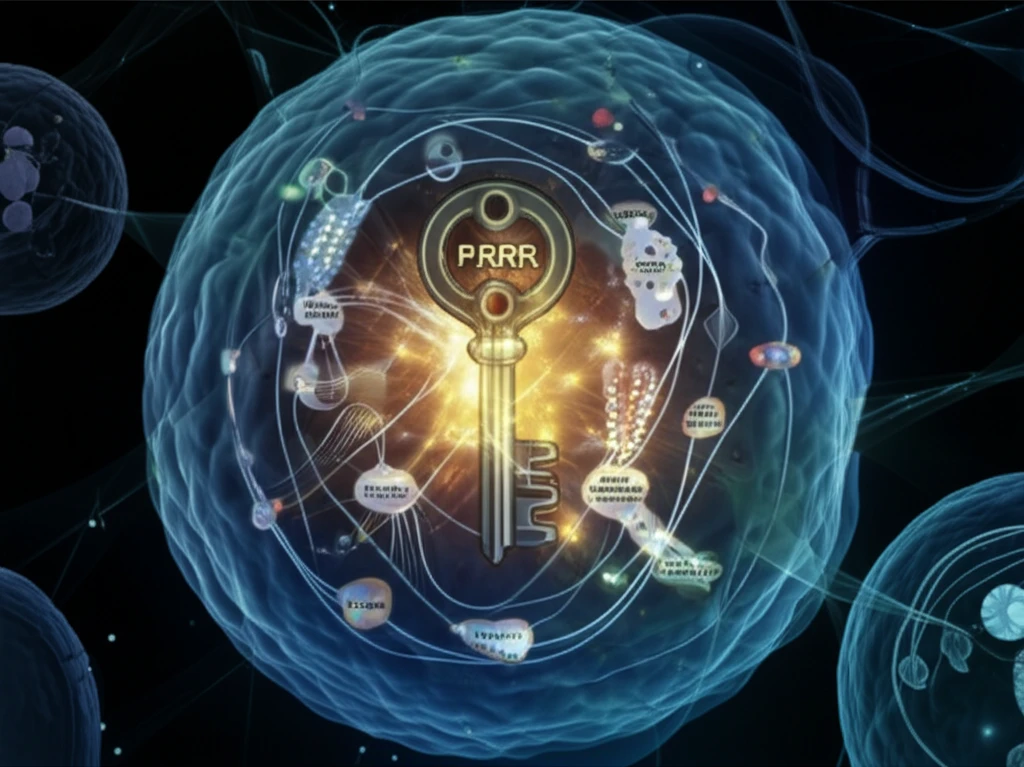
A digital illustration of a cell, with the (pro)renin receptor depicted as a key, representing its role in cellular processes and health.

Unlocking Cellular Secrets: How a Tiny Receptor Could Revolutionize Health

"Dive into the fascinating world of the (pro)renin receptor ((P)RR) and its surprising role in cellular functions, potentially impacting everything from heart health to longevity."


In the vast and intricate landscape of the human body, tiny messengers called receptors play critical roles, acting as gatekeepers that control cellular activity. These receptors, often overlooked, are the first point of contact for external signals, initiating a cascade of events that can determine our health and well-being. Among these cellular communicators is the (pro)renin receptor ((P)RR), a protein that has recently captured the attention of scientists. This article delves into the (P)RR, a fascinating molecular entity, exploring its structure, function, and the exciting potential it holds for revolutionizing health treatments.

The (P)RR, initially recognized for its interaction with the renin-angiotensin system (RAS), a crucial system for regulating blood pressure, has evolved into something much more. Research indicates that the (P)RR is involved in the intricate world of intracellular processes, where it may play a role in the movement of vesicles, the process of autophagy, and even signaling pathways like Wnt, which is essential for many cellular functions. These seemingly unrelated functions suggest that this small receptor might actually have a very broad reach, influencing a wide array of cellular processes.

As we journey into the complexities of the (P)RR, we'll explore its structure and how it is localized in different parts of the cell. We'll also explore its potential roles in health and disease, including its connection to heart failure, autophagy, and even Wnt signaling pathways. Join us as we investigate the significance of this protein and the role it may play in shaping future healthcare breakthroughs.

The Structure of the (P)RR and its Cellular Neighborhoods

A digital illustration of a cell, with the (pro)renin receptor depicted as a key, representing its role in cellular processes and health.

To understand how the (P)RR works, we must first examine its structure. The protein is made up of 350 amino acids, and it has a complex structure, with a signal peptide at the beginning, a transmembrane domain, and a short cytoplasmic tail. The transmembrane domain allows the protein to cross the cell membrane, while the cytoplasmic tail interacts with other proteins inside the cell. It can also be cut by other enzymes, leading to shorter forms that may have different roles.

The (P)RR is not always found on the surface of the cell; it can also be found inside the cell, in compartments like the endoplasmic reticulum (ER) and the Golgi apparatus. This distribution is critical, because it means the receptor can interact with different components inside the cell. Some of the shorter forms may be found in other locations, like lysosomes, that contain enzymes that break down cellular components. The exact locations of the (P)RR have not yet been fully clarified, however the functions are thought to be diverse and important.

  • Transmembrane Domain: This structure enables the protein to cross cell membranes.
  • Cytoplasmic Tail: The tail interacts with various intracellular proteins and signaling pathways.
  • Shorter Forms: Created through enzymatic cleavage, potentially serving unique functions.
  • Cellular Compartments: The (P)RR is located within the ER, Golgi, and even the lysosomes, depending on the cell type.
The (P)RR's various locations and forms suggest a complex role in cellular function, with each domain and location potentially contributing to different processes. Scientists are trying to understand what these locations indicate about the role of this receptor.

The Future of (P)RR Research and Its Impact on Health

The journey to understand the full scope of the (P)RR is ongoing. The potential of this receptor to impact various health conditions is enormous, and future research will further clarify its role in different cellular processes. Understanding the (P)RR is a complex puzzle, and each new piece of information helps to create a more complete picture of its function. With more research, we may come closer to realizing a future where we use the full potential of the (P)RR to improve and revolutionize healthcare.

About this Article -

This article was crafted using a human-AI hybrid and collaborative approach. AI assisted our team with initial drafting, research insights, identifying key questions, and image generation. Our human editors guided topic selection, defined the angle, structured the content, ensured factual accuracy and relevance, refined the tone, and conducted thorough editing to deliver helpful, high-quality information.See our About page for more information.

Everything You Need To Know

1

What is the primary function of the (pro)renin receptor ((P)RR) and how was it initially understood?

Initially, the (pro)renin receptor ((P)RR) was recognized for its interaction with the renin-angiotensin system (RAS), which is a critical regulator of blood pressure. However, research has revealed that the (P)RR's function extends far beyond blood pressure regulation. It's now understood to be involved in a variety of intracellular processes, including vesicle movement, autophagy, and Wnt signaling pathways. These diverse functions suggest that the (P)RR has a broad influence on various cellular activities.

2

How does the structure of the (pro)renin receptor ((P)RR) contribute to its function within a cell?

The (pro)renin receptor ((P)RR) is composed of 350 amino acids and includes a signal peptide, a transmembrane domain, and a cytoplasmic tail. The transmembrane domain enables the protein to cross the cell membrane, allowing it to interact with both the inside and outside of the cell. The cytoplasmic tail interacts with other proteins and signaling pathways within the cell. Additionally, the (P)RR can be cleaved by enzymes into shorter forms, which may have different roles and locations within the cell, further diversifying its function. The (P)RR's presence in different cellular compartments like the endoplasmic reticulum (ER), Golgi apparatus, and lysosomes also indicates that it participates in various cellular processes.

3

What are some specific cellular processes that the (pro)renin receptor ((P)RR) influences, and why are these significant?

The (pro)renin receptor ((P)RR) influences several key cellular processes, including autophagy, vesicle movement, and Wnt signaling. Autophagy is crucial for cellular health as it involves the breakdown and recycling of cellular components. Vesicle movement is essential for transporting molecules within the cell. Wnt signaling is vital for many cellular functions, including cell growth, differentiation, and embryonic development. The receptor's involvement in these diverse processes highlights its broad impact on cellular function and overall health. Dysregulation of these processes can lead to various diseases, making the (P)RR a potential target for therapeutic interventions.

4

In what areas of health and disease might future research on the (pro)renin receptor ((P)RR) have the greatest impact?

Future research on the (pro)renin receptor ((P)RR) is expected to significantly impact our understanding and treatment of various health conditions, particularly heart failure. Given its role in autophagy and Wnt signaling, further research could also reveal insights into treating diseases related to cellular dysfunction, such as cancer and neurodegenerative disorders. Understanding the (P)RR's function could lead to the development of targeted therapies that modulate its activity to improve cellular health and treat diseases.

5

What is the significance of the (pro)renin receptor ((P)RR)'s varying locations within the cell, and how does this affect its function?

The (pro)renin receptor ((P)RR)'s presence in different cellular locations such as the endoplasmic reticulum (ER), Golgi apparatus, and lysosomes is highly significant because it suggests that the receptor interacts with different components and participates in various processes within each compartment. For instance, location within the ER might relate to protein folding and quality control, while location in the Golgi apparatus could involve protein modification and sorting. Localization in lysosomes may indicate involvement in degradation processes. The receptor's ability to be cleaved into shorter forms, which then localize to different areas, further diversifies its potential functions, indicating a complex and versatile role in cellular activities. This complexity highlights the need for further research to fully elucidate the functional implications of the (P)RR's diverse cellular locations.

Newsletter Subscribe

Subscribe to get the latest articles and insights directly in your inbox.