
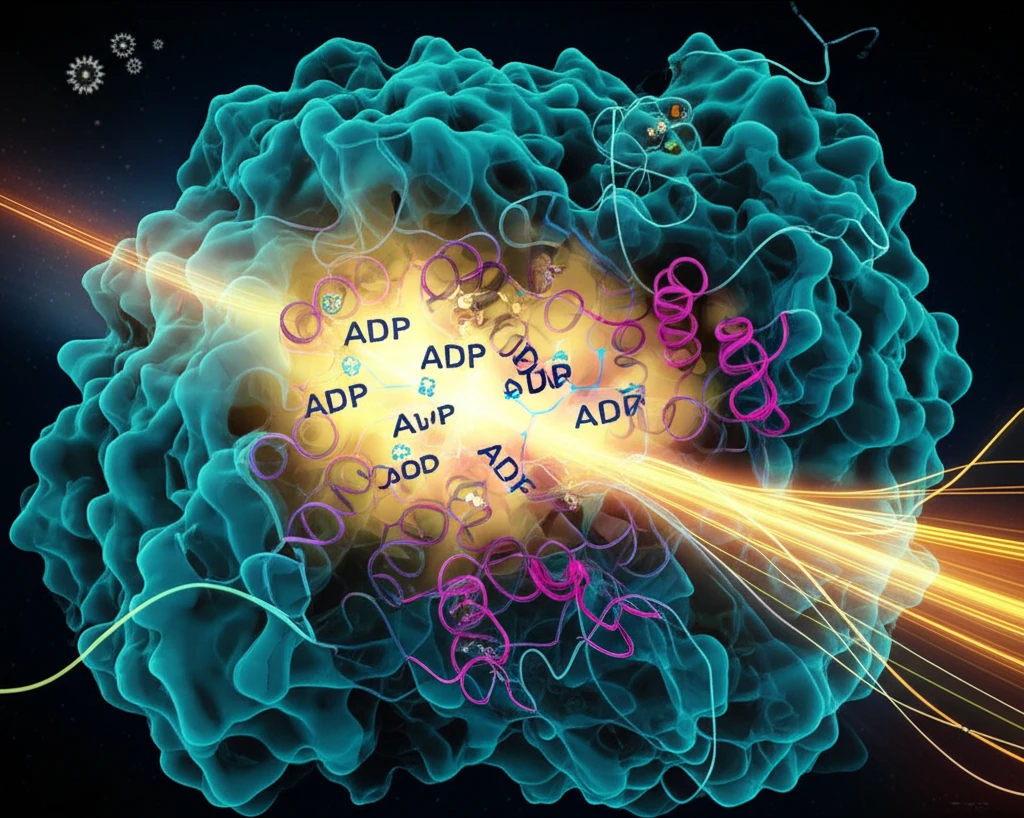
Unlocking Cellular Secrets: How a Protein Kinase Reveals New Pathways in Cell Regulation

"Saccharomyces cerevisiae CK2α's multiple binding modes offer a fresh perspective on ADP/GDP release, challenging conventional models of protein kinase activity."
Protein kinases are fundamental to cell regulation, acting as master switches that control a myriad of processes. Among these, CK2 stands out as a highly conserved and constitutively active enzyme, crucial for everything from cell growth to programmed cell death. What makes CK2 particularly intriguing is its ability to use both ATP and GTP as energy sources, setting it apart from its kinase counterparts.
Recent research has delved into the intricate workings of Saccharomyces cerevisiae CK2α (scCK2α), a catalytic subunit of CK2 in yeast. By examining its crystal structures in complex with various nucleotide analogues and divalent cations, scientists have uncovered novel binding modes that hint at a unique mechanism for releasing ADP/GDP, the byproducts of its activity. This discovery challenges existing models and opens new avenues for understanding kinase function.
This article explores the groundbreaking findings regarding scCK2α's structure and function, translating complex research into accessible insights. We will unravel how scCK2α's distinctive features provide clues about its co-substrate hydrolysis product release pathway, its dual co-substrate specificity, and the role of a unique insertion region in maintaining its constitutively active state.
Decoding the Structure: Unique Features of scCK2α
The crystal structures of scCK2α, complexed with GMPPNP, ATP, and AMPPN in the presence of magnesium or manganese ions, reveal a high degree of similarity to other known CK2 structures. Like its counterparts, scCK2α comprises two domains with a co-substrate nestled in the cleft between them. However, scCK2α exhibits three key distinctions:
- Multiple Binding Modes: scCK2α exhibits multiple nucleotide-divalent cation binding modes in its active site, differentiating it from the two-divalent-cation-occupied active sites of Zea mays CK2α and human CK2α.
- Conformational Changes: A conformational shift in Glu53 within the scCK2α-AMPPN complex disrupts its interaction with Lys45 and Arg48, resulting in a more open co-substrate binding pocket.
- ADP/GDP Release Pathway: The open pocket suggests a potential pathway for ADP/GDP release. However, the NE1 atom of the Trp residue in the 'DWG motif' forms a hydrogen bond to the O atom of Leu212, potentially hindering the 'DFG-in flip to DFG-out' model commonly found in eukaryotic protein kinases.
Implications and Future Directions
The discovery of multiple nucleotide-divalent cation binding modes in scCK2α, coupled with the proposed ADP/GDP release pathway, challenges our established understanding of protein kinase function. The research highlights the diverse mechanisms employed by enzymes to regulate cellular processes.
Further investigation into the conformational changes observed in scCK2α, particularly the role of the insertion region and the interactions of key residues like Lys50, Glu53, Arg161, and Lys197, promises to reveal more about the intricate regulation of CK2 activity.
By illuminating the unique characteristics of scCK2α, this research paves the way for developing targeted therapies that can modulate CK2 activity in various diseases, offering hope for innovative treatment strategies.