
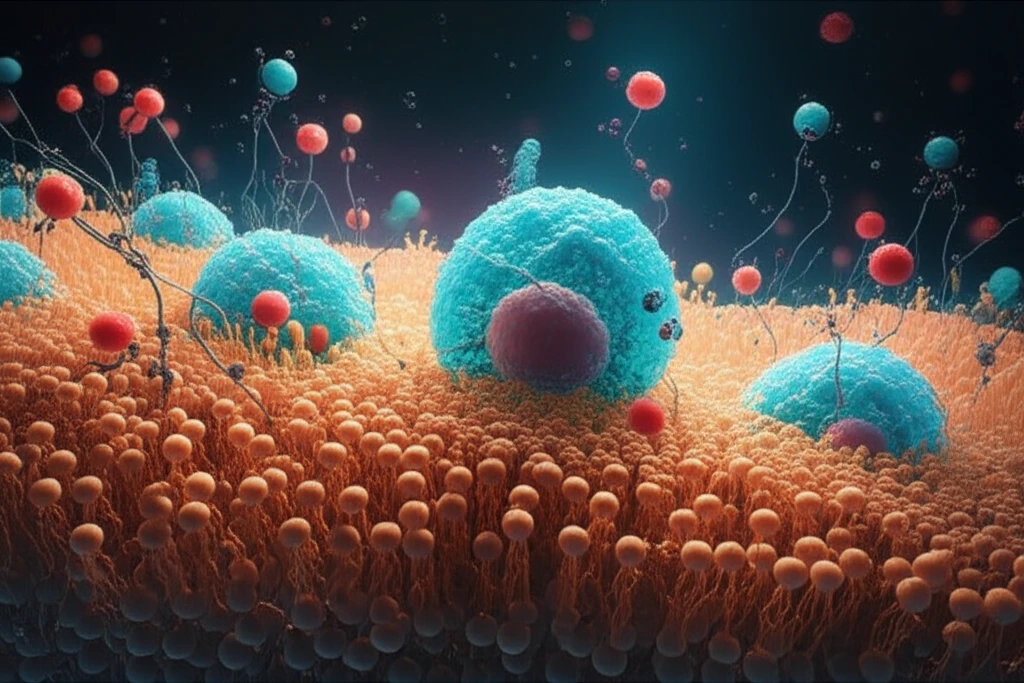
Cell membrane being dissolved by SMA copolymers, revealing proteins.

Unlocking Cells: How SMA Copolymers are Revolutionizing Membrane Protein Research

"Dive into the groundbreaking technique of using styrene-maleic acid (SMA) copolymers to solubilize cell membranes and extract proteins, offering new insights into cellular processes and potential therapeutic targets."


Extracting membrane proteins from cells has always been a tricky task. These proteins, vital for cell communication and function, are embedded within the cell's membrane, making them difficult to isolate without damaging them. Traditional methods often rely on detergents, which can disrupt the proteins' natural structure and behavior. But a new technique is changing the game: using styrene-maleic acid (SMA) copolymers.

SMA copolymers are molecules that can solubilize cell membranes, essentially dissolving them in a controlled way. This process allows researchers to extract membrane proteins in their native state, surrounded by a small disc of the cell membrane. This detergent-free approach preserves the proteins' integrity, enabling more accurate studies of their function and interactions. Recent research has focused on understanding exactly how SMA copolymers work at the cellular level, and whether they show any preference for specific parts of the cell.

This article explores the exciting potential of SMA copolymers in cell membrane research. We'll delve into a recent study that used fluorescence microscopy to visualize how SMA copolymers solubilize human cells, offering insights into the process and its implications for isolating and studying membrane proteins. Discover how this innovative technique could pave the way for new discoveries in cell biology and drug development.

SMA: A Multi-Stage Cellular Dissolver

Cell membrane being dissolved by SMA copolymers, revealing proteins.

The study employed SMA copolymers to solubilize HeLa cells, a commonly used human cell line. By tagging different parts of the cell with fluorescent markers, researchers could watch the solubilization process in real-time using fluorescence microscopy. This allowed them to observe how SMA interacted with different cellular compartments and membranes.

The results revealed that SMA solubilizes membranes in a multi-stage process that depends on the concentration of SMA used. The researchers found that:

  • SMA disrupts cell membranes in a step-by-step manner.
  • Inner cell membranes dissolve faster than the outer plasma membrane.
  • Proteins in the plasma membrane showed different rates of dissolving.
This suggests that SMA doesn't just randomly dissolve the cell; instead, it follows a specific order, potentially targeting different membrane types at different rates. This observation could be crucial for fine-tuning the technique to selectively extract certain proteins or membrane components.

SMA: The Future of Membrane Protein Research

This research highlights the potential of SMA copolymers as a valuable tool for membrane protein research. By providing a detergent-free method for solubilizing cell membranes, SMA allows researchers to study proteins in their native environment, leading to more accurate and relevant findings.

The study's findings on the multi-stage solubilization process and the differential behavior of plasma membrane proteins open up new avenues for investigation. Researchers can now explore how to optimize SMA-based techniques to selectively extract specific proteins or membrane domains, paving the way for targeted drug development and a deeper understanding of cell function.

As SMA technology continues to evolve, it promises to revolutionize our understanding of cell membranes and the proteins embedded within them. This, in turn, could lead to new treatments for a wide range of diseases and a more profound understanding of the fundamental processes of life.

About this Article -

This article was crafted using a human-AI hybrid and collaborative approach. AI assisted our team with initial drafting, research insights, identifying key questions, and image generation. Our human editors guided topic selection, defined the angle, structured the content, ensured factual accuracy and relevance, refined the tone, and conducted thorough editing to deliver helpful, high-quality information.See our About page for more information.

Everything You Need To Know

1

What are styrene-maleic acid (SMA) copolymers and how are they impacting membrane protein research?

Styrene-maleic acid (SMA) copolymers are revolutionizing membrane protein research by offering a way to solubilize cell membranes without detergents. This method allows for the extraction of membrane proteins in their native state, surrounded by a disc of the cell membrane, preserving their structure and function for more accurate studies. Traditional methods using detergents can disrupt the proteins' natural behavior, making SMA copolymers a significant advancement.

2

How did the fluorescence microscopy study enhance the understanding of how styrene-maleic acid (SMA) copolymers interact with cells?

The study used fluorescence microscopy to visualize how styrene-maleic acid (SMA) copolymers solubilize HeLa cells. By tagging different parts of the cell with fluorescent markers, researchers could observe the solubilization process in real-time. This allowed them to determine that SMA disrupts cell membranes in a step-by-step manner, with inner cell membranes dissolving faster than the outer plasma membrane, and proteins in the plasma membrane dissolving at different rates. This reveals the multi-stage process and selective nature of SMA's action.

3

Why is using styrene-maleic acid (SMA) copolymers considered a better approach than traditional detergent methods in membrane protein research?

Using styrene-maleic acid (SMA) copolymers provides a detergent-free method for solubilizing cell membranes. This is crucial because detergents can disrupt the natural structure and behavior of membrane proteins. By preserving the proteins' integrity, SMA allows researchers to study their function and interactions more accurately, leading to more reliable and relevant findings in cell biology and drug development.

4

What does the multi-stage solubilization process of cell membranes by styrene-maleic acid (SMA) copolymers reveal about its potential applications?

The research revealed that styrene-maleic acid (SMA) copolymers solubilize membranes in a multi-stage process that is dependent on the concentration of SMA used. It was observed that SMA disrupts cell membranes in a step-by-step manner, inner cell membranes dissolve faster than the outer plasma membrane, and proteins in the plasma membrane showed different rates of dissolving. This could be crucial for fine-tuning the technique to selectively extract certain proteins or membrane components, offering a more targeted approach to membrane protein research.

5

What implications does the use of styrene-maleic acid (SMA) copolymers have for future discoveries in cell biology and drug development?

The use of styrene-maleic acid (SMA) copolymers could lead to new discoveries in cell biology and drug development because they allow researchers to study membrane proteins in their native environment. This detergent-free method preserves the proteins' integrity, enabling more accurate studies of their function and interactions. This can lead to the identification of new therapeutic targets and the development of more effective drugs. While the research highlights the potential, it does not delve into specific drug targets or therapeutic areas, focusing instead on the methodology and its implications.

Newsletter Subscribe

Subscribe to get the latest articles and insights directly in your inbox.