
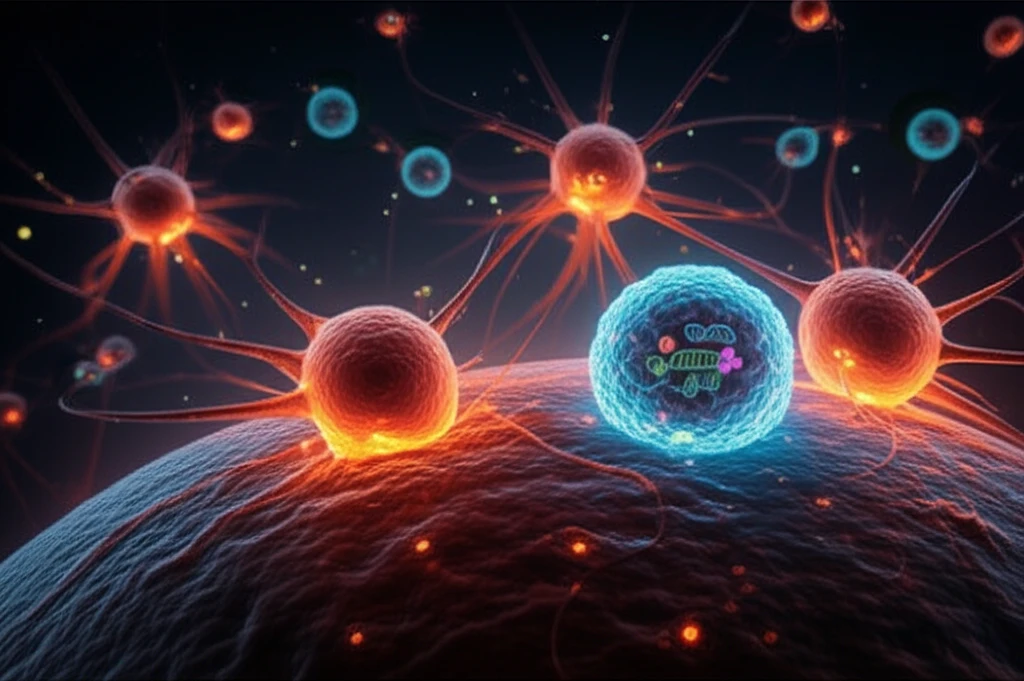
Cancer cells adapting to hypoxia through epigenetic modifications.

Unlocking Cancer's Secrets: How Hypoxia and Epigenetics Shape Tumor Behavior

"Delve into the groundbreaking research uncovering how oxygen deprivation and epigenetic changes fuel tumor growth, drug resistance, and metastasis, paving the way for innovative cancer therapies."


Imagine a bustling city where resources are scarce. In the world of cancer, this is hypoxia: a state where tumor cells are deprived of oxygen. Just like a city adapts to survive, cancer cells undergo remarkable changes, orchestrated by a master regulator called Hypoxia-Inducible Factor-1 (HIF-1).

HIF-1 controls hundreds of genes that help tumors thrive in low-oxygen environments. These genes drive processes like angiogenesis (forming new blood vessels), invasion (spreading to new areas), and altered metabolism. While scientists have long understood the key players in this hypoxic response, a new frontier is emerging: the role of epigenetics.

Epigenetics refers to modifications that alter gene expression without changing the underlying DNA sequence. It’s like adding annotations to a musical score – the notes remain the same, but the way they're played changes dramatically. This article explores how epigenetic mechanisms regulate the hypoxic response, and how this knowledge can be leveraged to develop novel cancer treatments.

Decoding Epigenetic Regulation in Cancer: Key Players and Processes

Cancer cells adapting to hypoxia through epigenetic modifications.

Epigenetic regulation is primarily governed by two main processes: DNA methylation and histone modification. DNA methylation involves adding a methyl group to DNA, typically leading to gene silencing. Histone modifications, on the other hand, involve altering histone proteins, around which DNA is wrapped. These modifications can either activate or repress gene expression.

These modifications are installed, removed, and interpreted by a diverse cast of epigenetic enzymes, influencing gene expression patterns. Because cancer cells exhibit distinct DNA methylation and histone modification patterns compared to normal cells, researchers are eager to develop therapies that restore healthy epigenetic states. Hypoxia profoundly impacts these epigenetic enzymes, making them attractive targets for cancer therapy.

Several epigenetic enzymes are significantly affected by hypoxic conditions:
  • Ten-Eleven Translocation 1 (TET1): TET1 is an enzyme that removes methyl groups from DNA, promoting gene expression. While mutations in TET genes are common in cancers, hypoxia can actually increase TET1 expression in some contexts, leading to complex changes in gene regulation.
  • G9a and GLP: These enzymes are responsible for adding methyl groups to histones, typically leading to gene repression. Hypoxia induces the expression of G9a and GLP, which then methylate other proteins involved in the hypoxic response, fine-tuning its activity.
  • Jumonji C (JmjC) Domain-Containing Demethylases: This family of enzymes removes methyl groups from histones. Their activity can be reduced by low oxygen levels, as they require oxygen to function. However, some JmjC demethylases are actually upregulated by hypoxia, highlighting the complex interplay between oxygen levels and epigenetic regulation.
  • Sirtuins (SIRTs): These enzymes are NAD+-dependent deacetylases, meaning they remove acetyl groups from proteins. They play a role in various cellular processes, including aging and stress resistance. Certain sirtuins, such as SIRT1 and SIRT6, interact with HIF-1 and influence the hypoxic response. The exact role of SIRT1 in hypoxia is still debated, with some studies showing decreased expression and activity under hypoxia, while others report increased expression.
In addition to these key players, enzymes like Protein Arginine Methyltransferase 2 (PRMT2), Histone Deacetylase 3 (HDAC3), and Alkylation Repair Homolog Protein 5 (ALKBH5) also contribute to the complex epigenetic landscape shaped by hypoxia.

The Future of Cancer Therapy: Targeting Epigenetics in Hypoxic Tumors

Understanding the intricate link between hypoxia and epigenetics opens new avenues for cancer therapy. By targeting specific epigenetic enzymes, researchers hope to disrupt the ability of tumors to adapt to low-oxygen conditions, making them more vulnerable to conventional treatments like chemotherapy and radiation. Furthermore, combining epigenetic drugs with immunotherapies may enhance the immune system's ability to recognize and destroy cancer cells.

About this Article -

This article was crafted using a human-AI hybrid and collaborative approach. AI assisted our team with initial drafting, research insights, identifying key questions, and image generation. Our human editors guided topic selection, defined the angle, structured the content, ensured factual accuracy and relevance, refined the tone, and conducted thorough editing to deliver helpful, high-quality information.See our About page for more information.

This article is based on research published under:

DOI-LINK: 10.1016/j.cophys.2018.11.007, Alternate LINK

Title: Epigenetic Regulation Of The Hypoxic Response

Subject: Physiology (medical)

Journal: Current Opinion in Physiology

Publisher: Elsevier BV

Authors: Hye Jin Nam, Sung Hee Baek

Published: 2019-02-01

Everything You Need To Know

1

What is hypoxia, and why is it significant in the context of cancer?

Hypoxia, or low oxygen, is a condition where tumor cells experience oxygen deprivation, akin to a resource-scarce environment. This state triggers the activation of Hypoxia-Inducible Factor-1 (HIF-1), a key regulator that orchestrates the tumor's response. The implications of hypoxia include enhanced angiogenesis, invasion, and altered metabolism, which contribute to tumor growth, drug resistance, and metastasis. Understanding hypoxia is crucial because it reveals how tumors adapt and survive, providing targets for therapies.

2

What is epigenetics, and why is it important in cancer research?

Epigenetics involves modifications that alter gene expression without changing the DNA sequence itself, analogous to annotations on a musical score that change the way it's played. This includes processes like DNA methylation and histone modification. DNA methylation involves adding a methyl group to DNA, typically silencing genes, whereas histone modifications involve altering histone proteins, which can activate or repress gene expression. These epigenetic changes are critical because they regulate the activity of genes, influencing how cancer cells behave and respond to their environment, including hypoxic conditions. This knowledge is vital for developing therapies that can revert these modifications and restore normal cellular function.

3

What are DNA methylation and histone modification, and how do they impact cancer?

DNA methylation is a process where a methyl group is added to DNA, often leading to the silencing of genes. This process is influenced by enzymes like Ten-Eleven Translocation 1 (TET1), which removes methyl groups, and is affected by hypoxia. Histone modification involves altering histone proteins to affect gene expression. Enzymes like G9a and GLP add methyl groups to histones, while Jumonji C (JmjC) Domain-Containing Demethylases remove them. These modifications are crucial because they directly influence which genes are 'turned on' or 'turned off,' dictating cellular behavior. Hypoxia's impact on these enzymes highlights how environmental stressors can alter the epigenetic landscape and drive tumor progression, making these enzymes targets for therapeutic intervention.

4

Which epigenetic enzymes are key players in the hypoxic response?

Several epigenetic enzymes play critical roles in the hypoxic response. Ten-Eleven Translocation 1 (TET1) removes methyl groups from DNA, but its activity can be complex. G9a and GLP add methyl groups to histones, often repressing gene expression, with hypoxia increasing their expression. Jumonji C (JmjC) Domain-Containing Demethylases remove methyl groups from histones, with their activity reduced by low oxygen levels, but some are upregulated. Sirtuins (SIRTs), such as SIRT1 and SIRT6, remove acetyl groups from proteins and interact with Hypoxia-Inducible Factor-1 (HIF-1). These enzymes are important because they directly shape the epigenetic landscape of cancer cells under hypoxia, influencing gene expression patterns that promote tumor survival and resistance to treatment.

5

How can targeting epigenetic enzymes in hypoxic tumors improve cancer treatment?

Targeting epigenetic enzymes in hypoxic tumors holds significant promise for cancer therapy. By disrupting enzymes like Ten-Eleven Translocation 1 (TET1), G9a, GLP, Jumonji C (JmjC) Domain-Containing Demethylases, and Sirtuins (SIRTs), researchers can potentially reverse the adaptations that allow tumors to thrive in low-oxygen conditions. This approach could enhance the effectiveness of conventional treatments like chemotherapy and radiation, and may also improve the efficacy of immunotherapies by making cancer cells more recognizable to the immune system. The goal is to make tumors more vulnerable to treatment and prevent their spread and growth.

Newsletter Subscribe

Subscribe to get the latest articles and insights directly in your inbox.