
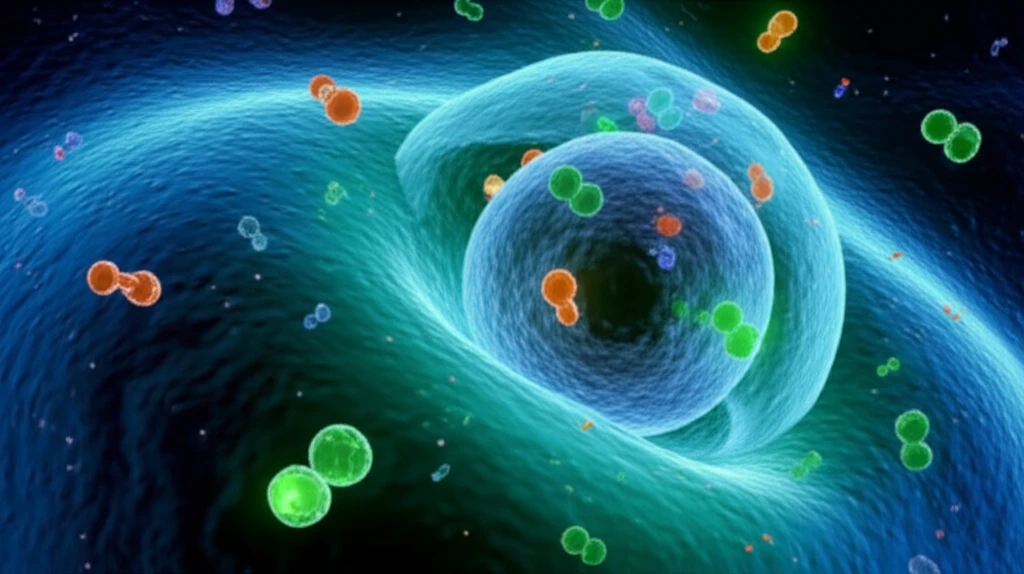
Reactive species interacting within a stylized cancer cell during radiation therapy

Unlocking Cancer Treatment: How Scientists are Revolutionizing Radiation Therapy

"A Deep Dive into Geant4-DNA Chemistry Models and Their Impact on Personalized Cancer Care"


Radiation therapy stands as a cornerstone in cancer treatment, offering hope and healing to countless patients. For those undergoing radiation with low Linear Energy Transfer (LET), like photons and protons, most of the biological impact comes from the indirect chemical damage caused by reactive species produced during water radiolysis. Imagine these reactive species as tiny, yet powerful, agents, disrupting the cellular environment and triggering a cascade of biological effects.

To truly understand and optimize cancer treatment at a microscale, scientists need to model every aspect, from the initial particle interactions to the subsequent water radiolysis and the 3D distribution of reactive species over time. In other words, we need to visualize and simulate the entire process, capturing the birth, movement, and interactions of these reactive species as they navigate the cellular landscape. This level of detail can unlock personalized strategies that maximize treatment effectiveness while minimizing harm to healthy tissues.

Enter Geant4-DNA, a cutting-edge simulation toolkit that's transforming how we approach radiation therapy. By integrating sophisticated chemistry models with existing physics models, Geant4-DNA allows researchers to comprehensively simulate water radiolysis and track the behavior of reactive species in intricate detail. Now, scientists are independently validating species yields with experimental observations and radiobiological simulations, opening new avenues for precision in cancer treatment.

What is Geant4-DNA and How Does It Model Radiation Chemistry?

Reactive species interacting within a stylized cancer cell during radiation therapy

Geant4-DNA serves as an open-source Monte Carlo simulation toolkit that comes equipped with a comprehensive library of physics models applicable to a broad spectrum of particles and energies. What sets Geant4 apart is its capacity to model complex simulation geometries, which can consist of intricate shapes made from diverse elements, isotopes, materials, and molecules. Thanks to Geant4-DNA's very low energy physics models, the microscale track structures can be modeled for directly ionizing radiation in water through step-by-step interactions.

The recent inclusion of chemistry modeling to Geant4-DNA now facilitates the simulation of the production, diffusion, reactions, and recombination of reactive species resulting from water radiolysis. In essence, Geant4-DNA arms users with novel tools, thereby broadening the toolkit’s applications and facilitating user-driven development. Imagine the potential: complete radiobiological modeling that encompasses physical, chemical, and biological phases, bridging the gaps often present in traditional radiobiological models.

Here’s how it works:
  • Physical Stage: Models the initial interactions of radiation with water molecules, creating ions and excited molecules.
  • Physicochemical Stage: Tracks the thermalization and solvation of electrons, leading to the formation of reactive species.
  • Chemical Stage: Simulates the diffusion, reactions, and recombination of these reactive species over time.
Though several simulation tools can model radiolysis, most handle the chemical stage using independent reaction time (IRT) methods. While IRT simulations offer computational efficiency and yield accurate simulations of radiolysis, they fall short of modeling the diffusion of individual reactive species over time—a crucial element for radiobiological modeling. Geant4-DNA chemistry steps in to fill this void, leveraging Geant4’s robust physics models and ability to handle complex geometries. Tools like GATE and TOPAS already benefit from Geant4, making the integration of chemical stages in radiation damage models a natural progression. Moreover, Geant4’s open-source nature promotes modification, replication, and collaborative sharing of simulation code.

The Future of Personalized Cancer Treatment

Geant4-DNA chemistry models are revolutionizing how we approach cancer treatment. By providing a detailed and validated simulation of water radiolysis and reactive species dynamics, these models offer the potential to personalize radiation therapy. While there is still work to be done—particularly in refining the extinction of hydroxyl radical yield and formation of hydrogen peroxide—the agreement between Geant4-DNA simulations and experimental observations is promising. With further experimental data and model refinements, Geant4-DNA can pave the way for optimized and personalized cancer treatments.

About this Article -

This article was crafted using a human-AI hybrid and collaborative approach. AI assisted our team with initial drafting, research insights, identifying key questions, and image generation. Our human editors guided topic selection, defined the angle, structured the content, ensured factual accuracy and relevance, refined the tone, and conducted thorough editing to deliver helpful, high-quality information.See our About page for more information.

This article is based on research published under:

DOI-LINK: 10.1002/mp.13332, Alternate LINK

Title: Validation And Investigation Of Reactive Species Yields Of Geant4‐ Dna Chemistry Models

Subject: General Medicine

Journal: Medical Physics

Publisher: Wiley

Authors: Dylan Peukert, Sebastien Incerti, Ivan Kempson, Michael Douglass, Mathieu Karamitros, Gérard Baldacchino, Eva Bezak

Published: 2018-12-26

Everything You Need To Know

1

What is Geant4-DNA and what is its purpose?

Geant4-DNA is a sophisticated, open-source Monte Carlo simulation toolkit specifically designed to model the interaction of radiation with matter at the molecular and cellular level. It includes comprehensive physics models that allow scientists to simulate the initial particle interactions, water radiolysis, and the subsequent behavior of reactive species. The toolkit's significance lies in its ability to provide a detailed understanding of how radiation damages cells, facilitating the development of personalized cancer treatment strategies.

2

Why is understanding radiation chemistry crucial in cancer treatment?

Radiation therapy, a cornerstone in cancer treatment, relies heavily on understanding how radiation interacts with cells. In radiation therapy with low Linear Energy Transfer (LET), most of the biological impact stems from the indirect chemical damage caused by reactive species resulting from water radiolysis. These reactive species disrupt the cellular environment, triggering biological effects. Geant4-DNA allows scientists to model every aspect, from initial particle interactions to the distribution of reactive species, thus, optimizing treatment and minimizing damage to healthy tissues.

3

What are the different stages that Geant4-DNA models?

The three stages modeled by Geant4-DNA are the Physical Stage, Physicochemical Stage, and Chemical Stage. The Physical Stage models the initial interaction of radiation with water molecules. The Physicochemical Stage tracks the thermalization and solvation of electrons. The Chemical Stage simulates the diffusion, reactions, and recombination of reactive species over time. This comprehensive approach, bridging physics and chemistry, is key to understanding the complex process of radiation damage and its impact on cancer cells.

4

Why is Geant4-DNA a significant advancement in cancer treatment?

Geant4-DNA is important because it addresses the limitations of traditional radiobiological models, particularly regarding the diffusion of reactive species. While other simulation tools use independent reaction time (IRT) methods for computational efficiency, these methods don't fully capture the dynamic movement of individual reactive species. Geant4-DNA, by leveraging robust physics models and handling complex geometries, fills this void, enabling more accurate and detailed simulations of the chemical stage of radiation damage. This capability is crucial for developing personalized cancer treatments.

5

How can Geant4-DNA models revolutionize cancer treatment?

Geant4-DNA chemistry models are paving the way for personalized cancer treatment by providing validated simulations of water radiolysis and reactive species dynamics. Although challenges remain, such as refining the extinction of hydroxyl radical yield and formation of hydrogen peroxide, the agreement between the simulations and experimental observations is promising. This understanding can lead to optimized treatments, tailoring radiation therapy to each patient's specific needs and maximizing treatment effectiveness while minimizing harm to healthy tissues.

Newsletter Subscribe

Subscribe to get the latest articles and insights directly in your inbox.