
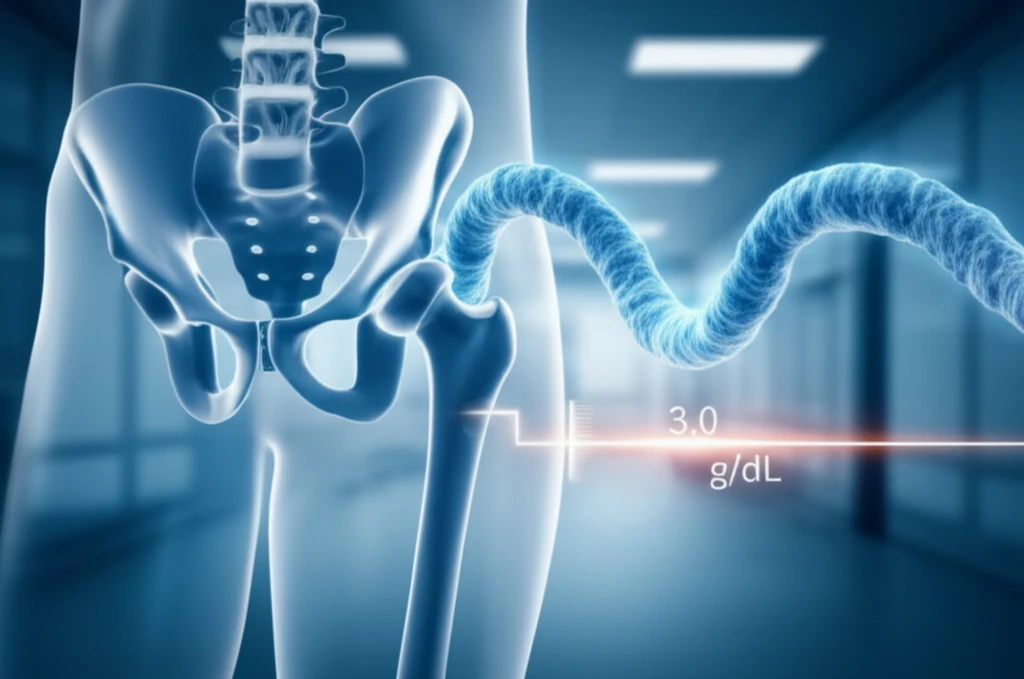
Illustration of a hip joint with albumin protein, highlighting the 3.0 g/dL threshold for hip replacement complications.

Unlocking Better Hip Replacement Outcomes: Is Your Albumin Level the Key?

"New research highlights the critical threshold of serum albumin for minimizing complications after total hip arthroplasty, offering insights for improved patient care."


Total hip arthroplasty (THA) is a transformative procedure for individuals suffering from chronic hip pain and limited mobility. While THA offers significant improvements in quality of life, like any surgery, it carries potential risks and complications. Recent research has focused on identifying modifiable factors that can optimize patient outcomes and minimize adverse events.

One such factor is serum albumin, a protein in the blood that plays a crucial role in maintaining fluid balance, transporting nutrients, and supporting immune function. Low serum albumin levels, a condition known as hypoalbuminemia, have been linked to increased perioperative complications following THA. However, the specific threshold at which these complications significantly rise has remained unclear – until now.

A new study published in HIP International sheds light on this critical threshold, providing valuable insights for surgeons and patients alike. By analyzing data from a large cohort of patients undergoing THA, researchers have identified a specific serum albumin level that appears to be associated with a significant increase in perioperative complications. This discovery has the potential to refine preoperative risk assessment and optimize patient management, ultimately leading to better outcomes after THA.

The Albumin-THA Connection: Why Does It Matter?

Illustration of a hip joint with albumin protein, highlighting the 3.0 g/dL threshold for hip replacement complications.

Low serum albumin often reflects underlying malnutrition or chronic inflammation, both of which can impair the body's ability to heal and fight off infection. In the context of THA, low albumin levels have been associated with a range of adverse outcomes, including:

Understanding these risks is the first step toward mitigating them. The challenge, however, has been determining the precise albumin level that signals a heightened risk of complications. Previous studies have often used a cutoff of 3.5 g/dL to define low serum albumin, but this may not accurately reflect the threshold at which complications truly begin to escalate in THA patients.

  • Increased risk of infection
  • Wound healing problems
  • Systemic complications (e.g., pneumonia, sepsis)
  • Cardiac and pulmonary issues
  • Increased mortality
The HIP International study aimed to address this gap by identifying the specific serum albumin threshold associated with a significant rise in perioperative complications after THA. The researchers analyzed data from the American College of Surgeons NSQIP database, a large, multi-institutional dataset that includes detailed information on surgical procedures and patient outcomes. The study cohort included 24,586 patients who underwent unilateral primary THA with reported preoperative albumin levels. By stratifying patients based on their albumin levels and analyzing the incidence of various complications, the researchers were able to pinpoint a critical threshold.

Taking Control of Your Health: What This Means for You

The HIP International study provides valuable insights for both surgeons and patients undergoing THA. By identifying a specific serum albumin threshold of 3.0 g/dL, this research highlights the importance of preoperative nutritional assessment and optimization. While further research is needed to confirm whether correcting low albumin levels can directly reduce complications, the findings suggest that addressing modifiable risk factors like malnutrition may lead to better outcomes after THA. Talk to your doctor about assessing your nutritional status before surgery and taking steps to improve your albumin levels if necessary. This proactive approach can empower you to take control of your health and optimize your chances of a successful hip replacement.

About this Article -

This article was crafted using a human-AI hybrid and collaborative approach. AI assisted our team with initial drafting, research insights, identifying key questions, and image generation. Our human editors guided topic selection, defined the angle, structured the content, ensured factual accuracy and relevance, refined the tone, and conducted thorough editing to deliver helpful, high-quality information.See our About page for more information.

This article is based on research published under:

DOI-LINK: 10.1177/1120700018808704, Alternate LINK

Title: The Serum Albumin Threshold For Increased Perioperative Complications After Total Hip Arthroplasty Is 3.0 G/Dl

Subject: Orthopedics and Sports Medicine

Journal: HIP International

Publisher: SAGE Publications

Authors: Charles L Nelson, Atul F Kamath, Nabil M Elkassabany, Zhenggang Guo, Jiabin Liu

Published: 2018-11-11

Everything You Need To Know

1

What is a total hip arthroplasty (THA)?

Total hip arthroplasty, or THA, is a surgical procedure designed to alleviate chronic hip pain and improve mobility for individuals suffering from various hip conditions. It involves replacing the damaged hip joint with an artificial implant. While THA can significantly enhance a patient's quality of life, it's essential to understand that, like any surgery, it carries potential risks and complications. Therefore, optimizing patient health before and after the procedure is crucial for the best possible outcome.

2

What is serum albumin and why is it important?

Serum albumin is a protein found in the blood that performs several critical functions. It helps maintain fluid balance within the body, transports essential nutrients, and supports the immune system. Low levels of serum albumin, known as hypoalbuminemia, can indicate underlying malnutrition or chronic inflammation. These conditions can impair the body's ability to heal and fight off infections, potentially leading to complications after total hip arthroplasty. Maintaining an adequate level of serum albumin is vital for overall health and can influence surgical outcomes.

3

What is the specific serum albumin level that's considered a critical threshold for THA patients?

Research indicates that a serum albumin level of 3.0 g/dL is a critical threshold for patients undergoing total hip arthroplasty. Patients with levels below this threshold may face a significantly increased risk of perioperative complications, such as infections, wound healing problems, systemic complications like pneumonia or sepsis, cardiac and pulmonary issues, and even increased mortality. Identifying this threshold allows healthcare providers to assess risk more accurately and implement strategies to optimize patient health before surgery.

4

Why is it important to maintain optimal serum albumin levels before undergoing THA?

Maintaining an optimal serum albumin level is important because low levels are associated with several complications following total hip arthroplasty. These include increased risk of infection, impaired wound healing, systemic complications, cardiac and pulmonary issues, and increased mortality. Addressing and correcting low albumin levels through nutritional support and management of underlying conditions can potentially improve patient outcomes and reduce the likelihood of adverse events after THA.

5

What do these findings mean for someone considering or scheduled for a total hip arthroplasty?

The findings suggest that assessing nutritional status and optimizing serum albumin levels before total hip arthroplasty could lead to better patient outcomes. While more research is needed to confirm whether correcting low albumin levels directly reduces complications, addressing modifiable risk factors like malnutrition appears promising. Patients should discuss their nutritional status with their doctor and take proactive steps to improve their albumin levels if necessary, potentially enhancing their chances of a successful hip replacement.

Newsletter Subscribe

Subscribe to get the latest articles and insights directly in your inbox.