
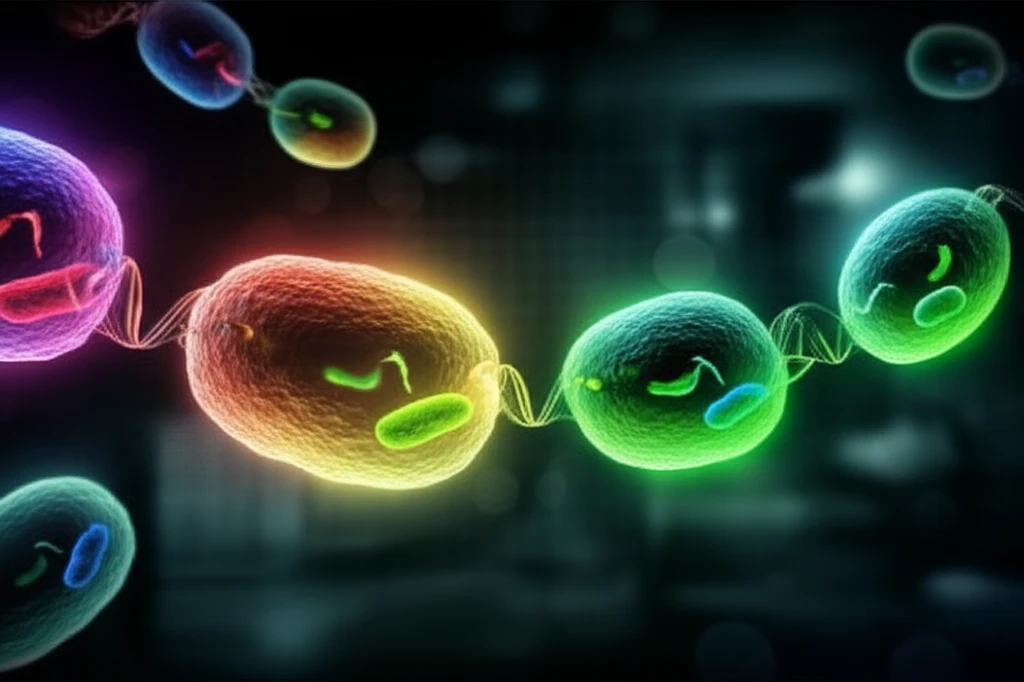
Surreal illustration of bacterial cells exchanging glowing plasmids, emphasizing the role of antirestriction proteins in gene transfer.

Unlocking Bacterial Secrets: How Scientists Are Outsmarting Resistance

"Discover how understanding antirestriction proteins KlcA and ArdB could revolutionize our fight against antibiotic resistance and improve gene transfer technologies."


In the microscopic world of bacteria, a constant battle is waged for survival. Self-transmissible plasmids, tiny rings of DNA, play a crucial role in this conflict by carrying genes that can help bacteria resist threats, including antibiotics. But bacteria aren't defenseless. They have their own defense mechanisms, including restriction-modification (RM) systems, which act like molecular scissors, cutting up foreign DNA that enters the cell.

However, some plasmids have evolved a clever counter-strategy: antirestriction proteins. These proteins, like KlcA and ArdB, can inhibit the RM systems, allowing the plasmid to successfully transfer its genes into the bacterial cell. Understanding how these antirestriction proteins work is crucial for several reasons. It can help us combat the spread of antibiotic resistance, as these proteins often facilitate the transfer of resistance genes between bacteria. Also, it can provide insights into improving gene transfer technologies, which are essential for various applications in biotechnology and medicine.

Recent research has shed new light on the function and activity of KlcA and ArdB, two antirestriction proteins found in plasmids. This study, published in FEMS Microbiology Letters, delves into the specific mechanisms by which these proteins inhibit RM systems, offering valuable clues for future strategies to combat bacterial resistance and improve genetic engineering techniques.

The KlcA and ArdB Story: Understanding Antirestriction Activity

Surreal illustration of bacterial cells exchanging glowing plasmids, emphasizing the role of antirestriction proteins in gene transfer.

The study focused on KlcA (found in plasmid RP4) and ArdB (found in plasmid R64). These proteins are known to inhibit type I RM systems, which are common in bacteria. The researchers aimed to measure how effectively these proteins block restriction activity and to identify the crucial parts of the proteins responsible for this function. By understanding these mechanisms, scientists hope to find new ways to control bacterial gene transfer.

Here's what the researchers discovered:

  • KlcA (RP4) Inhibits EcoKI: When the klcA gene is placed on a plasmid with a strong promoter, it effectively inhibits the EcoKI restriction enzyme. This shows that KlcA can indeed function as an antirestriction protein.
  • ArdB and KlcA Have Similar Activity: The study found that ArdB (R64) and KlcA (RP4) have approximately equal antirestriction activity. This suggests that despite some differences in their amino acid sequences, they function similarly.
  • Key Amino Acids Identified: By analyzing ArdB homologs, the researchers identified four groups of conserved amino acids on the protein's surface. These groups are likely important for the protein's structure and function.
  • Polar Amino Acids are Crucial: When certain polar amino acids in ArdB were replaced with hydrophobic ones, the antirestriction activity significantly decreased (around 100-fold). This highlights the importance of these polar amino acids for the protein to function correctly.
  • A 'Ring Belt' is Key: A conserved region forming a 'ring belt' on the protein's surface, including amino acids E32, S84, E132, N77, and D141, was identified as a crucial section for ArdB/KlcA function.
These findings provide valuable insights into how KlcA and ArdB proteins work. By pinpointing the critical amino acids and regions responsible for antirestriction activity, the researchers have opened new avenues for potential interventions. This knowledge could be used to develop strategies to prevent the spread of antibiotic resistance or to improve the efficiency of gene transfer technologies.

The Future of Fighting Resistance

This research on KlcA and ArdB proteins has significant implications for how we approach antibiotic resistance and genetic engineering. By understanding the intricate mechanisms that bacteria use to defend themselves, scientists can develop more effective strategies to combat these defenses. The identification of key amino acids and regions in antirestriction proteins opens the door for targeted interventions that could prevent the spread of antibiotic resistance genes or enhance the efficiency of gene transfer technologies. Further research in this area promises to yield even more innovative solutions for these critical challenges.

About this Article -

This article was crafted using a human-AI hybrid and collaborative approach. AI assisted our team with initial drafting, research insights, identifying key questions, and image generation. Our human editors guided topic selection, defined the angle, structured the content, ensured factual accuracy and relevance, refined the tone, and conducted thorough editing to deliver helpful, high-quality information.See our About page for more information.

This article is based on research published under:

DOI-LINK: 10.1093/femsle/fny227, Alternate LINK

Title: Antirestriction Activities Of Klca (Rp4) And Ardb (R64) Proteins

Subject: Genetics

Journal: FEMS Microbiology Letters

Publisher: Oxford University Press (OUP)

Authors: Ignatiy I Goryanin, Anna A Kudryavtseva, Vladimir P Balabanov, Valentina S Biryukova, Ilya V Manukhov, Gennadii B Zavilgelsky

Published: 2018-09-18

Everything You Need To Know

1

What are KlcA and ArdB, and what do they do?

KlcA and ArdB are antirestriction proteins. These proteins are found in plasmids, which are small, circular pieces of DNA within bacteria. Their main function is to counteract the restriction-modification (RM) systems that bacteria use to defend against foreign DNA. RM systems act like molecular scissors, cutting up invading DNA. KlcA and ArdB inhibit these scissors, allowing the plasmid, and any genes it carries, to survive and transfer into the bacterial cell.

2

Why is understanding KlcA and ArdB important?

Understanding KlcA and ArdB is critical because it directly impacts our ability to combat antibiotic resistance. Many antibiotic resistance genes are carried on plasmids. If KlcA or ArdB are present, they can facilitate the transfer of these resistance genes between bacteria, spreading the resistance. By understanding these proteins' mechanisms, scientists can develop strategies to block their function, thereby limiting the spread of antibiotic resistance. This knowledge could lead to more effective treatments for infections.

3

What specific discoveries were made regarding KlcA and ArdB?

The study discovered key details about how KlcA and ArdB function to counteract bacterial defenses. Researchers found that KlcA (from plasmid RP4) effectively inhibits the EcoKI restriction enzyme. It also showed that ArdB (from plasmid R64) has similar antirestriction activity to KlcA, despite some differences in their amino acid sequences. The researchers pinpointed specific amino acids, particularly polar amino acids in ArdB, and a conserved 'ring belt' region as crucial for the proteins' function. These findings allow for targeted interventions to interrupt the spread of antibiotic resistance.

4

Why is the identification of key amino acids and the 'ring belt' significant?

The identification of key amino acids and the 'ring belt' in KlcA and ArdB is extremely important because this knowledge offers potential targets for therapeutic interventions. Knowing which parts of the proteins are essential for their function allows scientists to develop strategies that could interfere with, or block, their activity. This could mean designing drugs that bind to these crucial regions, preventing KlcA and ArdB from inhibiting the RM systems. This would make the bacteria vulnerable again to their own defenses, thereby preventing the spread of antibiotic resistance genes.

5

What are the broader implications of this research on KlcA and ArdB?

The implications of this research are far-reaching. By understanding how KlcA and ArdB proteins work, scientists can develop new approaches to fight antibiotic resistance and improve gene transfer technologies. For antibiotic resistance, this means targeting the proteins to make bacteria susceptible to antibiotics again. For gene transfer technologies, it means potentially optimizing the efficiency of gene transfer for applications in biotechnology and medicine. Further research is expected to yield even more innovative solutions, leading to new treatments and advancements in genetic engineering.

Newsletter Subscribe

Subscribe to get the latest articles and insights directly in your inbox.