
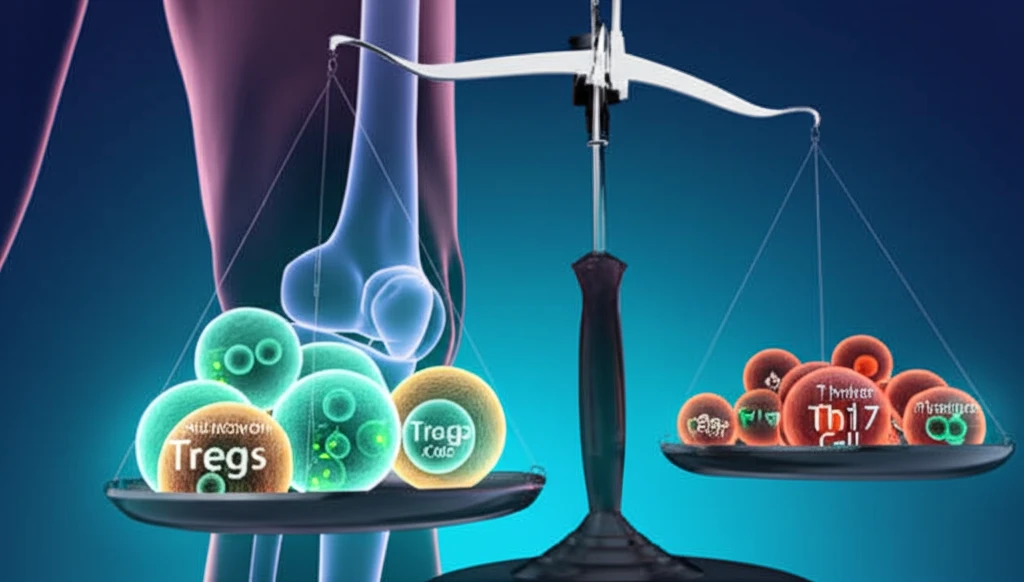
Balanced scale representing the Treg/Th17 balance in autoimmune arthritis treatment.

Unlocking Arthritis Relief: How Balancing Immune Cells Could Be the Key

"A groundbreaking look at how regulatory B cells and the Treg/Th17 balance can revolutionize autoimmune arthritis treatment."


Autoimmune arthritis is a debilitating condition affecting millions worldwide, characterized by chronic inflammation and progressive joint damage. Current treatments often focus on managing symptoms, but a deeper understanding of the underlying immune mechanisms is crucial for developing more effective therapies.

Recent research has shed light on the critical role of regulatory B cells (Bregs) in modulating the immune response. These specialized cells, particularly those expressing the transcription factor Foxp3, have shown promise in suppressing inflammation and restoring immune balance in autoimmune diseases.

A pivotal study published in the Journal of Translational Medicine explored the therapeutic potential of adoptive transfer of Foxp3-expressing Bregs in ameliorating autoimmune arthritis. The study highlighted the importance of the Treg/Th17 cell balance in this process, opening new avenues for targeted interventions.

The Crucial Role of Treg/Th17 Balance in Arthritis

Balanced scale representing the Treg/Th17 balance in autoimmune arthritis treatment.

The immune system's intricate network involves a delicate balance between different types of cells. Among these, regulatory T cells (Tregs) and T helper 17 cells (Th17) play opposing roles in maintaining immune homeostasis. Tregs suppress immune responses and prevent autoimmunity, while Th17 cells promote inflammation and defend against extracellular pathogens.

In autoimmune arthritis, this balance is often disrupted, with an overabundance of Th17 cells driving chronic inflammation and joint destruction. Restoring the Treg/Th17 balance is therefore a key therapeutic goal. The study referenced earlier emphasizes that Foxp3-expressing regulatory B cells can play a huge role in shifting that balance, mitigating the destructive effect of Th17 cells.

  • Tregs (Regulatory T Cells): Suppress immune responses, prevent autoimmunity.
  • Th17 Cells (T Helper 17 Cells): Promote inflammation, defend against pathogens.
  • Treg/Th17 Imbalance: Leads to chronic inflammation and joint damage in autoimmune arthritis.
  • Therapeutic Goal: Restore Treg/Th17 balance to alleviate arthritis symptoms.
This intricate dance between Tregs and Th17 cells determines the severity and progression of autoimmune arthritis. Understanding and modulating this balance through targeted therapies like adoptive transfer of Foxp3-expressing Bregs holds immense potential for future treatments.

The Future of Arthritis Treatment: Balancing Act

The findings highlight the potential of targeting regulatory B cells to restore immune balance in autoimmune arthritis. Further research is needed to fully understand the mechanisms involved and optimize therapeutic strategies. However, the promise of adoptive transfer of Foxp3-expressing Bregs as a novel approach to ameliorating autoimmune arthritis offers hope for those seeking long-term relief and improved quality of life. By focusing on the root causes of the disease and working with the body's natural defense mechanisms, future arthritis treatments may offer a more sustainable and effective solution.

About this Article -

This article was crafted using a human-AI hybrid and collaborative approach. AI assisted our team with initial drafting, research insights, identifying key questions, and image generation. Our human editors guided topic selection, defined the angle, structured the content, ensured factual accuracy and relevance, refined the tone, and conducted thorough editing to deliver helpful, high-quality information.See our About page for more information.

This article is based on research published under:

DOI-LINK: 10.1186/s12967-016-0980-z, Alternate LINK

Title: Erratum To: Amelioration Of Autoimmune Arthritis By Adoptive Transfer Of Foxp3-Expressing Regulatory B Cells Is Associated With The Treg/Th17 Cell Balance

Subject: General Biochemistry, Genetics and Molecular Biology

Journal: Journal of Translational Medicine

Publisher: Springer Science and Business Media LLC

Authors: Mi-Kyung Park, Young Ok Jung, Seon-Yeong Lee, Seung Hoon Lee, Yu-Jung Heo, Eun-Kyung Kim, Hye-Jwa Oh, Young-Mee Moon, Hye-Jin Son, Min-Jung Park, Sung-Hwan Park, Ho-Youn Kim, Mi-La Cho, Jun-Ki Min

Published: 2016-07-26

Everything You Need To Know

1

What is the main problem in autoimmune arthritis that the research addresses?

The primary issue in autoimmune arthritis is chronic inflammation and progressive joint damage caused by an imbalance in the immune system. Specifically, there's an overabundance of Th17 cells, which promote inflammation, leading to joint destruction. The research aims to restore the balance by targeting these cells and the overall immune response.

2

How do regulatory B cells (Bregs) help in treating autoimmune arthritis, according to this research?

The research emphasizes the role of regulatory B cells (Bregs), especially those expressing the transcription factor Foxp3, in suppressing inflammation and restoring immune balance. Researchers are exploring the adoptive transfer of these Foxp3-expressing Bregs to help mitigate the destructive effects of the overactive Th17 cells. The goal is to shift the Treg/Th17 balance, reducing inflammation and improving joint health.

3

What are the roles of Tregs and Th17 cells, and how does their balance impact arthritis?

Tregs (Regulatory T Cells) suppress immune responses, preventing autoimmunity. Th17 cells (T Helper 17 Cells) promote inflammation and defend against pathogens. In autoimmune arthritis, an imbalance occurs where there are too many Th17 cells, leading to chronic inflammation and joint damage. The goal of treatment is to restore the Treg/Th17 balance, reducing the harmful effects of Th17 cells and promoting immune homeostasis.

4

Why is restoring the Treg/Th17 balance a key therapeutic goal in managing autoimmune arthritis?

Restoring the Treg/Th17 balance is crucial because the imbalance directly contributes to the chronic inflammation and joint damage characteristic of autoimmune arthritis. When the balance is disrupted, with an overabundance of Th17 cells, the body's immune system attacks its own joints. By shifting the balance, with strategies like adoptive transfer of Foxp3-expressing Bregs, the goal is to reduce this inflammation and mitigate joint damage, providing a more effective treatment.

5

What future directions are anticipated for arthritis treatment based on this research, and what is the significance of this approach?

The research highlights the potential of targeting regulatory B cells to restore immune balance in autoimmune arthritis. The future involves further research to understand the mechanisms involved and optimize therapeutic strategies. The adoptive transfer of Foxp3-expressing Bregs offers a novel approach that focuses on the root causes of the disease and works with the body's natural defense mechanisms, offering the potential for more sustainable and effective long-term relief, and improved quality of life for those affected by autoimmune arthritis.

Newsletter Subscribe

Subscribe to get the latest articles and insights directly in your inbox.