
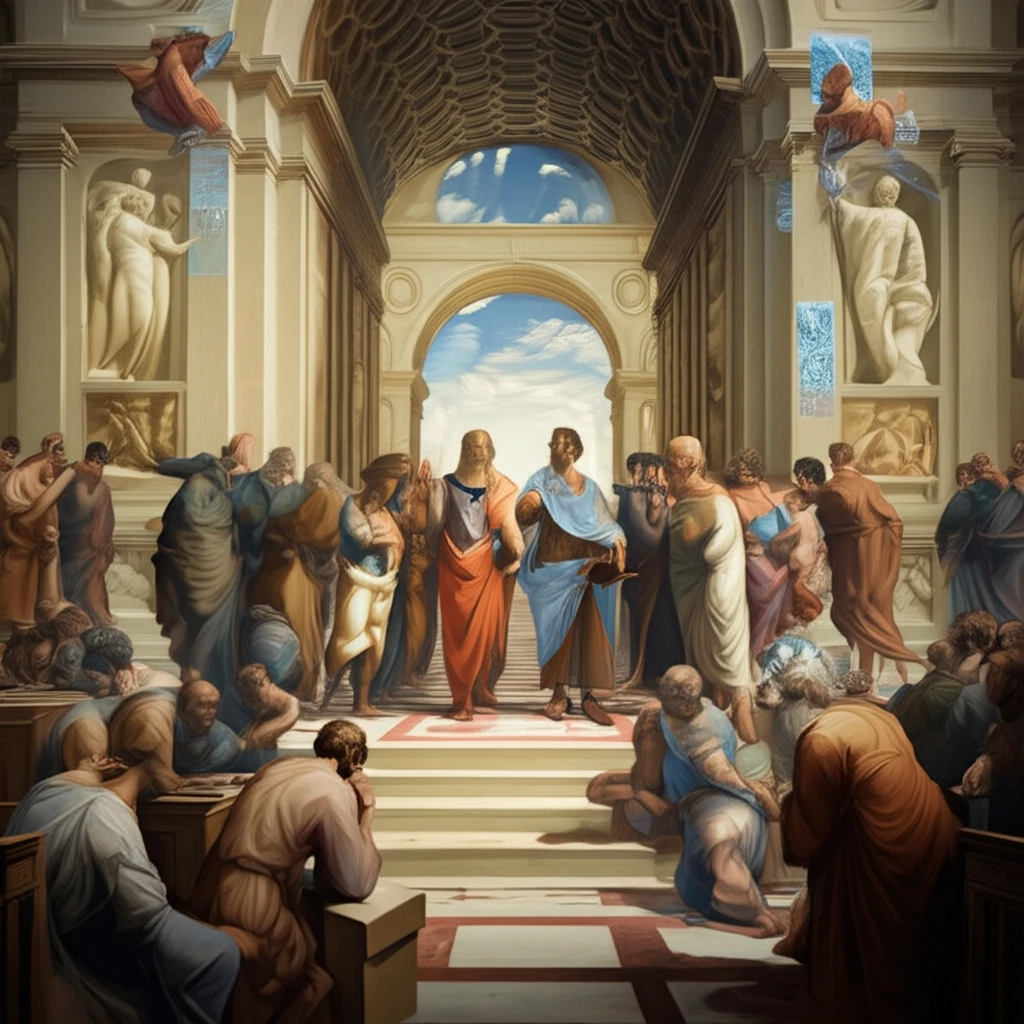
Unlocking Ancient Wisdom: How Greek Political Thought Shapes Today's World

"Explore the enduring relevance of ancient Greek political philosophy and its profound impact on modern democracies."
In the vast landscape of political philosophy, the ideas of ancient Greece stand as foundational pillars. Thinkers like Plato, Aristotle, and countless others grappled with fundamental questions of governance, justice, and the ideal society. Their insights, meticulously analyzed by scholars such as Paul Cartledge, continue to resonate in modern political discourse.
Cartledge, a renowned historian of ancient Greece, bridges the gap between historical analysis and philosophical inquiry. His work, particularly 'Political Thought in Ancient Greece,' examines the intricate relationship between theory and practice in the ancient world, offering valuable lessons for contemporary political thinkers and citizens alike.
This exploration will uncover how the core concepts debated by the Greeks – democracy, citizenship, and the role of law – still influence our understanding of politics today. By examining Cartledge's interpretations and drawing connections to current events, we gain a richer perspective on the challenges and opportunities facing modern democracies.
The Polis and the Origins of Politics
The term "politics" itself descends directly from the Greek polis, or city, whose affairs the ancient Greeks treated as a nearly boundless concern, with few if any boundaries marking off the political from the nonpolitical. As the survey of the period records, the major peculiarities of the ancient Greek political system were its fragmented nature and its particular focus on urban centers within otherwise tiny states. That fragmentation helps explain the array of political experiments the Greeks produced. Paul Cartledge's study documents how these ideas and their practice interacted dynamically from early historic times through the early Roman Empire. Roman political thought, explored through figures such as Cicero and Seneca, is often studied as a follow-up that shows how these Greek ideas evolved.
Theory and Practice as the Guiding Lens
Scholars commonly approach ancient Greek political thought by examining its relationship to practice; the Bryn Mawr Classical Review notes that Paul Cartledge structures his introduction around three "problematics," the first being the relationship between theory and practice. A recurring question in this literature is whether ancient Greece anticipated modern constitutional devices, with one explainer reading the Parthenon as a symbol of Greek democracy and political innovation that influenced modern constitutional thought, though whether the Greeks truly possessed a separation of powers remains a contested point rather than settled fact. The Stanford Encyclopedia of Philosophy adds that important developments in political thinking took place under the Hellenistic kingdoms that supplanted Macedonian suzerainty over the formerly independent Greek city-states. Methodologically, then, the field balances institutional analysis with the study of ideas as they were applied and transformed across time and place.
From Homeric Epics to the City-State World
Ancient Greek political thought reaches back to the origins of Greek civilization, when early texts such as the Homeric epics already depicted a political world of warrior-chiefs, where a quarrel could bear directly on the outcome of the Trojan War. Ancient Greece was never a unified nation but a collection of city-states, each with its own distinct political system, and it was within these small communities that ideas about governance took root. The Greeks laid foundations of governance that have shaped the Western world, from citizenship to the framing of political authority. As one wide-ranging history puts it, these ancient political texts can still speak meaningfully to citizens of the twenty-first century. Together these accounts trace a trajectory from epic-age origins, through the fragmented polis world, to systems whose legacy we still debate.
The Interdisciplinary Lens: Unveiling the Complexities of the Polis
Cartledge emphasizes the importance of an interdisciplinary approach to understanding ancient Greek political thought. It's not merely about dissecting philosophical treatises; it's about weaving together insights from history, political science, sociology, art, and literature to paint a comprehensive picture of the polis – the ancient Greek city-state.
- Democracy's Genesis: Tracing the evolution of democratic principles from their ancient roots to modern applications.
- Theories into Practice: Examining how Greek philosophical ideals were implemented (or not) in real-world political systems.
- Interdisciplinary Approach: Highlighting the need to integrate diverse fields like history, sociology, and literature for a comprehensive understanding.
- Enduring Relevance: Showcasing how ancient Greek ideas continue to inform contemporary political debates.
Testing Greek Ideas Against Practice
Current scholarship continues to test Greek political ideas against historical practice. Paul Cartledge's "Ancient Greek Political Thought in Practice," reviewed in journals such as Greece and Rome, investigates the dynamic interaction between thought and practice through carefully selected case studies spanning the early historic period to the early Roman Empire. Published in the Key Themes in Ancient History series, the book has drawn roughly three dozen reader ratings and holds a 3.91 average on Goodreads, where reviewers echo that ancient Greece was a place of tremendous political experiment and innovation and that the first serious political thinkers emerged there. Meanwhile, the journal Polis: The Journal for Ancient Greek Political Thought offers a peer-reviewed venue for continuing research in the field. Together these reflect an active and evolving research conversation rather than a settled canon.
The Exclusions and Darker Categories
Scholarly treatments of ancient Greek political thought do not present Athenian democracy as an unqualified success. Study guides on the critiques and limitations of ancient Greek democracy highlight the exclusions and structural weaknesses of the system, noting how it fell short of modern democratic ideals. Historians also stress that the Greek political vocabulary itself contains darker categories: the ancient definition of a tyrant describes a ruler who seized power outside ordinary constitutional channels, a figure Greek writers both feared and analyzed. These counterperspectives matter because they complicate any simple story of Greek democracy as a pure ancestor of modern government. Read together, they suggest the Greek achievement was as much an experiment with failure as a template for success.
Ideas in Motion Across the Greek World
Comparative study of ancient Greek political thought tends to focus on how ideas were applied and evolved within actual societal practices. The published version of Paul Cartledge's "Ancient Greek Political Thought in Practice" examines key figures, concepts, and historical contexts, showing how ideology was in turn shaped by institutions and events. By juxtaposing theory against practice across different city-states and eras, this approach reveals both continuity and divergence in Greek political life. It also invites comparison with later political systems, where similar questions of who governs and how power is checked recur in different forms.
A Timeless Legacy: Learning from the Ancients
While 'Political Thought in Ancient Greece' may be concise, it serves as a potent reminder of the enduring relevance of ancient Greek political thought. By engaging with the ideas of the past, we can gain fresh perspectives on the challenges and opportunities facing our own societies. As we navigate the complexities of the 21st century, the wisdom of the ancients offers a valuable compass for charting a course towards a more just and equitable future.
A Living Field of Debate
The study of ancient Greek political thought remains a field of interpretive debate, with no single expert consensus on how the Greeks' ideas should be read into the present. Most accounts, however, converge on the view that the Greeks inaugurated questions that political theory still asks today: what makes a good citizen, what legitimizes power, and how communities should govern themselves. Given the breadth and fragmentary nature of the surviving record, any synthesis should be treated as provisional rather than definitive. What appears durable is the conviction that these ancient debates continue to reward serious engagement.
Extending the Greek Questions Forward
Ancient Greek political thought, defined in one overview as the ideas and theories about politics, governance, and the state developed by the ancient Greeks, points toward where the field may go next. Future research is likely to extend the study of these ideas beyond the classical canon into their varied applications across the Greek world and beyond. The growing accessibility of Greek texts through digital formats and the presence of journals devoted to the subject suggest a steadily expanding research agenda. As scholars reassess the relevance of these theories for modern governance, the next frontiers probably lie in connecting Greek categories to contemporary debates rather than in recovering a single original meaning.
Translating a City-State Ethic into Modern States
The legacy of ancient Greek political thought is most visible in modern democratic theory and practice, where its concepts still shape civic education, political engagement, and the balance between individual rights and societal needs. As one study of Greek tragedy argues, the Greek idea of politics lays the foundations for our modern sense of political activity itself. That inheritance, however, is not without tensions: modern democracies must reconcile the participatory ideals inherited from Greece with the scale and pluralism of contemporary states. The systemic challenge, then, is to translate a city-state ethic into the institutional realities of nation-sized, culturally diverse societies.
Ideas With Real-World Consequences
Paul Cartledge's "Ancient Greek Political Thought in Practice" grounds its argument in carefully selected case studies that show how Greek ideas took concrete form in the lives of actual communities. The book traces the dynamic interaction between thought and practice from the early historic period to the early Roman Empire, treating political ideas not as abstractions but as forces with real-world consequences. Reviews of the work, published in the Key Themes in Ancient History series, emphasize this connection between intellectual history and lived experience. In this telling, the human stakes of Greek politics—who rules, who is excluded, and how communities hold power accountable—remain the field's most compelling point of contact with the present.