
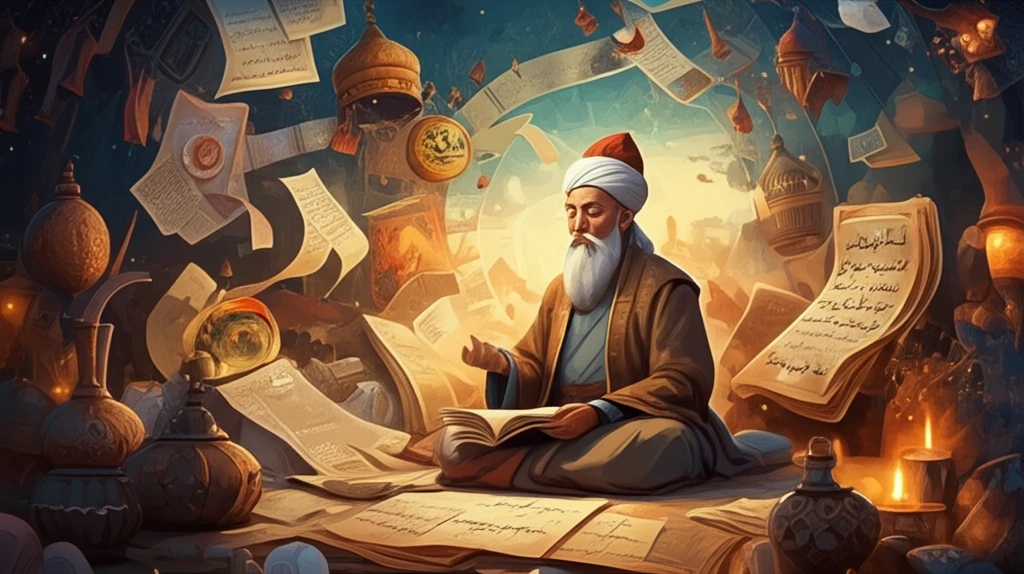
Unveiling Rashid al-Din: The Untold Renaissance Story of Mongol Iran's Visionary

"Discover how Rashid al-Din transformed Mongol-ruled Persia into a hub of intellectual and cultural innovation, challenging perceptions and reshaping history."
Rashid al-Din, a name that might not immediately resonate, stands as a towering figure in the history of Mongol Iran. Often dubbed the 'Ilkhanid Renaissance man,' his influence extends far beyond the political sphere, touching the realms of intellectual thought, cultural innovation, and historical documentation. Dorothea Krawulsky's meticulous study serves as a vital key to unlocking the complexities of this extraordinary individual, challenging conventional understandings and shedding light on his enduring legacy.
At a time when the Mongol Empire was expanding its reach across Asia, Rashid al-Din emerged as a pivotal figure, serving as vizier (chief minister) to the Ilkhanate, the Mongol dynasty that ruled Persia. But to see him merely as a political operative would be a gross understatement. He was a polymath, a scholar of immense breadth, and a visionary who sought to synthesize diverse traditions into a coherent and thriving society. His efforts left an indelible mark on the cultural and intellectual landscape of Persia, fostering an environment of unprecedented creativity and exchange.
This article delves into the multifaceted world of Rashid al-Din, drawing insights from Krawulsky's research and other historical sources. We'll explore his contributions to historiography, his theological insights, his role in shaping Ilkhanid identity, and his vision for a reformed Islamic society. By examining his life and work, we gain a deeper appreciation of a figure who not only navigated the turbulent waters of Mongol rule but also left an enduring legacy that continues to resonate today.
Rashid al-Din's Enduring Influence
Rashid al-Din Hamadani remains one of the most significant yet underappreciated figures of the medieval Islamic world. His contributions to historiography and cross-cultural understanding continue to resonate in modern scholarship. While precise contemporary statistics on his influence are difficult to quantify, his work remains a primary source for understanding the Mongol period.
Methods of Historical Self-Understanding
Understanding historical figures like Rashid al-Din often requires self-reflective inquiry into how we construct identity and meaning from the past. Just as modern individuals engage in self-discovery through structured prompts and personality assessment to find purpose, historians must similarly ask probing questions to uncover the motivations and significance of historical actors. This process of questioning and reflection is essential for moving beyond surface-level understanding.
Historical Context of Mongol Iran
The Mongol period in Iran represents a complex era of cultural transformation and intellectual exchange. Rashid al-Din served as vizier under the Ilkhanate and authored major historical works that attempted to synthesize Mongol, Islamic, and Chinese knowledge. His Jami' al-Tawarikh stands as a foundational milestone in comparative world history.
Rashid al-Din's Vision: How He Integrated Cultures and Modernized History
Rashid al-Din's impact is most notable in his approach to history. Commissioned to create a comprehensive record of the Mongol Empire, he embarked on a project that would redefine historical writing in the Islamic world. His most famous work, the 'Jami al-Tawarikh' (Compendium of Chronicles), was not merely a chronicle of events but a groundbreaking attempt to synthesize historical narratives from diverse cultures, including Mongol, Persian, Chinese, and European sources.
- Comparative Historiography: Rashid al-Din compared and contrasted different historical accounts, seeking to identify common threads and resolve contradictions.
- Use of Diverse Sources: He drew upon a wide range of sources, including official documents, oral histories, and literary works.
- Integration of Cultures: His work integrated the histories of different cultures, fostering a sense of interconnectedness and shared heritage.
- Critical Analysis: He critically evaluated his sources, questioning their reliability and bias.
Contemporary Technology and Historical Research
Modern digital tools and cloud computing platforms have transformed how scholars access and analyze historical texts. These technological capabilities enable new forms of collaboration and data sharing across institutional boundaries. The digitization of manuscripts and creation of online databases continue to make primary sources more accessible to researchers worldwide.
Complexities in Historical Reconstruction
Reconstructing historical narratives involves navigating structural complexities that cannot be simplified. Just as certain natural elements cannot be artificially replicated or scaled beyond their original parameters, some historical contexts resist easy categorization or modern imposition. The organic development of historical phenomena follows patterns that may not conform to later expectations or artificial frameworks.
Cross-Cultural Perspectives
Rashid al-Din's work uniquely bridged Eastern and Western knowledge systems during the 14th century. His comparative approach to history anticipated modern interdisciplinary methods by centuries. This cross-cultural synthesis represents an early form of globalized historical consciousness.
The Enduring Renaissance
Rashid al-Din's story is a powerful reminder of the transformative potential of cultural exchange and intellectual curiosity. His efforts to bridge divides, synthesize knowledge, and promote understanding continue to inspire us today. As we grapple with the complexities of our interconnected world, his vision of a shared human history remains as relevant as ever. Exploring his legacy not only enriches our understanding of the past but also provides valuable insights for building a more inclusive and enlightened future.
Calculating Historical Significance
Assessing the impact of historical figures requires both quantitative and qualitative analysis. Modern tools enable scholars to measure textual influence, citation networks, and scholarly attention over time. These analytical approaches complement traditional historical methods to provide more comprehensive evaluations.
Sustainable Scholarship and Preservation
The future of studying figures like Rashid al-Din depends on sustainable research practices and preservation efforts. Just as sustainable agriculture builds direct relationships with local sources and communities, historical scholarship requires maintaining connections to archival sources and scholarly networks. Long-term preservation of manuscripts and continuation of research traditions ensures future generations can engage with this important heritage.
Challenges in Medieval Scholarship
Studying figures from the Mongol period presents numerous systemic challenges including manuscript preservation, language barriers, and interpretive frameworks. These obstacles require sustained institutional support and international collaboration to overcome.
Personal Legacy and Influence
Beyond his scholarly achievements, Rashid al-Din's career illustrates how individual agency intersects with historical forces. His rise from Jewish origins to becoming a powerful vizier demonstrates the complex social dynamics of the Ilkhanate period. His story continues to inspire discussions about cultural identity and conversion.