
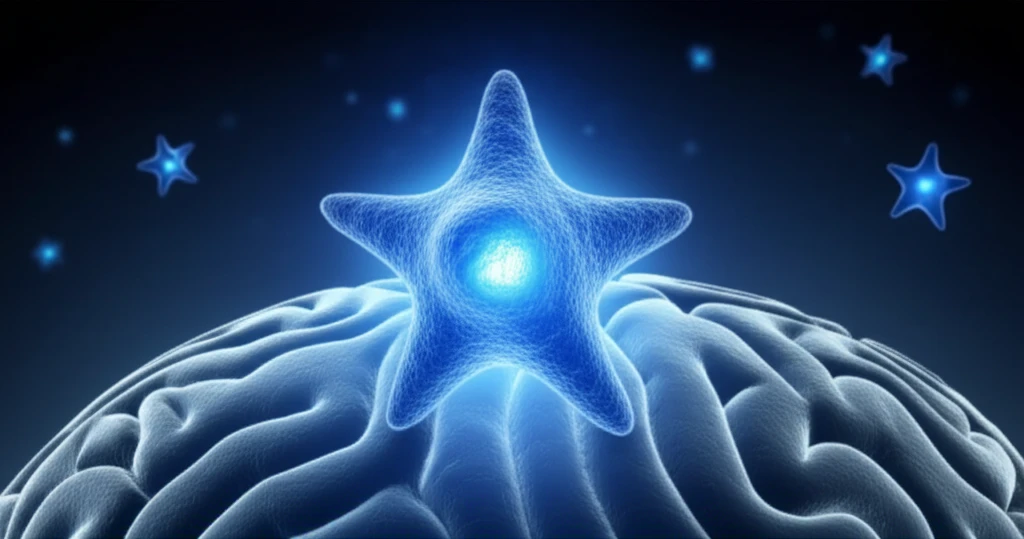
Illustration of a calming astrocyte over a brain landscape with faded amyloid plaques.

Unlocking Alzheimer's: How Calming Astrocyte Activity Could Slow the Disease

"New research reveals a key pathway in brain cells that, when modulated, significantly improves Alzheimer's-related deficits in mice, offering a promising new therapeutic avenue."


Alzheimer's disease, a devastating neurodegenerative condition, is characterized by a complex interplay of factors, including the accumulation of amyloid plaques, synaptic dysfunction, and neuroinflammation. While neurons have long been the primary focus of Alzheimer's research, a growing body of evidence suggests that astrocytes, star-shaped glial cells in the brain, play a crucial and often overlooked role in the disease's progression.

Astrocytes, normally responsible for maintaining a healthy brain environment, become reactive in Alzheimer's, exhibiting changes in morphology and gene expression. However, the specific contribution of these reactive astrocytes to the disease process has remained a subject of debate. Are they helping, hindering, or both? This new research sheds light on this question by identifying a key signaling pathway within astrocytes that appears to drive many of the detrimental effects associated with Alzheimer's.

This article dives into the details of this groundbreaking study, explaining how scientists identified and modulated the JAK2-STAT3 pathway in astrocytes, and the remarkable improvements they observed in mouse models of Alzheimer's. We'll explore the potential implications of these findings for future therapeutic interventions.

Taming Reactive Astrocytes: The JAK2-STAT3 Connection

Illustration of a calming astrocyte over a brain landscape with faded amyloid plaques.

The researchers focused on the JAK2-STAT3 signaling pathway, a cascade of molecular events inside cells that regulates gene expression. Prior work had hinted at the involvement of this pathway in astrocyte reactivity, but this study provides compelling evidence that it acts as a central control mechanism.

To investigate, the scientists used a clever genetic technique to either inhibit or activate the JAK2-STAT3 pathway specifically in astrocytes of mice. They then assessed the impact on various Alzheimer's-related pathologies. The results were striking:

  • Reduced Amyloid Plaques: Inhibiting the JAK2-STAT3 pathway led to a significant decrease in the number of amyloid plaques, a hallmark of Alzheimer's disease.
  • Improved Spatial Learning: Mice with suppressed astrocyte reactivity showed marked improvements in spatial learning and memory tasks.
  • Restored Synaptic Function: The modulation of astrocyte activity reversed synaptic deficits, which are crucial for learning and memory, restoring the ability of neurons to communicate effectively.
Conversely, when the researchers activated the JAK2-STAT3 pathway in healthy mice, they observed an increase in astrocyte reactivity and impaired synaptic function, mimicking aspects of Alzheimer's disease. This bidirectional control firmly establishes the JAK2-STAT3 pathway as a key regulator of astrocyte function in the context of Alzheimer's.

A New Hope for Alzheimer's Therapies?

This research offers a compelling rationale for targeting astrocyte reactivity as a therapeutic strategy in Alzheimer's disease. By identifying the JAK2-STAT3 pathway as a master regulator of astrocyte behavior, the study provides a specific and druggable target for intervention.

While the findings are promising, it's important to remember that this research was conducted in mouse models. Further studies are needed to validate these results in humans and to develop safe and effective therapies that can modulate the JAK2-STAT3 pathway in the human brain. However, the potential benefits are significant.

By taming reactive astrocytes and restoring their normal function, we may be able to slow the progression of Alzheimer's disease, improve cognitive function, and ultimately offer a better quality of life for individuals and families affected by this devastating condition. The future of Alzheimer's treatment may lie, in part, in understanding and modulating the complex roles of these star-shaped brain cells.

About this Article -

This article was crafted using a human-AI hybrid and collaborative approach. AI assisted our team with initial drafting, research insights, identifying key questions, and image generation. Our human editors guided topic selection, defined the angle, structured the content, ensured factual accuracy and relevance, refined the tone, and conducted thorough editing to deliver helpful, high-quality information.See our About page for more information.

This article is based on research published under:

DOI-LINK: 10.1186/s40478-018-0606-1, Alternate LINK

Title: Modulation Of Astrocyte Reactivity Improves Functional Deficits In Mouse Models Of Alzheimer’S Disease

Subject: Cellular and Molecular Neuroscience

Journal: Acta Neuropathologica Communications

Publisher: Springer Science and Business Media LLC

Authors: Kelly Ceyzériat, Lucile Ben Haim, Audrey Denizot, Dylan Pommier, Marco Matos, Océane Guillemaud, Marie-Ange Palomares, Laurene Abjean, Fanny Petit, Pauline Gipchtein, Marie-Claude Gaillard, Martine Guillermier, Sueva Bernier, Mylène Gaudin, Gwenaëlle Aurégan, Charlène Joséphine, Nathalie Déchamps, Julien Veran, Valentin Langlais, Karine Cambon, Alexis P Bemelmans, Jan Baijer, Gilles Bonvento, Marc Dhenain, Jean-François Deleuze, Stéphane H R Oliet, Emmanuel Brouillet, Philippe Hantraye, Maria-Angeles Carrillo-De Sauvage, Robert Olaso, Aude Panatier, Carole Escartin

Published: 2018-10-16

Everything You Need To Know

1

What specific pathway in brain cells was found to improve Alzheimer's-related deficits, and how does it work?

The research identified the JAK2-STAT3 signaling pathway within brain astrocytes as a key contributor to Alzheimer's disease progression. By modulating this pathway in mouse models, scientists observed a reduction in amyloid plaques, improved learning and memory, and restoration of synaptic function. This suggests that targeting astrocyte reactivity, specifically through the JAK2-STAT3 pathway, could offer a novel approach for treating Alzheimer's disease.

2

How does inhibiting the JAK2-STAT3 pathway in astrocytes affect amyloid plaque formation in Alzheimer's?

Astrocytes, normally responsible for maintaining a healthy brain environment, become reactive in Alzheimer's disease. This research indicates that by inhibiting the JAK2-STAT3 pathway within these reactive astrocytes, it's possible to reduce the formation of amyloid plaques. Amyloid plaques are a hallmark of Alzheimer's, and reducing them has been shown to improve cognitive function in mouse models. Future research should explore the long term effects and whether this reduction translates into sustained cognitive benefits.

3

In what ways does modulating the JAK2-STAT3 pathway impact synaptic function, and why is this important for Alzheimer's?

The study demonstrated that modulating the JAK2-STAT3 pathway in astrocytes could reverse synaptic deficits, which are crucial for learning and memory. Restoring synaptic function allows neurons to communicate more effectively, leading to improvements in cognitive performance. Conversely, activating the JAK2-STAT3 pathway impaired synaptic function. More research is needed to understand other factors that affect synaptic deficits.

4

Can you explain the role of the JAK2-STAT3 signaling pathway in astrocytes and how it was studied in relation to Alzheimer's?

The research focused on the JAK2-STAT3 signaling pathway, a cascade of molecular events inside cells that regulates gene expression. Scientists used genetic techniques to inhibit or activate this pathway specifically in astrocytes of mice and then assessed the impact on Alzheimer's-related pathologies. This bidirectional control firmly establishes the JAK2-STAT3 pathway as a key regulator of astrocyte function in the context of Alzheimer's. It is important to determine whether it is possible to impact upstream activators and downstream targets.

5

What implications does identifying the JAK2-STAT3 pathway as a key regulator of astrocyte behavior have for developing new Alzheimer's therapies?

By identifying the JAK2-STAT3 pathway as a master regulator of astrocyte behavior, this study provides a specific and druggable target for intervention in Alzheimer's disease. Targeting astrocyte reactivity through the JAK2-STAT3 pathway offers a potential therapeutic strategy to slow disease progression. Future research needs to determine how to safely and effectively modulate this pathway in humans and to assess the potential side effects of such interventions.

Newsletter Subscribe

Subscribe to get the latest articles and insights directly in your inbox.