
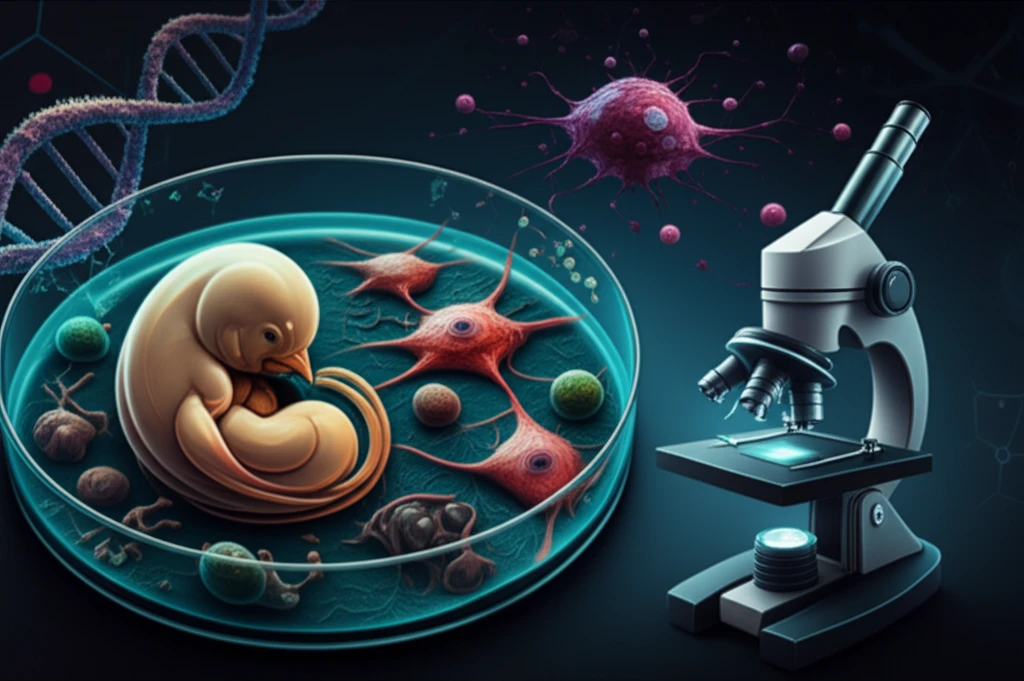
Illustration of chick embryo cells in a petri dish, symbolizing muscle dystrophy research. Shows cells with the effect of the disease, DNA and a microscope.

Unlocking a Cure: How Chick Embryo Cells Could Revolutionize Muscle Dystrophy Research

"Groundbreaking research using chick embryonic cells offers a new, accessible way to study muscle dystrophy, potentially leading to faster advancements in treatment and a better understanding of this debilitating disease."


Muscle dystrophy (MD) is a group of genetic diseases that cause progressive weakness and loss of muscle mass. These conditions, which affect millions worldwide, significantly reduce quality of life and, in severe cases, can be fatal. Despite significant research efforts, effective cures remain elusive, with current treatments primarily focused on managing symptoms.

Recent studies, detailed in the journal In Vitro Cellular & Developmental Biology - Animal, present a novel approach to understanding muscle dystrophy. Researchers are utilizing chick embryonic cells to create an in-vitro model of the disease. This innovative method promises to accelerate research, offering a more accessible and potentially more effective way to study MD and test new treatments.

This article will delve into the intricacies of this research, explaining how scientists are harnessing the power of chick embryonic cells to mimic the conditions of MD. We'll explore the potential benefits of this model, including its cost-effectiveness, ease of use, and the promise of faster progress in finding effective treatments for those affected by this devastating disease.

The Chick Embryo Model: A New Dawn for Muscle Dystrophy Research

Illustration of chick embryo cells in a petri dish, symbolizing muscle dystrophy research. Shows cells with the effect of the disease, DNA and a microscope.

The choice of chick embryonic cells as a model is rooted in their similarities to human muscle development. Vertebrate muscles develop in comparable ways, making chick embryos a relevant and accessible subject for study. Moreover, chick embryos are relatively easy to manipulate in the laboratory, offering a cost-effective alternative to other, more complex models.

In this particular study, scientists isolated myoblasts, the precursors to muscle cells, from 11-day-old chick embryos. They then cultured these cells and treated them with an antibody that disrupts a crucial protein called alpha-dystroglycan. This disruption mimics the conditions of MD by severing the connection between the cells and the extracellular matrix, a key characteristic of the disease.

  • Morphological Changes: The treated muscle cells exhibited altered shapes and structures, similar to those seen in muscle dystrophy.
  • Reduced Contractility: The cells' ability to contract was diminished, reflecting the muscle weakness associated with the disease.
  • Atrophy Observed: The cells displayed signs of wasting or shrinking, a common symptom of muscle dystrophy.
  • Gene Expression Changes: The researchers observed changes in gene expression patterns that mirrored those seen in MD patients, with some genes upregulated and others downregulated.
This approach offers a simplified, yet effective, means of investigating the disease. The ability to induce MD-like conditions in vitro allows researchers to study the disease mechanisms more closely and, crucially, to test potential treatments in a controlled environment. The relative simplicity and cost-effectiveness of this model could significantly accelerate the pace of research in the field.

Looking Ahead: The Promise of Chick Embryo Models

The research utilizing chick embryonic cells represents a promising step forward in the fight against muscle dystrophy. This innovative model provides an accessible, efficient, and cost-effective platform for studying the disease. By enabling researchers to better understand the mechanisms of MD and test potential treatments more rapidly, this research holds the potential to transform the lives of those affected by this debilitating disease. Further exploration into this approach will likely bring us closer to effective treatments and, ultimately, a cure for muscle dystrophy.

About this Article -

This article was crafted using a human-AI hybrid and collaborative approach. AI assisted our team with initial drafting, research insights, identifying key questions, and image generation. Our human editors guided topic selection, defined the angle, structured the content, ensured factual accuracy and relevance, refined the tone, and conducted thorough editing to deliver helpful, high-quality information.See our About page for more information.

This article is based on research published under:

DOI-LINK: 10.1007/s11626-018-0297-8, Alternate LINK

Title: Chick Embryonic Cells As A Source For Generating In Vitro Model Of Muscle Cell Dystrophy

Subject: Cell Biology

Journal: In Vitro Cellular & Developmental Biology - Animal

Publisher: Springer Science and Business Media LLC

Authors: Verma Urja, Kashmira Khaire, Suresh Balakrishnan, Gowri Kumari Uggini

Published: 2018-10-09

Everything You Need To Know

1

Why are chick embryonic cells useful for studying muscle dystrophy?

Chick embryonic cells are useful due to their similarities to human muscle development. Vertebrate muscles develop in comparable ways, making chick embryos a relevant subject for study. Additionally, they are relatively easy to manipulate in a laboratory setting, providing a cost-effective alternative to other models.

2

How do scientists create a muscle dystrophy model using chick embryonic cells?

Scientists isolate myoblasts (precursors to muscle cells) from chick embryos. These cells are then cultured and treated with an antibody that disrupts alpha-dystroglycan, a crucial protein. This disruption mimics the conditions of muscle dystrophy by severing the connection between the cells and the extracellular matrix, which is a key characteristic of the disease. Morphological changes, reduced contractility, atrophy and changes in gene expression patterns are then observed, mirroring muscle dystrophy.

3

What specific changes occur in chick embryonic cells when modeling muscle dystrophy?

When chick embryonic cells are used to model muscle dystrophy, several changes occur. The cells exhibit altered shapes and structures (morphological changes), similar to those seen in muscle dystrophy. Their ability to contract is diminished (reduced contractility), reflecting the muscle weakness associated with the disease. The cells display signs of wasting or shrinking (atrophy). Finally, changes occur in gene expression patterns that mirror those seen in muscle dystrophy patients, with some genes upregulated and others downregulated.

4

What is the role of alpha-dystroglycan in muscle dystrophy, and how is it addressed in the chick embryo model?

Alpha-dystroglycan is a crucial protein that connects muscle cells to the extracellular matrix, which is vital for maintaining muscle structure and function. In muscle dystrophy, this connection is disrupted. In the chick embryo model, scientists disrupt alpha-dystroglycan with an antibody, effectively severing the connection between the cells and the extracellular matrix. This disruption mimics the conditions of muscle dystrophy, allowing researchers to study the effects of this disconnection and test potential treatments.

5

What are the potential long-term implications of using chick embryo models for muscle dystrophy research, and what further research might be conducted?

The use of chick embryo models could significantly accelerate muscle dystrophy research due to its accessibility, efficiency, and cost-effectiveness. The ability to study disease mechanisms and test potential treatments more rapidly could lead to the development of more effective therapies and, potentially, a cure for muscle dystrophy. Further research might involve using the chick embryo model to test a wide range of potential drug candidates, investigate the specific genetic pathways involved in muscle dystrophy, and explore gene therapy approaches to restore alpha-dystroglycan function.

Newsletter Subscribe

Subscribe to get the latest articles and insights directly in your inbox.