
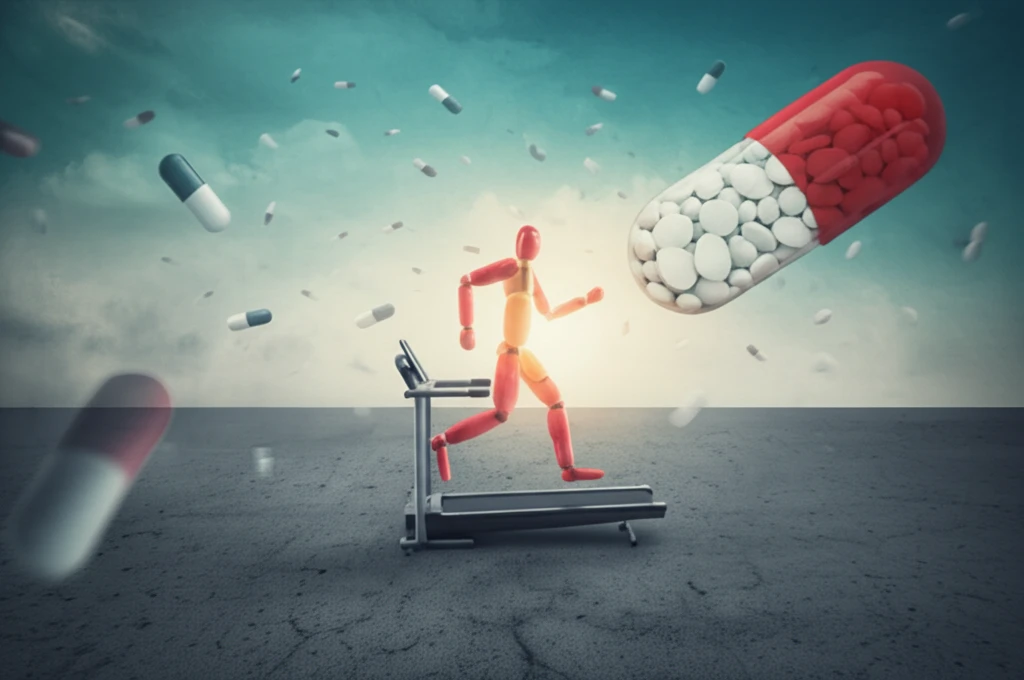
Person running on a treadmill made of pills and capsules.

Unlock Your Workout: How Medications and Exercise Interact

"Discover the hidden ways your medications can impact your fitness routine and how to optimize your health through informed exercise choices."


For centuries, medicine has been a cornerstone of treating human and animal ailments. Yet, the interplay between therapeutic drugs and physical activity remains a complex and often overlooked area. While many people instinctively reach for medication to resolve health issues, a significant portion of medical consultations result in prescriptions, reflecting a desire for a quick fix. Simultaneously, self-medication is on the rise, expanding options for health management but also introducing potential risks.

However, it's crucial to acknowledge that medication use is not without its drawbacks. Adverse drug events contribute to substantial morbidity, mortality, and economic burdens, particularly among older adults. Therefore, a rational approach to using chemical substances is essential. The field of pharmacology has advanced significantly, providing crucial insights into molecular structures and the effects of drugs through animal models.

On a parallel track, physical exercise has long been recognized for its health benefits, dating back to ancient times. The term 'exercise' has evolved from simple practice to a fundamental component of well-being, influencing functional changes in the body. Beneficial effects such as improved conditioning and increased longevity have been attributed to exercise, underscoring its importance in health management.

The Crucial Intersection: Pharmacology and Exercise

Person running on a treadmill made of pills and capsules.

Interestingly, the fields of exercise research and chemistry initially converged on the study of metabolism during physical activity. It was observed that the human body uses oxygen in conjunction with micronutrients to produce ATP, the primary energy currency of the organism. While pharmacological research has focused on optimizing active properties, metabolism, and interactions between drugs, exercise physiology has explored oxygen consumption, strength gain, and energy sources during exercise. Both disciplines have provided valuable insights into how the body adapts to various conditions.

Today, we have compelling evidence linking exercise prescriptions to the treatment and prevention of diseases. But a critical question remains: How does exercise affect the kinetics of drugs within the body? Can exercise amplify or diminish the effects of pharmacological treatments? Conversely, how do medications influence the adaptations resulting from exercise? These questions underscore the urgent need to integrate 'Pharmacology and Exercise' as a core discipline in health-related courses such as physical therapy, physical education, and medicine.

  • Biotransformation, Distribution, and Excretion: How exercise changes the way drugs are processed and eliminated by the body.
  • Pharmacokinetics and Pharmacodynamics: The modification of drug actions and effects due to physical activity.
  • Physiological Variables: The impact of pH, temperature, cardiac output, and hormones during exercise on drug effects.
  • Adverse Effects: Understanding how medications influence autonomic control, hemodynamic responses, and micronutrient availability during exercise.
  • Drug Interactions: Studying the effects of drugs on dehydration, fatigue, and weakness experienced during exercise.
Integrating pharmacology into the study of exercise provides a holistic view of how drugs interact with the body's physiological responses to physical activity. This knowledge is invaluable for health professionals, offering a deeper understanding of drug actions, receptor interactions, and dose-response relationships. Moreover, it emphasizes the importance of considering the impact of treatments on both acute and chronic responses to exercise.

A Call to Action: Integrating Knowledge for Better Health

Given the global rise in physical inactivity and pharmaceutical consumption, it is imperative to enhance our understanding of how exercise and drugs interact. By increasing research and teaching on the combined effects of exercise and pharmacological therapy, we can better serve public health needs and promote optimal outcomes. It is essential to improve the quality and quantity of studies in this vital field, recognizing exercise as a powerful tool that, when combined with pharmacological agents, can lead to synergistic benefits.

About this Article -

This article was crafted using a human-AI hybrid and collaborative approach. AI assisted our team with initial drafting, research insights, identifying key questions, and image generation. Our human editors guided topic selection, defined the angle, structured the content, ensured factual accuracy and relevance, refined the tone, and conducted thorough editing to deliver helpful, high-quality information.See our About page for more information.

This article is based on research published under:

DOI-LINK: 10.4172/2165-7025.1000e128, Alternate LINK

Title: Pharmacology And Exercise: An Essential Discipline And Research Area In Health Courses

Subject: General Medicine

Journal: Journal of Novel Physiotherapies

Publisher: OMICS Publishing Group

Authors: Thiago Gomes Heck

Published: 2013-01-01

Everything You Need To Know

1

Why is understanding the interaction between medications and exercise so important?

The interaction between medications and exercise is crucial because it directly impacts the effectiveness of workouts and the overall health outcomes. Medications can influence how the body responds to exercise, affecting physiological variables and potentially leading to adverse effects. Conversely, exercise can alter how the body processes and eliminates drugs, a concept related to biotransformation, distribution, and excretion. Considering both Pharmacology and Exercise offers a holistic approach to health, allowing for informed decisions that optimize the benefits of both interventions and minimize risks.

2

How can exercise affect the way my body processes drugs?

Exercise can significantly impact the processing of drugs within the body by influencing several key factors. These include biotransformation, distribution, and excretion. For example, increased blood flow during exercise can alter drug distribution, potentially affecting how quickly a drug reaches its target site. Also, changes in metabolism and organ function during exercise can influence how the body breaks down and eliminates drugs, ultimately affecting their concentration and duration of action. Understanding these effects is vital for optimizing drug dosages and timing in relation to exercise sessions.

3

What are some examples of the physiological variables that can be affected by both exercise and medications?

Several physiological variables are affected by both exercise and medications, impacting drug effects. These include pH levels, body temperature, cardiac output, and hormone concentrations. Exercise, for instance, can lead to changes in pH due to the production of lactic acid, while medications can affect these variables. For example, some drugs might alter heart rate or blood flow, which are crucial during physical activity. The combined effect of these variables and medications requires a careful approach to managing health and exercise routines.

4

In what ways can medications influence my body's response during exercise?

Medications can influence the body's response to exercise in several ways, potentially leading to a range of effects. They can impact autonomic control, altering heart rate and blood pressure responses. They can also affect hemodynamic responses, influencing blood flow and oxygen delivery to working muscles. Additionally, medications can affect micronutrient availability, influencing energy production and muscle function. Understanding these potential effects is essential for modifying exercise intensity, duration, and type to avoid adverse effects and achieve optimal training results. This is studied through the discipline of Pharmacology and Exercise

5

What specific areas of study are essential for understanding the combined effects of drugs and exercise?

To fully understand the combined effects of drugs and exercise, several key areas of study are essential. These include the study of biotransformation, distribution, and excretion, which examines how exercise alters drug processing and elimination. Another crucial area is pharmacokinetics and pharmacodynamics, which investigates the modification of drug actions and effects due to physical activity. Analyzing how physiological variables like pH, temperature, cardiac output, and hormones influence drug effects during exercise is also important. Finally, studying adverse effects and drug interactions during exercise, such as the impact on dehydration, fatigue, and weakness, is critical for ensuring safety and efficacy. Integrating these areas provides a complete view of how Pharmacology and Exercise interact.

Newsletter Subscribe

Subscribe to get the latest articles and insights directly in your inbox.