
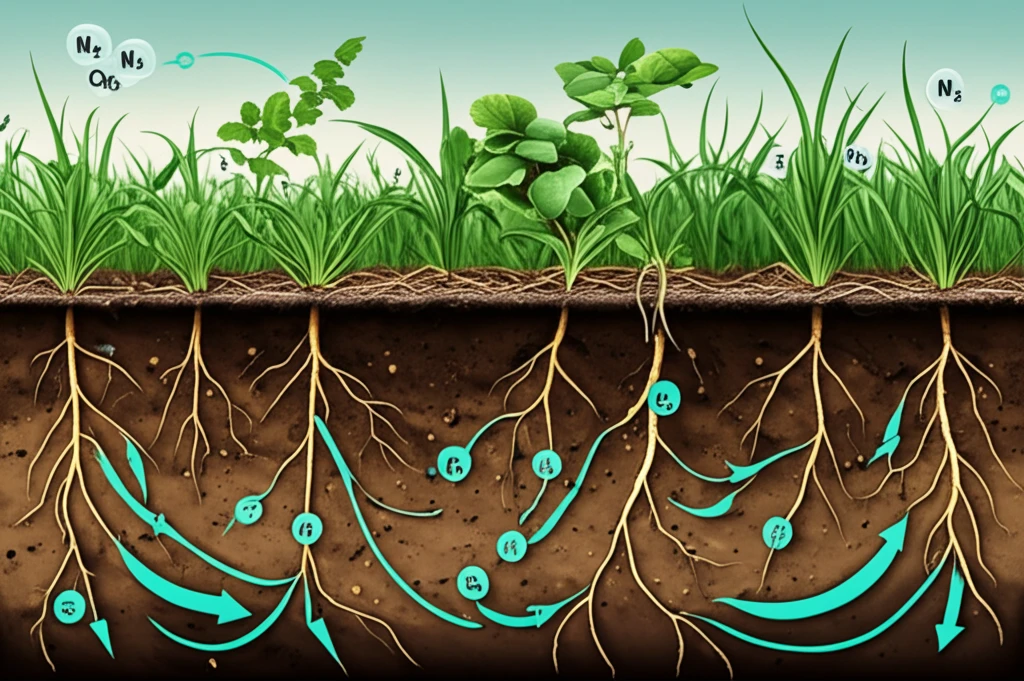
Unlock Your Soil's Potential: How No-Till Farming Impacts Nitrogen Dynamics

"Discover the secrets to healthier soil and reduced environmental impact with no-till farming practices."
In an era where sustainable agriculture is not just a buzzword but a necessity, understanding the intricate dynamics of soil is more critical than ever. Traditional soil preparation methods, particularly in temperate climates, often involve tilling—a practice that, while serving immediate agricultural needs, can disrupt the natural soil ecosystem. However, in tropical climates, where the natural fertility of the soil is often limited, intensive tilling can accelerate the oxidation of organic matter, leading to soil degradation.
Enter no-till farming, a method that champions the preservation of soil structure and the enhancement of soil health through the maintenance of crop residues. This approach not only shields the soil from erosion but also fosters an environment conducive to increased organic matter, improved chemical conditions, enhanced physical properties, and thriving biological activity. The cornerstone of no-till farming lies in its ability to alter the dynamics of nitrogen (N) within the soil, a nutrient vital for plant growth and overall ecosystem health.
Nitrogen, an essential element for plant life, exists in the soil in various forms, primarily bound within organic compounds. The transformation of this organic N into inorganic forms, such as ammonium and nitrate, is a process known as mineralization—a key factor influencing soil fertility and plant nutrition. Understanding how no-till farming affects this process, as well as other N-related processes like denitrification, is crucial for optimizing crop yields and minimizing environmental impacts.
No-Till's Measurable Benefits for Soil
No-till farming reduces soil erosion, retains moisture, and improves soil structure and organic matter content. These practices also increase the water-holding capacity of soil and help conserve and regulate moisture within it, such as by controlling water infiltration. Because of these effects, no-till practices have emerged as an effective tool in balancing nutrient management and maximizing nitrogen use.
From Tillage to Zero Tillage
No-till farming, also known as zero tillage or direct drilling, is an agricultural technique for growing crops or pasture without disturbing the soil through tillage. In contrast, plants that cannot fix nitrogen must pull it from the soil, depleting the soil in the process, which makes nitrogen-based fertilizers one of the single most important additives in modern farming. This makes the interaction between tillage method and nitrogen management a central concern for soil fertility.
Foundations in Nitrogen Science
Understanding the nitrogen cycle is foundational to no-till nitrogen management, and nitrogen itself was originally formed in the hearts of stars through the process of nuclear fusion. No-till farming emerged as a technique for growing crops or pasture without disturbing the soil through tillage, marking a fundamental shift from conventional soil disturbance. The approach has since been recognized for keeping organic material in the soil and reducing water erosion.
The Science of No-Till and Nitrogen: A Deep Dive
A recent study conducted in Tibagi, Paraná State, Brazil, offers valuable insights into how the duration of no-till farming and different crop successions influence soil nitrogen dynamics. The experiment, set in a clayey Oxisol—a common soil type in tropical regions—compared areas under no-till management for 12 and 22 years, with crop rotations of corn/wheat and soybean/wheat. Researchers meticulously analyzed soil N stocks, inorganic N levels, and the rates of N mineralization and denitrification.
- Longer no-till duration increases soil N stocks.
- Crop succession significantly impacts N₂O emissions.
- Inorganic N levels rise with prolonged no-till adoption.
- Net mineralization and nitrification rates improve under long-term no-till.
Field Nitrogen Dynamics Under Management
Field nitrogen dynamics critically influence nitrogen availability for crops, especially under varying soil and management conditions. Research on potentially mineralizable soil nitrogen and indices of nitrogen availability helps assess how much nitrogen crops can access. These dynamics determine whether applied nitrogen becomes a valuable fertility resource or a potential pollutant.
Recognizing No-Till's Trade-Offs
The use of no-till farming has both negative and major plus points, according to industry commentary. Its advantages include reducing the impact on the soil, keeping organic material in the soil, and reducing water erosion and the temperature of the soil. However, the acknowledged negative aspects indicate that the practice is not without drawbacks and must be managed carefully.
No-Till Versus Deep Plowing
No-till farming avoids the need for deep plowing to control weeds, which was made possible with improved varieties of crops introduced in 1996. No-to-low-till practices improve soil health and reduce erosion compared with conventional tillage. No-till has also reduced herbicide run-off into streams, an additional environmental benefit relative to tilled systems.
Looking Ahead: Sustainable Farming for the Future
As we move towards a future where sustainable agricultural practices are paramount, understanding and optimizing soil nitrogen dynamics will be essential. No-till farming, with its potential to enhance soil health, reduce erosion, and sequester carbon, offers a promising pathway towards more sustainable food production systems. By embracing these practices and continuing to explore the complex interactions within the soil ecosystem, we can unlock the full potential of our agricultural landscapes and ensure a healthier planet for generations to come.
A Balanced Tool for Soil Health
No-till practices have emerged as an effective tool in balancing nutrient management and maximizing nitrogen use while improving soil structure and organic matter content. Environmental science professor Bill Clark at the American University in Bulgaria made an analysis concluding that the benefits of no-till farming for the environment are even greater than planting trees. Taken together, expert commentary frames no-till as a significant lever for soil and climate health.
Managing Nitrogen as a Dual Resource
Nutrients in manure are potentially valuable resources for the management of soil fertility, but these nutrients are potential pollutants as well. Field nitrogen dynamics will continue to shape nitrogen availability for crops under varying soil and management conditions. Future progress depends on managing nitrogen inputs within no-till systems to capture their fertility value while limiting environmental harm.
Balancing Fertility and Pollution Risk
The central systemic challenge of no-till nitrogen management is that the same nutrients that build soil fertility can become pollutants when mismanaged. No-till reduces soil erosion and retains moisture, but it also changes how nitrogen moves through the soil profile. Addressing this requires integrating nutrient management with tillage decisions rather than treating them in isolation.
Feeding Crops Without Depleting Soil
Plants that cannot fix their own nitrogen must instead pull it from the soil, depleting the soil in the process, which makes nitrogen-based fertilizers one of the single most important additives in modern farming. No-till farming reduces soil erosion, retains moisture, and improves soil structure and organic matter content, helping farmers sustain productivity. By keeping organic material in the soil, no-till directly supports the nitrogen supply that crops depend on season after season.