
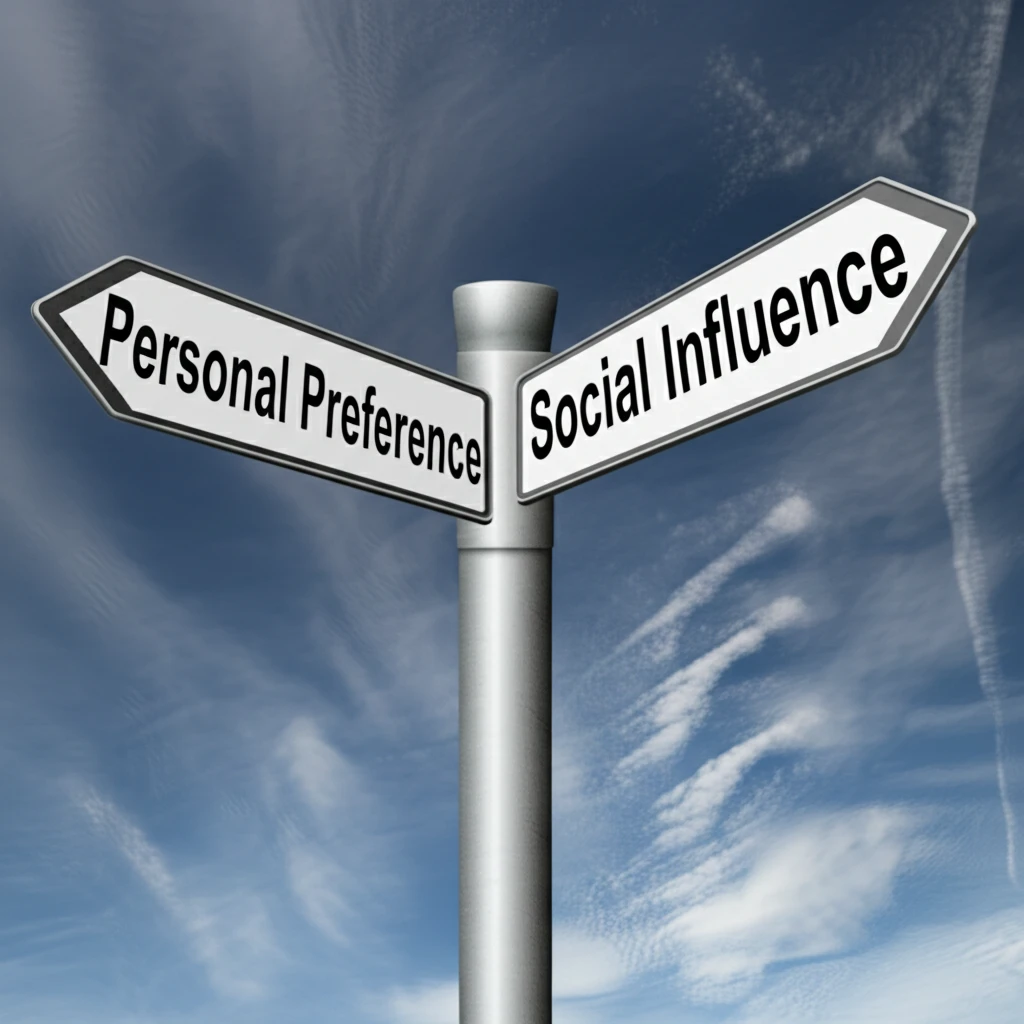
Unlock Your Potential: How Social Learning and Personal Preferences Shape Your Choices

"Discover the fascinating interplay between what you want and what others do, and how this balance influences everything from art appreciation to answering tough questions."
We've all been there: deciding what to wear, which news sources to trust, or what product to buy. While we might think these decisions are solely based on our individual tastes and needs, a powerful force is often at play: social learning. This means that we're influenced by the actions and opinions of those around us. But how do we balance our own preferences with what society suggests? It's a question that lies at the heart of understanding human behavior.
Deciphering the weight of personal tastes versus social influence is complex. Imagine trying to figure out if someone likes a particular style of music because they genuinely enjoy it, or because their friends do. It's even trickier because we tend to gravitate towards people who share our tastes, making it hard to separate genuine preference from peer influence. So, how can we truly understand what drives our decisions?
New research combines experimental data with advanced modeling techniques to disentangle the effects of intrinsic preferences and social learning. The findings reveal that both factors are always at play, but their relative importance shifts depending on the situation. Understanding this dynamic can provide valuable insights into why we make the choices we do, and how social norms are formed.
Social Learning in Modern Life
Social learning—the process by which people acquire new behaviors, attitudes, and knowledge through observing and interacting with others—plays an increasingly prominent role in education, organizational behavior, and digital communities. As societies become more interconnected through technology, the volume and speed at which individuals learn from peers have grown substantially. Understanding how social influences shape personal choices is critical for educators, policymakers, and individuals seeking to make more informed decisions. While precise global statistics on social learning adoption vary widely across contexts, its centrality to human development is broadly recognized across psychological and educational research.
Social Learning Algorithms and Their Trade-Offs
Cognitive neuroscience research has identified two principal computational algorithms for social learning: value shaping (VS), in which individuals integrate others' experiences to update their own preferences, and decision biasing (DB), in which social information directly shifts choice behavior. While these mechanisms can accelerate collective decision-making, they also carry inherent tensions between efficiency and flexibility—particularly in rapidly changing environments. Formal decision-aiding approaches face serious criticisms, many of which also apply to informal social decision-making processes that lack structured analysis. Additionally, Bandura's social learning theory has been critiqued for overemphasizing observational learning while underestimating the roles of innate factors, trial-and-error, and individual differences in shaping behavior.
The Roots of Social Learning Theory
Social learning theory has its intellectual roots in behaviorist psychology, which emphasized reinforcement and conditioning as drivers of behavior. A pivotal shift came with Albert Bandura's work in the 1960s and 1970s, most famously the Bobo doll experiments, which demonstrated that children could acquire aggressive behaviors simply by observing adult models—without direct reinforcement. Bandura's framework established that learning is a cognitive process occurring within a social context, achievable through observation or instruction alone, not solely through direct experience. This represented a major departure from strict behaviorism and laid the foundation for what Bandura later expanded into Social Cognitive Theory, incorporating concepts like self-efficacy and reciprocal determinism.
Decoding the Decision-Making Process: Preferences vs. Social Learning
The study's core innovation lies in its method for separating intrinsic preferences from social influence. Researchers designed experiments where participants made choices in different scenarios, both with and without knowledge of others' decisions. For example, participants were asked to choose between two works of art, or to answer knowledge-based questions. Crucially, the researchers also measured the strength of individual preferences beforehand, allowing them to predict how someone would choose in the absence of social influence.
- Preferences matter most in subjective choices: When faced with decisions based on personal taste, like choosing art, individuals were more likely to rely on their own intrinsic preferences.
- Social learning dominates objective tasks: In situations with a clear right or wrong answer, people tended to prioritize social learning, conforming to the choices of others.
- Reward and punishment alter the balance: When people expected to be rewarded for their choices, intrinsic preferences became even more influential. Conversely, the threat of punishment amplified social learning and conformity.
New Findings on Social Learning Flexibility
A 2025 study published in Nature Scientific Reports found that children who learned through trial-and-error (asocial learning) demonstrated more flexible problem-solving compared to those who relied on social learning, marking the first empirical evidence of this particular advantage of independent learning. Research published in PNAS in late 2025 further explored how social learning algorithms like value shaping and decision biasing can either enhance or undermine collective decision-making efficiency, depending on environmental demands. Meanwhile, the integration of machine learning techniques into social sciences is reshaping traditional research methodologies, opening new paradigms for analyzing decision-making processes and behavioral patterns across populations.
Criticisms of Social Learning Theory
A central critique of Bandura's social learning theory is its heavy reliance on observational learning, which critics argue oversimplifies the complex nature of real-world behavior that typically involves a blend of observation, trial-and-error, and direct instruction. The theory has also been faulted for omitting innate biological factors and failing to adequately account for individual differences in how people learn and respond to social stimuli. Despite these limitations, social cognitive theory remains widely taught and applied because it captures genuinely important aspects of observational learning, self-belief, and behavior change that competing theoretical frameworks do not fully address. The ongoing debate highlights that no single theory comprehensively explains the full range of human learning processes.
Social Comparison and Neural Decision Mechanisms
A systematic review spanning over three decades of research on social comparison in decision-making has synthesized how individuals evaluate themselves relative to others when making choices, filling a significant gap in the academic literature on this topic. Neuroscience research has revealed that social learning and decision-making rely on orchestrated interactions across multiple brain regions, with the inference about others' behaviors being dynamically updated during social interactions. Studies on the neuroscience of social comparison show that when people engage in comparison with others, they seek information about similarities and differences largely to improve their own self-evaluation, with this process involving distinct neural pathways specialized for social judgment under uncertainty.
Navigating the Social Landscape: Implications for Polarization and Beyond
The study's findings have important implications for understanding how social norms are formed and how behaviors can become polarized. The simulations showed that in situations where people expect punishment, conformist social learning is reinforced. This can lead to echo chambers and entrenched beliefs, making it difficult for new ideas to gain traction. Conversely, environments that encourage individual expression and reward independent thinking can foster greater diversity and innovation. By understanding the factors that influence our choices, we can create environments that promote both individual autonomy and collective well-being.
Opinion Formation in Networked Social Learning
Traditional social learning models assume agents exchange full belief information with neighbors while inferring the true state of nature, but real-world networks involve partial and random information sharing that complicates this process. Research from EPFL has developed frameworks studying opinion formation and decision-making over graph-topology networks, where agents observe data and interact selectively with neighbors. These models reveal that the structure of social connections fundamentally shapes how opinions converge or diverge within a group. Deep learning-based sentiment analysis methods, such as attention-based approaches, are now being applied to extract and explain social opinions from text data, bridging computational methods with social learning theory to provide more transparent crowd decision-making processes.
Emerging Directions in Social Learning Research
The intersection of machine learning and social science research promises to fundamentally alter how researchers study decision-making processes and behavioral analysis, with computational methods enabling analysis at scales previously impractical. Future research will likely focus on better isolating the specific social cues—such as competence and predictability—that drive adaptive social decision-making, addressing current methodological confounds identified in existing paradigms. As digital platforms continue to medate social interaction, understanding how algorithmic environments shape social learning processes will become an increasingly urgent area of inquiry. The development of more nuanced computational frameworks that account for both the benefits and risks of social information-sharing represents a critical frontier for the field.
Structural Barriers to Effective Social Learning
While social learning offers powerful mechanisms for knowledge transfer and behavior change, systemic challenges persist in ensuring these processes lead to positive outcomes rather than the reinforcement of harmful norms or misinformation. The balance between conforming to group knowledge and maintaining independent critical thinking remains a fundamental tension in educational and organizational contexts. Rapid sociocultural and technological change further complicates this balance, as the speed of information flow can outpace individuals' capacity to critically evaluate what they learn from social sources. Addressing these challenges requires interdisciplinary approaches that draw on psychology, neuroscience, education, and technology design to create environments that support adaptive rather than maladaptive social learning.
Social Learning in Community and Practice Settings
Participatory action research involving community residents and academic researchers has demonstrated that social learning dynamics within collaborative teams are essential for translating knowledge into real-world impact, particularly in studies exploring relationships between urban development and community health. Case study methodologies serve as microcosms of real-world challenges, bridging theory and practice by presenting unscripted situations where clients' needs, societal systems, and personal biases intersect—providing learners with safe spaces to practice decision-making under pressure. These real-world applications underscore that social learning is not merely an abstract psychological concept but a lived process with tangible consequences for communities, professionals, and the people they serve. The reflective documentation of collaborative learning processes offers valuable lessons for educators and practitioners seeking to harness social learning more effectively.