
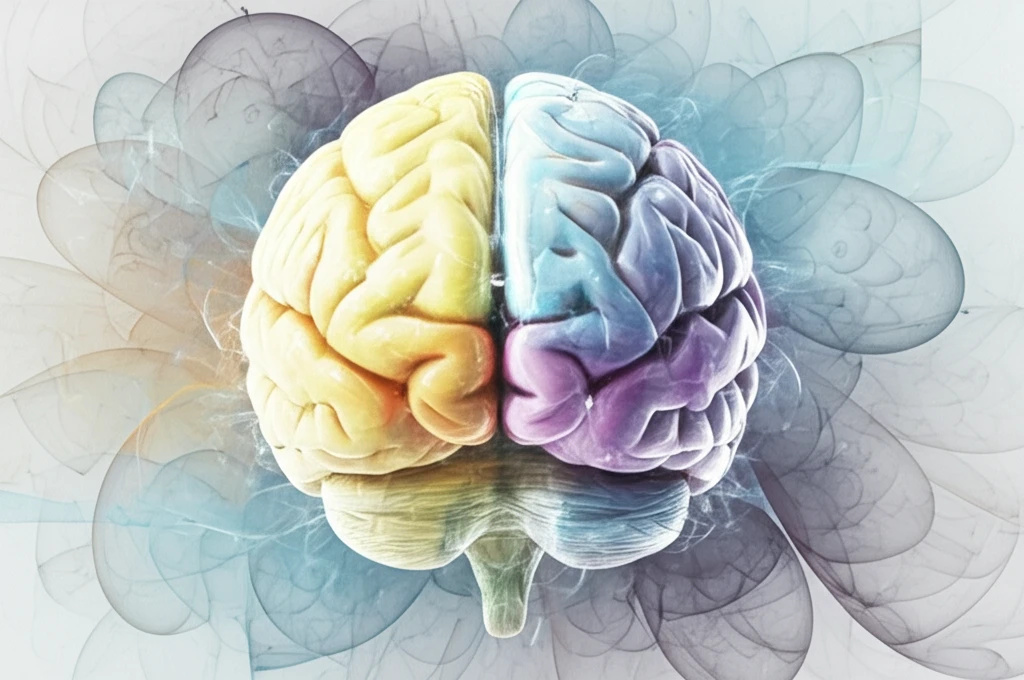
Unlock Your Mind: How Simplicity and Complexity Fuel Creative Breakthroughs

"Discover the surprising dance between simplification and complexification that sparks innovation and deeper understanding in math, art, and everyday life."
In a world obsessed with efficiency and streamlined solutions, the pursuit of simplicity often takes center stage. We're told to declutter our lives, simplify our routines, and focus on the essential. But what if the key to true understanding and innovation lies not in shunning complexity, but in embracing its intricate dance with simplicity?
This article delves into the fascinating relationship between simplification and what the author calls “complexification.” Inspired by mathematical and artistic concepts, we'll explore how these seemingly opposing forces work together to fuel creative breakthroughs and deeper insights.
Think of it as a constant back-and-forth, a spiraling journey where simplifying a problem often requires first diving into its complexities, and vice versa. Let's explore how this dynamic interplay manifests in various fields, from mathematics to art, and how you can harness it to unlock your own creative potential.
Current Landscape
Creative breakthroughs increasingly depend on navigating the tension between simplicity and complexity in modern problem-solving. Research suggests that teams and individuals who master this balance produce more innovative outcomes across disciplines. The growing complexity of global challenges demands new frameworks for integrating these seemingly opposing forces.
Conventional Wisdom
Traditional approaches often treat simplicity and complexity as a binary choice rather than complementary forces. Many methodologies prioritize reductionism or comprehensive analysis in isolation, missing the dynamic interplay that drives creative insight. These frameworks frequently fail to account for how simple rules can generate complex emergent behaviors.
Historical Foundations
The history of complexity science reveals that macroscopic complexity consistently emerges from simple micro-level interaction rules, a pattern recognized across decades of research. Complexity science as a field grew by integrating lessons from diverse efforts rather than following a single theoretical lineage. The universe's current complexity represents accumulated transformations from an originally simple state, not an initial condition of complexity. Major milestones in systems and complexity theory trace turning points that continue to shape contemporary understanding of this relationship.
The Yin and Yang of Ideas: Why Simplicity Needs Complexity
The traditional view often presents simplification as a linear path – a process of whittling away the unnecessary to reveal the core essence. However, this perspective overlooks a crucial element: the role of exploration and experimentation in truly understanding something. Imagine trying to explain a complex mathematical theorem without first grappling with its intricate details and various potential solutions.
- Exploration First: Complexification allows you to explore different perspectives and approaches.
- Deeper Understanding: You gain a more nuanced grasp of the subject matter.
- Innovation Catalyst: By understanding the complexities, you're better equipped to identify innovative solutions and connections.
Current Research Frontiers
Recent work demonstrates that clinically established hydrogels achieve versatility through model-driven modular design that balances simplicity with functional complexity. Psychological research confronts a Precision-Breadth-Simplicity impossible trinity where studies cannot simultaneously achieve precision, broad scope, and simplicity due to human cognitive limitations. Experimental findings often remain narrow when prioritizing precision and simplicity together. Perceived complexity can be predicted from remarkably few features, suggesting complexity itself may have a simple underlying structure.
Limits of Simplicity
The relationship between simplicity and complexity requires understanding simplicity itself before determining how the two interact. Wellness approaches that oversimplify risk stripping away critical redundancy that provides resilience in complex systems. Oversimplification can constrain understanding, problem-solving abilities, and creative potential across multiple domains. Both simplicity and complexity are unavoidable and often co-dependent rather than opposing ideals.
Contrasting Frameworks
The debate between simplicity and complexity advocates often mischaracterizes both positions, with simplicity proponents emphasizing ease of use while complexity advocates value powerful behavior. Simplicity focuses on essence and clarity, whereas complexity involves multiple interconnected parts that challenge understanding and execution. Making things easier for users frequently requires underlying complexity in design and implementation. Key principles across philosophy, science, and engineering favor simplicity as a heuristic but recognize its limits when confronting genuinely complex problems.
Embrace the Spiral: A New Way to Think About Problem-Solving
Instead of viewing simplicity and complexity as opposing forces, consider them as partners in a dynamic dance. Embrace the messy, exploratory phase of complexification as a necessary step towards achieving true understanding and innovative solutions. By allowing yourself to delve into the intricacies, you'll be better equipped to distill the essence and unlock your full creative potential. Don't be afraid to get lost in the details – it's often in the depths of complexity that the seeds of simplicity are sown.
Expert Synthesis
People employ opponent heuristics in explanatory reasoning, using simplicity as a cue to prior probability while treating complexity as a signal of goodness-of-fit. Simplicity concerns only hypothesis form rather than the nature of observations, requiring coordination with other assessment mechanisms for robust explanation. Notions of complexity and simplicity cut across disciplinary boundaries, epistemological frameworks, and political affiliations rather than belonging to specific schools of thought. True mastery manifests as the ability to distill knowledge to its essence, with historical figures like Newton and Darwin exemplifying this clarifying capacity.
Emerging Trends
Enterprises face naturally accumulating complexity from new products, customer channels, regulations, and technology tools, making simplicity a strategic imperative. The technological landscape in 2025 is being reshaped by a drive for simplicity, efficiency, and connectivity across sectors. In increasingly uncertain environments, simplicity is shifting from operational preference to competitive advantage. Organizations that manage complexity through intentional simplification gain strategic leverage in volatile markets.
Systemic Tensions
Systems designed for simplicity often confront complexity in practice, as seen in healthcare walk-in clinics pushed beyond their intended scope by growing demands for timely access. Limited access to primary care and increasing healthcare demands create systemic tensions between design intent and operational reality. Systems thinking and systemic design provide frameworks for identifying leverage points and creating adaptive solutions that work with rather than against complexity. Strategic planning increasingly requires systemic perspectives that recognize interconnected factors shaping organizational success.
Human-Centered Cases
Real-world innovation demonstrates that radical simplicity can achieve massive scale where complex AI-driven approaches struggle, as shown by the Haven Lantern case study. Design elements enhancing orientation and structure enable complex objects to be perceived as simple, directly improving usability through both visual and perceived simplicity. Case studies across industries reveal that sustainability initiatives succeed when they navigate the interplay between complexity and simplicity rather than pursuing either extreme. Nature consistently demonstrates that complexity requires simplicity as a foundational design principle for robust, innovative solutions.