
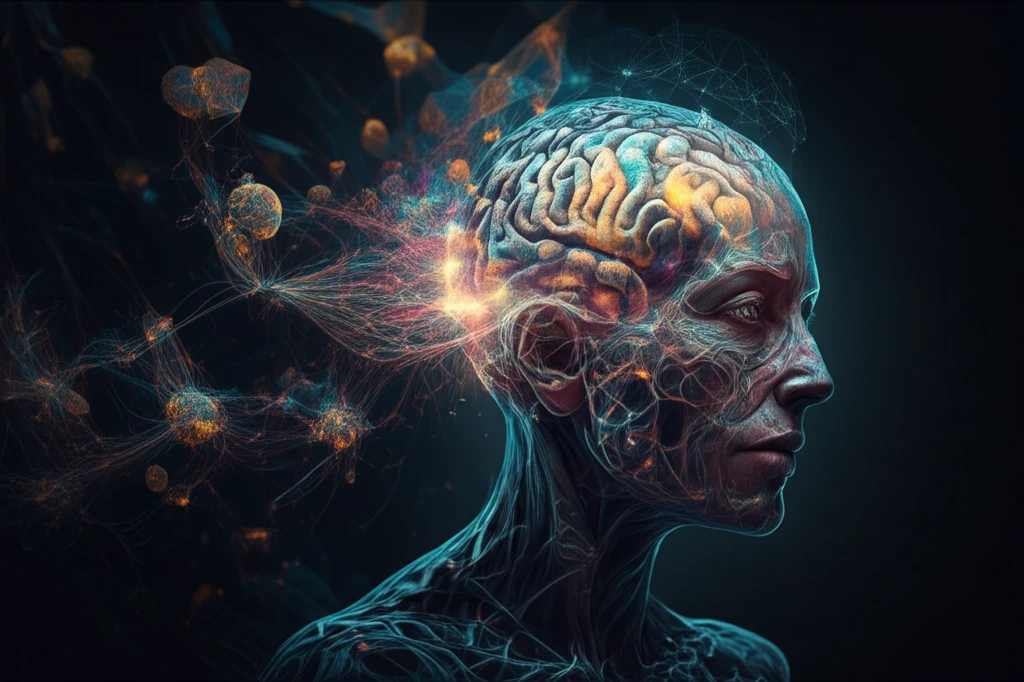
Unlock Your Inner Genius: How Creative Aging Rewires Your Brain

"New research reveals the surprising ways our brains adapt and thrive creatively as we age, opening doors to innovative thinking and personal growth."
For decades, the prevailing narrative around aging focused on decline – a gradual fading of cognitive abilities and creative spark. However, groundbreaking research is challenging these assumptions, revealing that the aging brain is not only capable of creativity but can even experience a surge in innovative thinking. This phenomenon, often referred to as "creative aging," highlights the brain's remarkable ability to adapt and rewire itself throughout our lives.
The key lies in understanding the intricate dance between different brain networks. In youth, creative thinking is often associated with strong connectivity between the executive control network (responsible for focus and planning) and the default mode network (linked to imagination and free-flowing thought). As we age, this connectivity pattern can shift, leading to new pathways for creative expression.
This article explores the science behind creative aging, drawing upon the latest neuroimaging studies to uncover the brain networks involved. We'll delve into how these networks change with age and, most importantly, how you can harness your brain's potential to unlock your own inner genius, regardless of age.
A Global Population Shift
Statistics point to a dramatic global shift in the coming decades. The population aged 80 and older is expected to triple to 426 million by 2030, while the 65-and-older population will keep expanding worldwide, reshaping healthcare, workforces, and budgets. In the United States, the CDC reports that the number of older individuals in the noninstitutionalized population has grown over the last five decades and is projected to continue growing. Taken together, these figures frame population aging as one of the defining demographic forces of this era.
Arts-Based Engagement as the Standard Method
The dominant approach to creative aging centers on purposeful, expressive activity. Researchers studying creativity and aging highlight the development of meaningful creative communities built around purposeful activities as a promising path to positive and successful aging. Personal accounts, such as a Bharatanatyam dancer's journey into creative aging, emphasize the importance of access to expressive movement, an access that can vanish quickly when fear of falls or institutional care takes over. These arts-based methods share a common limitation: they depend on access and community infrastructure that older adults do not always have.
From Early Books to Museum Partnerships
The history of creative aging is still young, but it has clear milestones. Nancy B. Millner's book 'Creative Aging: Discovering the Unexpected Joys of Later Life Through Personality Type' stands as an early text connecting personality and creative fulfillment in later life. In the institutional sphere, the Aroha organization began funding creative aging programs in 2013, and the museums it has supported have achieved extraordinary results for participants and organizations alike. These milestones arrive just ahead of a projected demographic marker, with observers noting that by 2035 the older population will be not only growing in size but skewed in composition.
The Brain's Creative Symphony: Default and Executive Networks
Recent research published in Neurobiology of Aging sheds light on the functional brain networks associated with divergent thinking – a key component of creativity – in both older and younger adults. The study used fMRI to examine brain activity while participants engaged in a divergent thinking task, requiring them to come up with novel uses for everyday objects. Researchers Areeba Adnan, Roger Beaty, Paul Silvia, R. Nathan Spreng, and Gary R. Turner, focused on the interplay between the default mode network and the executive control network.
- Enhanced Integration: Older brains show greater integration between networks.
- Compensation: This integration may offset age-related cognitive decline.
- Creative Potential: Indicates new pathways for creative thoughts.
Creativity as a Force for Late-Life Development
Recent research reframes later life as a period of creative growth rather than simple decline. The McMaster Optimal Aging Portal describes how art, storytelling, and hobbies strengthen minds, lift spirits, and connect people to others, transforming later life into a time of vibrant growth. Martin S. Lindauer's 'Aging, Creativity, and Art' offers a positive perspective on late-life development, examining the accomplishments of aging artists, their late artistic works, and the experiences of elderly arts audiences. One widely shared account of the neuroscience argues that while fluid intelligence, or quick problem-solving, may decline with age, crystallized intelligence, the accumulated knowledge, wisdom, and intuition built over a lifetime, actually increases.
Disputed Claims and Unsettled Definitions
Not all aging research and claims hold up under scrutiny. Critics of the 'successful aging' concept emphasize the need to address social inequalities and their impact on aging experiences, and studies have revealed 29 differing definitions of successful aging, complicating empirical research consistency. The field has also seen high-profile controversy: Dr. David Sinclair stepped down from a prominent aging research academy amid caustic criticism from fellow scientists over his claims of 'age reversal' in certain organisms. Taken together, these disputes show that aging research remains a contested field, where definitions and breakthroughs alike are subject to vigorous challenge.
One Word, Many Domains
The word 'aging' spans surprisingly different comparisons. In the culinary world, content creators compare methods such as dry-aged, wet-aged, and butter-aged steak. In social life, TikTok discussions explore how society views aging in men versus women, including how women in their 40s are perceived. The contrast illustrates that 'aging' describes both a deliberate craft and a social experience, and that no single definition fits every context.
Embrace Your Creative Potential at Any Age
The research on creative aging offers a powerful message: creativity is not the sole domain of the young. By understanding how our brain networks evolve and adapt over time, we can unlock new avenues for creative expression and personal growth. Whether it's through engaging in artistic pursuits, tackling complex problems, or simply embracing new experiences, there are countless ways to tap into your creative potential and thrive at any age. As research continues to illuminate the neural basis of creative thought, we can expect even more insights into how to cultivate a vibrant and innovative mind throughout our lives.
Purpose Over Decline
Commentators on creative aging converge on a central message: growing older does not mean giving up growth. As one opinion piece puts it, creative aging is not about denying the realities of age but about recognizing that purpose, curiosity, learning, and creativity remain essential throughout every stage of life. Aging experts echo the theme, warning that a growing number of older adults are experiencing loneliness due to a lack of connection with others, a situation that poses a significant threat to their health. Together, these voices suggest that the practical work of creative aging is to build the connections and sense of purpose that sustain well-being into late life.
Technology Enters the Creative Aging Frontier
The next frontier of creative aging is increasingly digital. New research counters longstanding 'digital dementia' fears, suggesting technology can play a constructive role, and a 2025 conceptual piece by Fristrup frames ageing as creative and expressive rather than merely a process of decline. On the consumer side, social media trends such as old-age filters let people visualize themselves at 80 and experiment with ideas about 'aging gracefully' and 'creative aging ideas.' Tools like Google Trends also offer a way to gauge how public interest in these aging-related topics shifts over time, location, and popularity.
A Demographic Wave With Systemic Consequences
Creative aging operates within a much larger demographic transformation. In the United States, the National Endowment for the Arts reports that 10,000 people are turning 65 every day, and the fastest-growing age group is women 85 and older. Reviews of aging populations describe these demographic shifts as posing multifaceted challenges to healthcare systems, necessitating a thorough exploration of their implications. In this context, access and supportive infrastructure become central to how well societies meet the needs of their oldest members.
Measurable Benefits, Real Connection
The human stakes behind creative aging are becoming measurable. A study highlighted by researchers links creative practice to younger brain clocks, with the more creative expertise and practice a person has, the greater the brain-health benefits, with impacts scaling from short-term learning to lifelong mastery. On the social side, creative-aging leader Maura O'Malley observes that the issue of social isolation for older adults was really exposed in recent years, and that it is not just an American thing but a worldwide impact. These findings and testimonies together frame creative engagement not as a luxury but as a practical tool for healthier, more connected later life.