
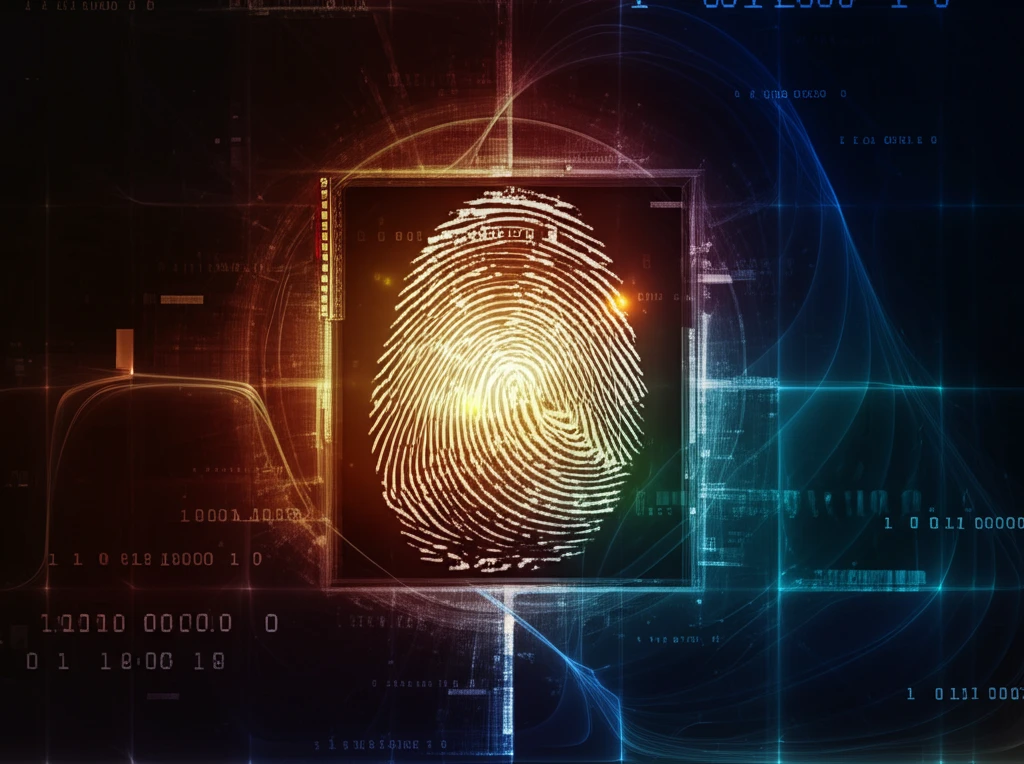
Unlock Your Identity: The Future of Fingerprint Technology is Here

"New advancements in fingerprint orientation field computation offer enhanced accuracy and security, even for low-quality images"
In an age where digital security is paramount, the humble fingerprint continues to evolve as a cornerstone of personal identification. From unlocking smartphones to securing sensitive data, fingerprint technology offers a unique and reliable method of authentication. The key to its effectiveness lies in the orientation field (OF), a complex map of ridge flows that defines the unique characteristics of each fingerprint.
However, creating an accurate OF, especially from imperfect fingerprint images, has long been a challenge. Issues such as spurious ridge structures and singularity location deviations (areas close to singular points, such as cores and deltas) can compromise the accuracy of traditional methods, leading to security vulnerabilities and user frustration. The article aims to address these issues by presenting a new method that has the power to reconstruct images with advanced efficiency.
But, now, a groundbreaking study is changing the game. Researchers have developed a novel approach combining weighted multi-scale composite windows (WMCM) with a hierarchical smoothing strategy to compute fingerprint OFs with unprecedented accuracy. This innovative technique addresses long-standing limitations in the field, promising more reliable and secure fingerprint recognition systems for everyone.
From Ink-Stained Fingers to Instant Scans
Fingerprint technology has come a long way from the ink-stained fingers of the past. With these advancements, background checks are faster, more accurate, and more secure than ever before. The unique ridges and valleys on each person's fingers form patterns that can be captured and matched electronically.
Capturing the Ridges and Valleys
Fingerprint technology works on the principle that no two fingerprints are alike, since the ridges and valleys on our fingers form unique patterns that can be captured and matched. Orientation field estimation, which maps the direction of these ridges, is central to the process, and the main accepted algorithms are the mask algorithm and the gradient algorithm. These methods are used in the spatial and frequency domains, respectively, and both can offer satisfactory fingerprint orientation field estimation.
Beyond the Ink-Stained Fingers of the Past
Fingerprint identification has moved far beyond the ink-stained fingers of the past, when prints were physically rolled onto paper. Today's digital capture methods have replaced those labor-intensive processes. These advancements have helped make background checks faster, more accurate, and more secure.
Decoding the New Fingerprint Technology
The new method tackles two major problems that have been problems for fingerprint recognition systems: adapting to the scale of fingerprint blocks to balance the need for accuracy and resisting noise, and how to construct genuine OFs near singular points to avoid deviations. Current methods struggle in areas with high curvature, leading to inaccurate localization of singular points which are vital for matching minutiae (unique ridge characteristics).
- Multi-Scale Composite Windows: Uses a combination of different sized windows to capture both fine details and overall structure.
- Hierarchical Smoothing: A multi-layered approach to refine the orientation field, correcting errors and smoothing out inconsistencies.
- Gradient-Based Method: Employs gradients to accurately determine ridge direction.
- Two-Orientation Zone Filtering: Filters the image in multiple passes to ensure accuracy.
Ultrasonic Sensors Arrive in Smartphones
The most recent fingerprint scanning technology to enter the smartphone market is the ultrasonic sensor. Qualcomm's Snapdragon Sense ID 3D fingerprint technology is a biometric security platform based on ultrasonic technology. These sensors consist of an ultrasonic transmitter and a receiver that capture the intrinsic details of the fingerprint.
When Algorithms Differ
Not every method performs equally well in every scenario. Among fingerprint orientation field algorithms, the main options are the mask algorithm and the gradient algorithm, which operate in the spatial and frequency domains, respectively. While both can offer satisfactory fingerprint orientation field estimation, the choice of approach matters for overall accuracy.
Optical vs. Ultrasonic Scanning
Optical fingerprint scanners, such as the technology used in Samsung devices, capture a visual image of the fingerprint. Ultrasonic scanners, by contrast, use a transmitter and receiver to capture the intrinsic details of the print. The newest ultrasonic sensors are now entering the smartphone market as a more advanced biometric option.
The Future of Fingerprint Technology
The implications of this research are far-reaching. By providing a more accurate and robust method for fingerprint OF computation, this new technology has the potential to significantly improve the reliability and security of fingerprint recognition systems. Whether it's unlocking your phone, accessing secure facilities, or verifying financial transactions, this advancement promises a future where fingerprint technology is more dependable and user-friendly than ever before. The study is an exciting leap forward, bringing enhanced security and efficiency to biometric authentication and building the path for the future of biometric technologies.
AI Meets Biometrics
One groundbreaking innovation is the integration of fingerprint technology with AI and machine learning. These technologies are being leveraged to enhance the accuracy and reliability of identity matching. Together, they are boosting the power of fingerprint-based systems in 2024 and beyond.
The Next Frontier in Scanning
The future of fingerprint scanners is arriving in the form of ultrasonic sensor technology, now entering the smartphone market through platforms such as Qualcomm Snapdragon Sense ID 3D. Futuristic ideas continue to reimagine fingerprint technology, from tech design concepts to applications tied to big data. These developments point toward faster, more secure identification in everyday devices.
Identity in a Connected World
Fingerprint technology sits within a broader ecosystem of identity verification that also includes device fingerprinting techniques, which identify users through their devices. AI and machine learning are increasingly integrated into these systems to enhance their power. Futuristic ideas about fingerprint technology, from circuit-board designs to big-data applications, reflect how deeply biometrics are woven into technology trends.
Making Background Checks Faster and Safer
For the people who rely on them, these advancements make background checks faster, more accurate, and more secure. Moving away from ink-stained fingers means less friction for applicants and more reliable results for employers. The result is fingerprint technology that protects identity in everyday life.