
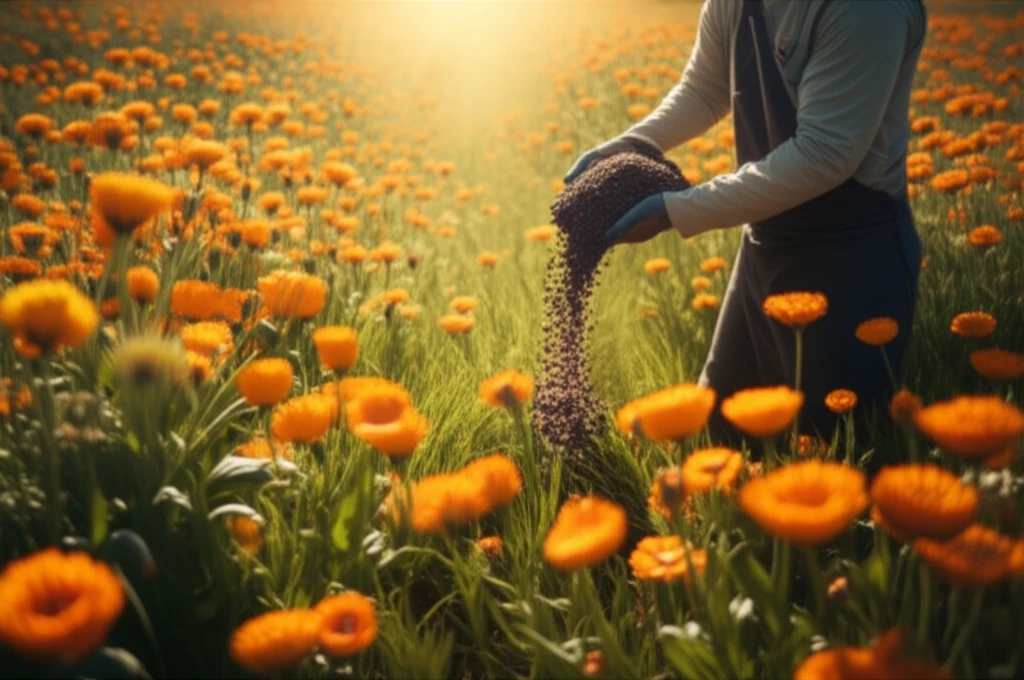
Calendula field with organic fertilization.

Unlock Your Garden's Potential: How Organic Fertilization Boosts Calendula Yields

"Discover the secrets to maximizing calendula production through organic methods, transforming your garden into a thriving medicinal herb haven."


In recent decades, agricultural practices have increasingly focused on enhancing productivity through various methods. Systems that minimize soil disturbance, like no-till farming, have become more viable, particularly in regions with sensitive agroecological conditions. These approaches protect the soil and limit disturbance to the arable layer, promoting both satisfactory yields and environmental equilibrium. Organic farming is gaining momentum, and for good reason. It protects our soil and creates a more sustainable ecosystem.

Calendula (Calendula officinalis L.) is a versatile plant known by many names such as calendula, marigold, or pot marigold. It stands between 30 to 60 cm tall. This plant is used for many purposes like dyes, medicine and culinary uses. It has anti-inflammatory, antiseptic and regenerating properties. Calendula is great for reducing inflammation in the mouth, improving the taste of teas and other blends.

Integrating Bahia grass (Paspalum notatum) enriches the soil with substantial biomass through its roots and rhizomes. This grass also contributes nitrogen, fostered by diazotrophic bacteria's association with its roots. Bahia grass’s value extends to weed control, reducing the need for synthetic herbicides, which poses concerns when growing medicinal plants. Research indicates that cultivating crops with Bahia grass shows comparable productivity to traditional soil mobilization methods, highlighting its efficacy and sustainability.

Optimal Organic Fertilization for Calendula: A Practical Guide

Calendula field with organic fertilization.

A study was conducted to evaluate how organic fertilization influences calendula production when directly planted with Bahia grass, this research provides actionable insights for gardeners and farmers. The experiment took place in Montes Claros, MG, from August to December 2006.

The experimental design used randomized blocks, testing four treatments of varied cured cattle manure doses (0, 3, 6, and 9 kg of dry mass per square meter) across six repetitions. Each experimental unit consisted of three calendula plants grown in a Haplic Cambisol soil, characterized by a pH of 6.8 and specific nutrient levels (P Mehlich = 8mg.dm-3, K = 0.4 mmolc.dm-3, etc.).

  • Sowing: Seeds were sown in 128-cell polystyrene trays, each with a 40cm3 volume, following the recommendations by Barbosa et al. (2007) for calendula seedling production.
  • Transplanting: Seedlings were transplanted to the field when they reached 5 cm in height, into holes of 30x30x30 cm spaced 50 cm apart, each pre-fertilized with the specified doses of cured manure.
  • Maintenance: The Bahia grass was periodically cut to 5 cm using a brush cutter. Plants were irrigated as needed using a perforated plastic hose for localized irrigation.
  • Harvesting: Flowers were harvested daily from the beginning of flowering, during dry mornings, for two months, as recommended by Pinto and Bertolucci (2002).
  • Drying: Plant material was evaluated after drying in a forced air oven.
The study revealed that controlling weeds was managed through regular mowing of the living mulch, which minimized herbicide use and soil disturbance, thus reducing the risk of microbiological contamination and ensuring higher sanitary quality of the harvested flowers. The highest yield of dry flower heads was achieved with the maximum dose of organic fertilizer, reaching 30.4 kg per hectare. Comparing to the control group, it shows that the organic fertilization is an importat part in plant health.

Balancing Act: Productivity vs. Sustainability

While calendula cultivation with Bahia grass offers reduced weed management and improved plant quality, it requires higher fertilization inputs. Farmers should carefully evaluate the economic and ecological trade-offs of this cultivation method. Further research is needed to optimize flower production in response to fertilization and other management practices, ultimately supporting sustainable and productive agricultural systems.

About this Article -

This article was crafted using a human-AI hybrid and collaborative approach. AI assisted our team with initial drafting, research insights, identifying key questions, and image generation. Our human editors guided topic selection, defined the angle, structured the content, ensured factual accuracy and relevance, refined the tone, and conducted thorough editing to deliver helpful, high-quality information.See our About page for more information.

Everything You Need To Know

1

What are the key benefits of using organic fertilization for Calendula cultivation?

Organic fertilization enhances the growth and yield of Calendula, leading to a more thriving medicinal herb garden. This method supports a sustainable ecosystem by protecting the soil, in contrast to conventional practices that may use synthetic fertilizers. The study highlights that using cured cattle manure significantly boosts Calendula production, with higher doses correlating to increased yields of dry flower heads. Furthermore, the use of organic practices also minimizes soil disturbance and the need for synthetic herbicides, improving the overall sanitary quality of the harvested flowers.

2

How does Bahia grass contribute to the organic cultivation of Calendula?

Bahia grass (Paspalum notatum) enriches the soil with substantial biomass through its roots and rhizomes, contributing to soil health and structure. It also provides nitrogen, thanks to the diazotrophic bacteria associated with its roots. This grass acts as a living mulch, suppressing weeds, thus reducing the need for synthetic herbicides. This is especially crucial when growing medicinal plants like Calendula, ensuring higher sanitary quality. Research indicates that cultivating Calendula with Bahia grass achieves comparable productivity to traditional soil mobilization methods, confirming its effectiveness in a sustainable agricultural system.

3

Can you explain the methodology used in the study regarding organic fertilization of Calendula?

The study, conducted in Montes Claros, MG, from August to December 2006, used randomized blocks to test four treatments of cured cattle manure (0, 3, 6, and 9 kg of dry mass per square meter). Each treatment was applied to three Calendula plants grown in Haplic Cambisol soil. Seeds were sown in polystyrene trays and transplanted when 5 cm tall. Bahia grass was regularly cut, and plants were irrigated using a perforated hose. Flowers were harvested daily for two months and evaluated after drying in a forced-air oven, measuring the yield of dry flower heads. The experimental design was focused on understanding the impact of varied doses of organic fertilizer on Calendula yield and health.

4

What are the implications of using cured cattle manure doses for Calendula, and what were the outcomes observed?

The study revealed that varying doses of cured cattle manure significantly influenced Calendula production. The highest yield of dry flower heads, reaching 30.4 kg per hectare, was achieved with the maximum dose of organic fertilizer (9 kg of dry mass per square meter). The results underline the crucial role of organic fertilization in plant health and productivity. This practice is a sustainable alternative to conventional methods. The increased yields demonstrate the potential of organic methods in maximizing Calendula production and quality, crucial for its medicinal uses.

5

What are the key considerations regarding the balance between productivity and sustainability when cultivating Calendula using organic methods?

While Calendula cultivation with Bahia grass and organic fertilization enhances productivity, it requires careful consideration of the inputs needed. Farmers should carefully evaluate the economic and ecological trade-offs of this method. Although organic fertilization and the integration of Bahia grass improve weed management, the use of higher doses of cured cattle manure can influence both the cost and the environmental impact. Further research is necessary to optimize flower production, balancing fertilization and management practices to support both sustainable and productive agricultural systems. The goal is to maximize yields without compromising ecological balance.

Newsletter Subscribe

Subscribe to get the latest articles and insights directly in your inbox.