
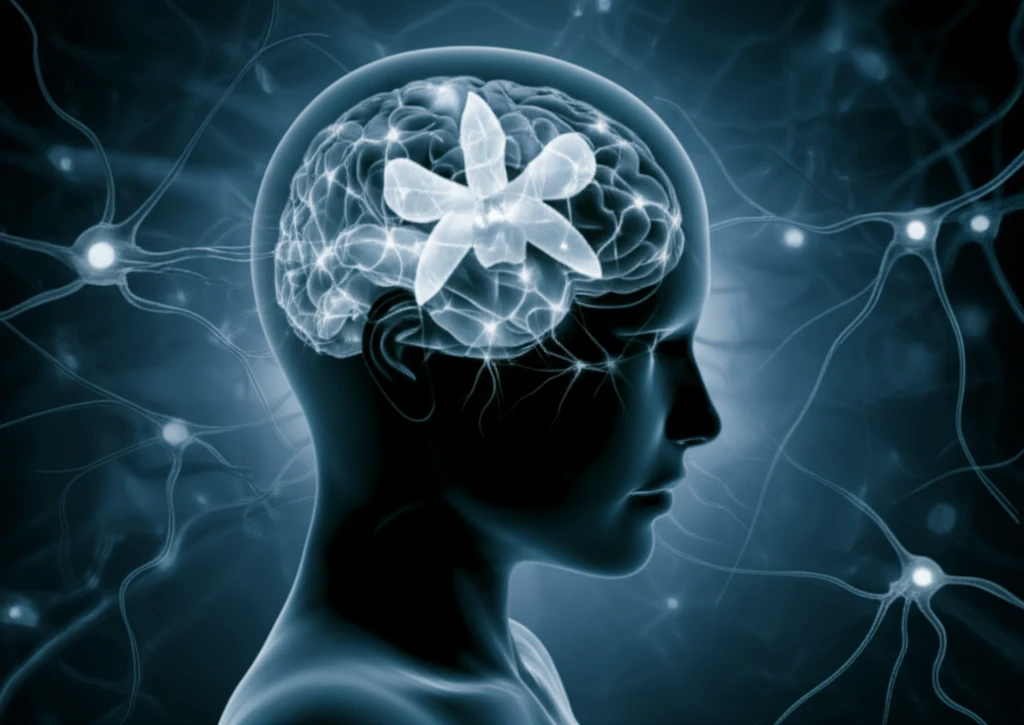
Illustration of a brain being cleared of tangled proteins by glowing pathways representing autophagy, inspired by Dendrobium nobile Lindl. alkaloids.

Unlock Your Brain's Potential: How a Natural Remedy Fights Alzheimer's

"Discover how Dendrobium nobile Lindl. alkaloids can improve memory and protect against Alzheimer's disease by targeting a key mechanism in the brain."


Alzheimer's disease (AD), a neurodegenerative condition, is a growing concern. Characterized by memory loss, cognitive decline, and significant impact on daily life, AD's complex causes have driven researchers to explore various therapeutic avenues. One promising area involves understanding and targeting how the brain clears out cellular waste.

A key process in maintaining brain health is autophagy, the body's way of removing damaged proteins and cellular components. Think of it as the brain's internal cleaning service. When this process falters, as it often does in Alzheimer's, toxic proteins like β-amyloid accumulate, leading to neuron damage and cognitive decline. Therefore, boosting autophagy is emerging as a vital strategy in the fight against AD.

Now, exciting new research points to a natural source that could hold the key to enhancing autophagy and combating Alzheimer's: Dendrobium nobile Lindl., a traditional Chinese medicine. A recent study published in Frontiers in Pharmacology reveals how alkaloids extracted from this plant, known as DNLA, can improve the brain's waste disposal system, reduce β-amyloid buildup, and improve memory in mice with Alzheimer's-like conditions. Let's delve into these findings and what they might mean for the future of Alzheimer's treatment.

DNLA: Supercharging the Brain's Cleaning Crew

Illustration of a brain being cleared of tangled proteins by glowing pathways representing autophagy, inspired by Dendrobium nobile Lindl. alkaloids.

The study specifically investigated how DNLA impacts autophagy, the cellular process responsible for clearing out misfolded proteins like β-amyloid. Researchers found that in mice genetically engineered to mimic Alzheimer's (APP/PS1 mice), DNLA significantly enhanced this crucial cleaning process.

Here's how DNLA works its magic:

  • Boosting v-ATPase A1: DNLA increases the production of a key protein, v-ATPase A1, essential for acidifying lysosomes. Think of lysosomes as the cell's recycling centers; they need to be acidic to break down waste effectively.
  • Cathepsin D Activation: By acidifying lysosomes, DNLA promotes the proper processing and activation of cathepsin D, a critical enzyme for breaking down proteins within the lysosomes.
  • β-Amyloid Degradation: DNLA encourages the breakdown of accumulated β-amyloid within autophagosomes, the structures that deliver waste to lysosomes.
  • Improved Memory: Ultimately, these cellular-level improvements translated to better cognitive performance. APP/PS1 mice treated with DNLA showed significant improvements in learning and memory tests, such as the Morris water maze.
These findings provide compelling evidence that DNLA can enhance autophagy and reduce β-amyloid accumulation, offering a potential therapeutic avenue for Alzheimer's disease. The study highlights DNLA's ability to target specific mechanisms within the autophagy pathway, potentially restoring the brain's natural ability to clear out toxic proteins.

A Promising Future for Alzheimer's Treatment?

While this research is promising, it's important to remember that this study was conducted on mice. Further research is needed to determine if DNLA has the same effects in humans. However, these findings provide a strong rationale for exploring DNLA as a potential therapeutic agent for Alzheimer's disease.

The study's focus on autophagy is particularly significant. As we learn more about the critical role of autophagy in brain health, targeting this pathway may offer new hope for preventing and treating Alzheimer's and other neurodegenerative diseases.

The discovery of DNLA's ability to enhance autophagy and reduce β-amyloid accumulation opens exciting new avenues for Alzheimer's research. By understanding how natural compounds like DNLA can influence the brain's natural cleaning processes, we can move closer to developing effective treatments for this devastating disease.

About this Article -

This article was crafted using a human-AI hybrid and collaborative approach. AI assisted our team with initial drafting, research insights, identifying key questions, and image generation. Our human editors guided topic selection, defined the angle, structured the content, ensured factual accuracy and relevance, refined the tone, and conducted thorough editing to deliver helpful, high-quality information.See our About page for more information.

This article is based on research published under:

DOI-LINK: 10.3389/fphar.2018.01479, Alternate LINK

Title: Dendrobium Nobile Lindl. Alkaloids Decreases The Level Of Intracellular Β-Amyloid By Improving Impaired Autolysosomal Proteolysis In App/Ps1 Mice

Subject: Pharmacology (medical)

Journal: Frontiers in Pharmacology

Publisher: Frontiers Media SA

Authors: Jing Nie, Lin-Shan Jiang, Yu Zhang, Yong Tian, Li-Sheng Li, Yan-Liu Lu, Wen-Jin Yang, Jing-Shan Shi

Published: 2018-12-18

Everything You Need To Know

1

What is Alzheimer's disease and why is it a growing concern?

Alzheimer's disease (AD) is a neurodegenerative condition characterized by memory loss and cognitive decline. It has a significant impact on daily life. The causes are complex. Research is exploring various therapeutic avenues, including targeting the brain's waste disposal system. This is where the study of Dendrobium nobile Lindl. alkaloids comes into play.

2

What is autophagy and why is it important in the context of brain health?

Autophagy is the brain's natural waste disposal system, a process where the body removes damaged proteins and cellular components. In Alzheimer's disease, this process often falters. The accumulation of toxic proteins like β-amyloid leads to neuron damage and cognitive decline. Boosting autophagy is considered a vital strategy to combat Alzheimer's disease. The study of Dendrobium nobile Lindl. alkaloids is significant because it has been shown to enhance autophagy.

3

What are Dendrobium nobile Lindl. alkaloids (DNLA) and how do they relate to Alzheimer's disease?

Dendrobium nobile Lindl. alkaloids (DNLA) are extracted from a traditional Chinese medicine. Research indicates that DNLA enhances autophagy, the brain's waste disposal system. DNLA has been shown to reduce β-amyloid buildup and improve memory in mice with Alzheimer's-like conditions. DNLA works by increasing the production of v-ATPase A1, promoting the activation of cathepsin D, and encouraging the breakdown of accumulated β-amyloid within autophagosomes.

4

How exactly does DNLA work within the brain to potentially combat Alzheimer's?

The study revealed that DNLA works at a cellular level to improve autophagy. It boosts v-ATPase A1, a key protein essential for acidifying lysosomes, the cell's recycling centers. By acidifying lysosomes, DNLA promotes the proper processing and activation of cathepsin D, an enzyme that breaks down proteins. Ultimately, these actions lead to the degradation of β-amyloid, leading to improved cognitive performance.

5

What were the key findings of the study involving Dendrobium nobile Lindl. alkaloids (DNLA) and what are the implications?

The study used mice genetically engineered to mimic Alzheimer's disease. The mice treated with Dendrobium nobile Lindl. alkaloids (DNLA) showed improvements in learning and memory tests, like the Morris water maze. While the research is promising, further studies are needed to determine if DNLA has the same effects in humans. This study provides a strong rationale for further exploring DNLA as a potential therapeutic agent for Alzheimer's disease.

Newsletter Subscribe

Subscribe to get the latest articles and insights directly in your inbox.