
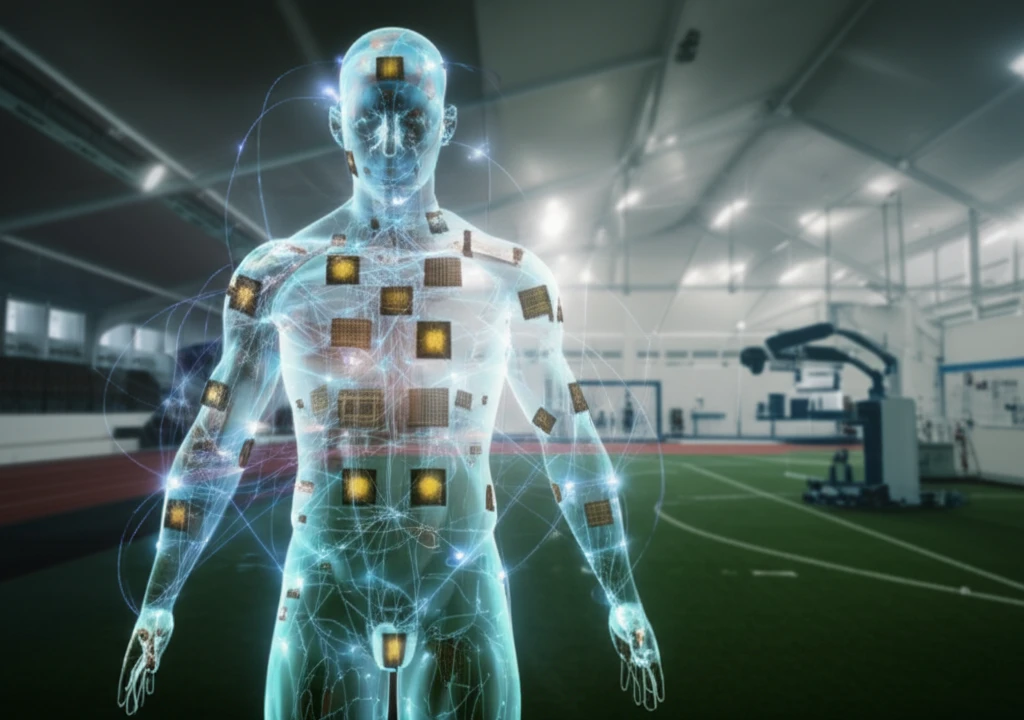
Unlock Your Body's Secrets: How Inertial Sensors are Revolutionizing Movement Analysis

"Discover the cutting-edge technology that's making human motion capture more accurate, accessible, and impactful than ever before, transforming healthcare, sports, and beyond."
Understanding the intricacies of human movement has long been a pursuit across various fields, from medicine to sports. Wearable Inertial Measurement Units (IMUs) are emerging as powerful tools for capturing and analyzing these movements in real-time. These tiny sensors, measuring acceleration, magnetic field, and gyroscopic data, offer a window into the complexities of human motion, paving the way for more accurate diagnoses, personalized treatments, and enhanced performance training.
The need for precise and robust motion capture is especially critical in addressing movement disorders. Many conditions require careful assessment of even the subtlest movements, making accuracy paramount. Practical considerations also play a significant role. For patients with movement disabilities, the ease of wearing and using these sensors is just as important as their technical capabilities. This means minimizing the number of sensors, positioning them comfortably, and ensuring they can be used for extended periods.
Estimating skeletal and limb orientations to describe human posture dynamically poses significant challenges. This article explores how innovative approaches in measurement conversion and data processing can enhance the accuracy and reliability of IMU-based motion capture. We'll delve into the use of quaternions to avoid common issues with traditional Euler angles, and discuss optimization techniques for improved accuracy. Using the human shoulder joint as a key example, we'll illustrate these concepts and their potential to transform movement analysis.
Improving Accuracy: A Converted Measurement Approach
Traditional methods for estimating limb orientation often involve complex, non-linear calculations. These can be prone to errors and instability, especially in systems with significant uncertainties. This research introduces a 'converted measurement' approach, which reframes the problem in a linear context. By representing the data in a way that allows for linear processing, the system can achieve greater accuracy and reduce the risk of divergence.
- Linearization for Accuracy: Measurement conversion ideas as a representation signifying a linear characterisation of an inherently non-linear estimation problem, pragmatically improves the overall estimation of the limb orientation.
- Quaternion Advantage: A quaternion, as opposed to the euler angle based approach is adopted to avoid Gimbal lock scenarios.
- Optimization-Based Normalization: Also lay a systematic basis for quaternion normalisation, typically performed in the pre-filtering stage, by introducing an optimisation based mathematical justification.
The Future of Movement Analysis
This research demonstrates the potential of innovative data processing techniques to enhance the accuracy and reliability of IMU-based motion capture. By combining converted measurements, quaternion optimization, and robust Kalman filtering, the system achieves significant improvements in human pose estimation. These advancements pave the way for more effective and accessible movement analysis in a wide range of applications, from healthcare to sports. As the technology continues to evolve, we can expect even more sophisticated tools for understanding and improving the way we move.