
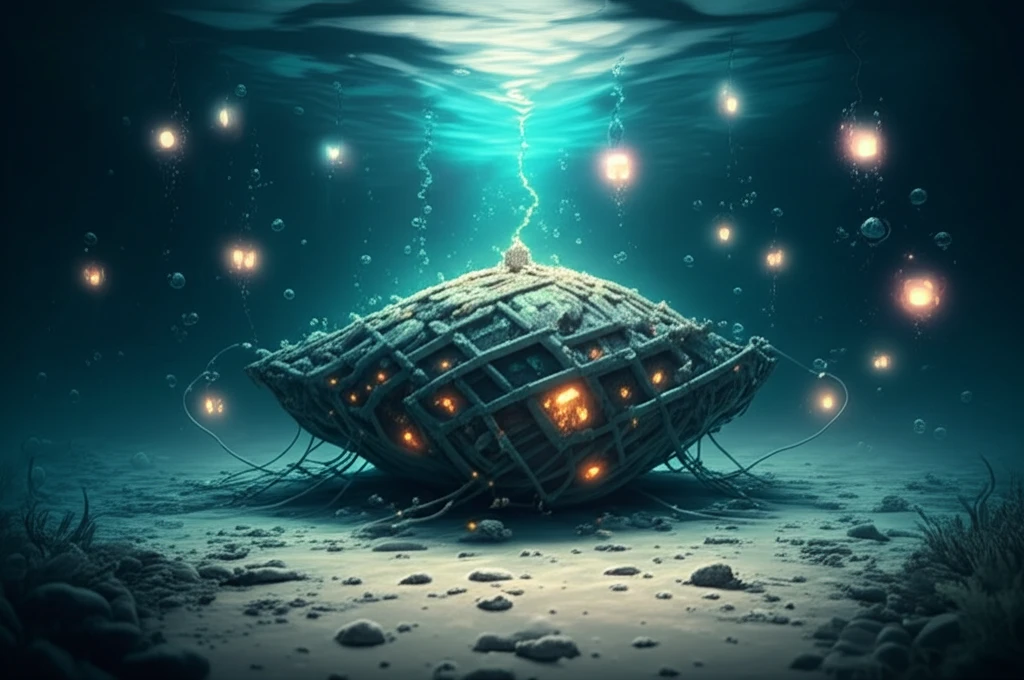
Unlock Underwater Secrets: How 3D Printing and Smart Sensors Revolutionize Ocean Exploration

"Dive into the future of ocean sensing with cutting-edge 3D-printed sensor arrays that mimic nature's lateral line, offering a cost-effective solution for underwater object localization."
Our oceans hold countless mysteries, resources, and ecological importance, yet exploring them presents significant technological challenges. Traditional methods of underwater detection, such as sonar, often grapple with environmental interference and sophisticated stealth techniques. This necessitates innovative solutions that can overcome these limitations and provide more effective means of underwater sensing.
Inspired by the lateral line system found in fish—a sensory system that detects pressure changes in the surrounding water—scientists are developing bio-inspired technologies that mimic this natural ability. These new approaches use pressure sensors to analyze the spatiotemporal information of the hydrodynamic environment, offering a way to perceive underwater objects without being hindered by the constraints affecting sonar.
Recent advancements in 3D printing have opened new avenues for creating these sophisticated sensor arrays. By leveraging 3D printing, researchers can rapidly prototype and customize sensor designs, making it easier and more affordable to explore different configurations and materials. This synergy between bio-inspired design and advanced manufacturing techniques is paving the way for a new era of underwater exploration.
A New Era of Ocean Discovery
AI is revolutionizing ocean exploration, giving researchers new ways to understand and protect the world's vast underwater environments. Advanced robotics can now dive deeper than ever before while sophisticated data analysis techniques extract meaning from the data they collect. These combined capabilities are expanding what scientists can learn about regions of the ocean that were previously out of reach.
From Sound Waves to Sight
Underwater sensing traditionally relies on two complementary approaches: acoustic sensors that use sound waves to gather information, and optical sensing technologies such as underwater imaging for object inspection. Sonar systems can map seafloor topography and detect objects in the water column, including shipwrecks and fish. However, each method has inherent constraints, which is why modern exploration increasingly pairs multiple sensing technologies aboard autonomous platforms.
From Shipboards to Swarms
Ocean exploration has evolved from crewed expeditions to increasingly autonomous and miniaturized tools. A notable milestone is the mini-autonomous underwater explorer (m-AUE) developed by Scripps oceanographer Jules Jaffe, a grapefruit-sized device meant to be deployed in large groups or swarms. These devices act like plankton, bobbing at a constant level while a fleet of them samples the ocean more broadly than any single instrument ever could.
The Power of 3D-Printed Sensor Arrays
At the heart of this technological leap is the pressure sensor array. To effectively detect and interpret underwater signals, these arrays must be both sensitive and waterproof. One sensor that meets these requirements is the MPVZ5004GW6U from Freescale, which offers a measuring range of 0-3.92 kPa and a sensitivity of 1 V/kPa. However, the real innovation lies in how these sensors are arranged and protected using 3D printing.
- Customization: Arrays can be tailored to specific research needs.
- Cost-Effectiveness: Reduces material waste and labor costs.
- Rapid Prototyping: Accelerates the design and testing phases.
- Material Innovation: Allows the use of environmentally friendly materials like PLA.
The State of Underwater Sensing
Recent reviews of underwater sensing technologies catalog the methods now applied to ocean exploration, from submersible navigation and underwater object detection to environmental monitoring. Optical techniques used in the field include underwater imaging for object inspection, spectrophotometry, and fluorophotometry, which measure environmental parameters. Acoustic sensing remains a core complement, using sound waves to map the seafloor and detect objects in the water column.
The Limits of the Deep
For all their advances, underwater technologies face persistent challenges that keep the deep ocean difficult to study. Acoustic and optical sensing each have weaknesses in particular conditions, which is why researchers rely on combinations of approaches rather than any single sensor. Company profiles in the marine sector highlight that even mature sensing technologies require ongoing development to meet the demanding conditions of the marine industry.
Acoustic vs. Optical Sensing
Acoustic sensors use sound waves to gather information about the underwater environment, making them effective for broad-scale mapping of seafloor topography and detection of objects such as shipwrecks and fish. Optical sensing technologies, by contrast, enable detailed underwater imaging for object inspection and techniques like spectrophotometry and fluorophotometry for environmental parameters. Where acoustics see across distance and darkness, optics deliver resolution and chemical detail, and modern expeditions often deploy both.
Future Implications and Applications
The fusion of 3D printing and sensor technology is not just a theoretical advancement; it has practical implications for a variety of fields. From environmental monitoring to marine archaeology, the ability to accurately locate objects underwater opens up new possibilities for exploration and discovery. As sensor technology continues to evolve and 3D printing becomes more accessible, we can expect even more innovative solutions that leverage these tools to unlock the secrets of the ocean.
Robots as Our Deep-Sea Eyes
Robotics have revolutionized the way we explore the ocean, with underwater drones and autonomous vehicles capable of reaching depths far beyond human divers. Advanced autonomous underwater vehicles equipped with sensors and cameras are now routinely sent to explore the deep ocean, gathering data that supports marine research and monitoring. Together with AI-driven analysis, these platforms turn a previously hidden world into measurable, actionable knowledge.
Plankton-Sized Explorers Ahead
The next frontier in exploration lies in miniaturization and collective intelligence, exemplified by the grapefruit-sized m-AUEs designed to be deployed in large groups or swarms. Bobbing at a constant level like plankton, these small autonomous explorers can sample the ocean across wide areas simultaneously. This swarm approach promises broader, more continuous coverage of ocean conditions than large single instruments can achieve.
Monitoring a Marine World
Breakthroughs in marine research increasingly depend on the integration of AI and robotics for ocean monitoring. AUVs equipped with sensors and cameras enable researchers to observe ecosystems in ways that support conservation and management. Yet delivering these tools at scale remains a systemic challenge, as sensing hardware must be engineered for durability, power, and reliability in demanding underwater conditions.
Making Exploration Accessible
Additive manufacturing, or 3D printing, builds solid objects layer by layer from a digital file, and the technology has moved from industrial curiosity to a hobbyist-friendly craft. Beginners now have accessible guides to creating their own 3D projects, putting fabrication power in more hands. For ocean research, such accessible tools pair with smart sensing to involve more people in studying and protecting the seas.