
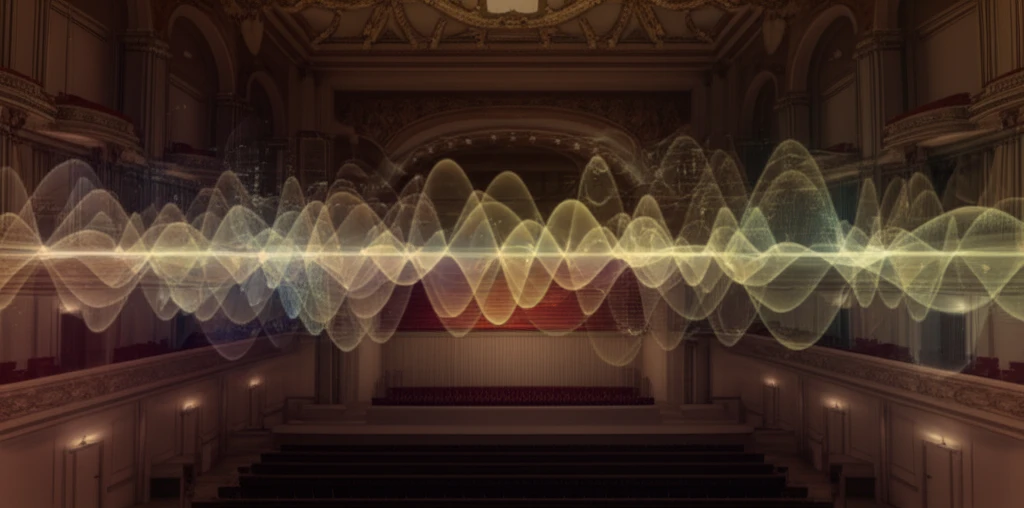
Quantum Acoustics: Sound waves visualized as glowing quantum structures in a concert hall.

Unlock the Secrets of Sound: How Quantum Physics is Revolutionizing Acoustics

"From concert halls to quantum realms: Discover how cutting-edge research is refining our understanding of resonance and sound transmission."


Sound, a familiar phenomenon, governs our experience of music, speech, and the very ambiance of our surroundings. The field of acoustics, dedicated to understanding sound, has traditionally relied on classical physics. However, recent breakthroughs are revealing the profound influence of quantum mechanics on how sound behaves, particularly in complex systems.

Acoustics researchers are increasingly exploring the quantum realm for novel insights. This exploration has led to a revolutionary new perspective shift for sound transmission, most recently demonstrated by author Jeffrey Galkowski of Stanford University that could lead to advancements in numerous fields. His research extends previous work to describe the location of resonances in diverse transmission problems.

This article delves into Galkowski's intriguing research, translating complex mathematical concepts into accessible insights for anyone curious about the future of sound science. We'll explore the 'quantum Sabine law,' its applications, and the implications of this quantum leap for technology and our understanding of the world around us.

The Quantum Sabine Law: A New Harmony of Physics

Quantum Acoustics: Sound waves visualized as glowing quantum structures in a concert hall.

In architectural acoustics, Wallace Clement Sabine's empirical formula describes the reverberation time of a room—how long it takes sound to decay. Sabine's work, groundbreaking for its time, laid the foundation for designing spaces with optimal sound quality. However, Sabine's original formula didn't account for wave phenomena, which led to the current explorations in quantum acoustics.

Galkowski’s research introduces a 'quantum Sabine law' that extends the classical understanding to account for quantum effects. This new law characterizes resonance-free regions in terms of dynamical quantities, connecting the imaginary part of resonances (generalized eigenvalues) to chord lengths and reflectivity coefficients within ray dynamics.

  • Transparent Obstacles: Understanding sound scattering by materials with different refractive indices, relevant to designing acoustic barriers and metamaterials.
  • Delta Potentials: Analyzing systems with highly frequency-dependent delta potentials, applicable to quantum corrals and concert hall design.
  • Boundary Stabilization: Improving the stability of wave equations in boundary control systems, relevant in reducing noise in various applications.
These applications demonstrate the quantum Sabine law's broad implications, ranging from fundamental physics to practical engineering. This advancement could revolutionize acoustic design, noise control, and even quantum computing.

The Future of Sound: A Quantum Leap

The quantum Sabine law represents a significant advancement in our understanding of acoustics, bridging the gap between classical and quantum physics. While still largely theoretical, this framework offers a new way to analyze and manipulate sound, with potential applications spanning numerous industries.

As quantum technologies continue to evolve, the insights from this research could become increasingly relevant. The ability to precisely control sound at the quantum level could unlock new possibilities in quantum computing, materials science, and beyond.

Jeffrey Galkowski's work inspires further investigation into the quantum properties of sound, heralding a new era where acoustics is not just about controlling noise, but about harnessing the power of sound at its most fundamental level.

About this Article -

This article was crafted using a human-AI hybrid and collaborative approach. AI assisted our team with initial drafting, research insights, identifying key questions, and image generation. Our human editors guided topic selection, defined the angle, structured the content, ensured factual accuracy and relevance, refined the tone, and conducted thorough editing to deliver helpful, high-quality information.See our About page for more information.

This article is based on research published under:

DOI-LINK: 10.2140/paa.2019.1.27, Alternate LINK

Title: The Quantum Sabine Law For Resonances In Transmission Problems

Subject: General Medicine

Journal: Pure and Applied Analysis

Publisher: Mathematical Sciences Publishers

Authors: Jeffrey Galkowski

Published: 2019-01-01

Everything You Need To Know

1

What is acoustics, and how is it changing?

Acoustics is the study of sound, traditionally rooted in classical physics. However, recent research is exploring how quantum mechanics influences sound, particularly in complex systems. This leads to a more comprehensive understanding of sound behavior.

2

What is the 'quantum Sabine law'?

The 'quantum Sabine law' extends Wallace Clement Sabine's classical formula for reverberation time, which has been a foundation for architectural acoustics. The original Sabine formula did not consider wave phenomena. Jeffrey Galkowski's research introduces quantum effects, characterizing resonance-free regions by connecting the imaginary part of resonances to chord lengths and reflectivity coefficients, bridging classical and quantum physics for a more precise understanding.

3

What are the key applications of the 'quantum Sabine law'?

The 'quantum Sabine law' has implications in several areas. These include understanding sound scattering through transparent obstacles, which is relevant to designing acoustic barriers and metamaterials. It also applies to analyzing systems with frequency-dependent delta potentials, useful in quantum corrals and concert hall design. Furthermore, it improves the stability of wave equations in boundary control systems, which aids in noise reduction.

4

How is Jeffrey Galkowski's research advancing the field of sound science?

Jeffrey Galkowski’s work introduces a 'quantum Sabine law' that enhances our ability to analyze and manipulate sound. This framework offers a fresh approach to acoustic design, noise control, and quantum computing, opening new avenues for technological advancements.

5

Why is the 'quantum Sabine law' significant?

While the 'quantum Sabine law' is still largely theoretical, its importance lies in bridging the gap between classical and quantum physics in acoustics. By accounting for quantum effects, it provides a more detailed and potentially more accurate model for sound behavior. This leads to practical benefits across a range of fields, from architectural design to quantum computing, potentially revolutionizing how we understand and use sound.

Newsletter Subscribe

Subscribe to get the latest articles and insights directly in your inbox.