
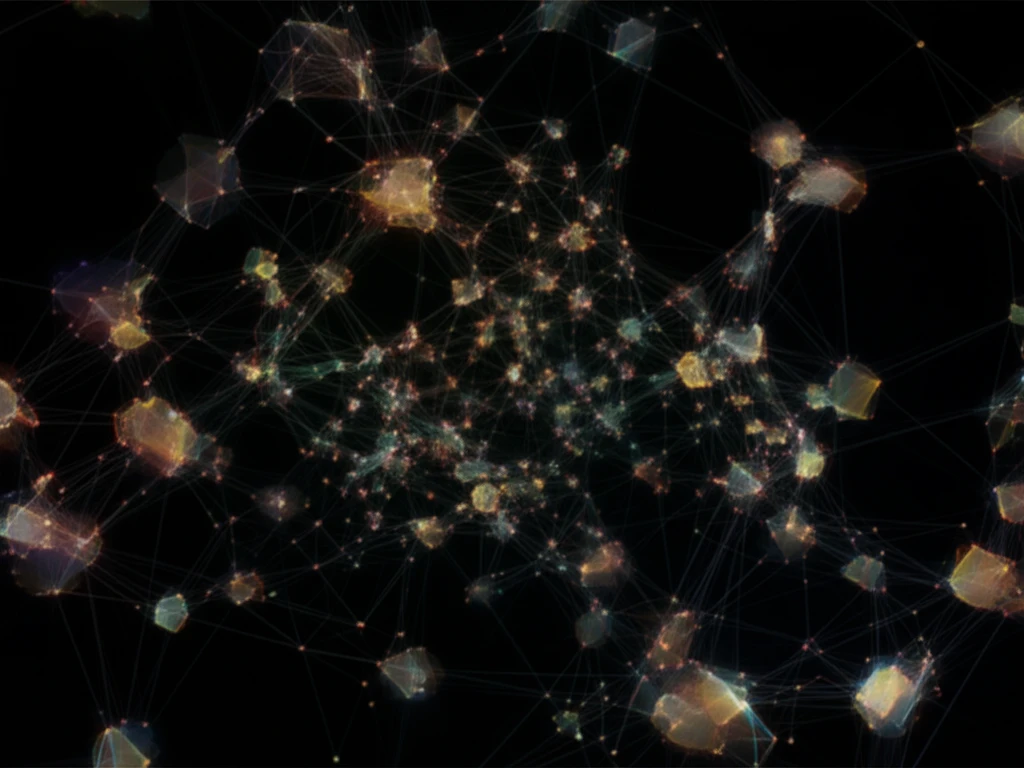
Interconnected nodes forming clusters, symbolizing community detection.

Unlock the Secrets of Social Networks: How Community Detection Works

"Navigate the complexities of online connections and discover how algorithms reveal hidden communities within dynamic social networks."


In today's interconnected world, social network analysis has become increasingly important. Understanding how people interact and form communities online is crucial for various applications, from marketing and social science research to identifying trends and potential risks.

At the heart of social network analysis lies the challenge of community detection – identifying groups of individuals with strong connections within the group and weaker connections to the outside world. These communities can represent shared interests, common affiliations, or any other factor that brings people together.

While early approaches focused on static networks, the reality is that social networks are constantly evolving. People join and leave groups, connections are formed and broken, and the overall structure shifts over time. This dynamic nature makes community detection a complex and ongoing challenge.

What is Community Detection and Why Does It Matter?

Interconnected nodes forming clusters, symbolizing community detection.

Community detection is the process of identifying subgroups within a network where nodes (representing individuals or entities) are more densely connected to each other than to the rest of the network. Think of it as finding the cliques, tribes, or interest groups that exist within a larger social circle.

The importance of community detection stems from its ability to reveal underlying patterns and structures in complex networks. By understanding how communities form and evolve, we can gain insights into various phenomena:

  • Social Behavior: How do people with similar interests connect and interact online?
  • Information Diffusion: How does information spread through different communities?
  • Trend Analysis: What are the emerging trends and topics within specific communities?
  • Risk Assessment: Can community detection help identify potential threats or malicious activities?
Imagine a social network where users discuss different topics. Community detection could reveal clusters of users interested in specific areas like gaming, fashion, or technology. This information can be valuable for targeted advertising, content recommendation, and understanding user behavior.

The Future of Community Detection

As social networks continue to grow and evolve, the need for effective community detection methods will only increase. Future research will likely focus on developing more scalable and efficient algorithms that can handle the complexities of real-world networks. Parallel processing and advanced techniques like Singular Value Decomposition (SVD) offer promising avenues for improvement. Ultimately, the goal is to unlock the full potential of social network data and gain a deeper understanding of human interaction.

About this Article -

This article was crafted using a human-AI hybrid and collaborative approach. AI assisted our team with initial drafting, research insights, identifying key questions, and image generation. Our human editors guided topic selection, defined the angle, structured the content, ensured factual accuracy and relevance, refined the tone, and conducted thorough editing to deliver helpful, high-quality information.See our About page for more information.

This article is based on research published under:

DOI-LINK: 10.4018/ijrsda.2018010103, Alternate LINK

Title: Detecting Communities In Dynamic Social Networks Using Modularity Ensembles Som

Subject: General Medicine

Journal: International Journal of Rough Sets and Data Analysis

Publisher: IGI Global

Authors: Raju Enugala, Lakshmi Rajamani, Sravanthi Kurapati, Mohammad Ali Kadampur, Y. Rama Devi

Published: 2018-01-01

Everything You Need To Know

1

What is community detection in the context of social networks, and why is it considered important?

Community detection is the process of identifying subgroups within a network where nodes, representing individuals or entities, are more densely connected to each other than to the rest of the network. This process reveals underlying patterns and structures in complex networks, allowing insights into social behavior, information diffusion, trend analysis, and risk assessment. For example, it can identify clusters of users interested in specific topics such as gaming, fashion, or technology.

2

How do algorithms like modularity ensembled with Self-Organizing Maps (SOM) contribute to uncovering hidden groups in dynamic social networks?

Algorithms like modularity ensembled with Self-Organizing Maps (SOM) are used to identify the hidden groups and connections that shape online experiences. These algorithms help to find communities by assessing the density of connections within potential groups, aiming to maximize the modularity score, which indicates the strength of community structure. Modularity ensembled with Self-Organizing Maps (SOM) can efficiently handle the evolving nature of social networks, where connections and group affiliations change over time.

3

What are the key challenges in community detection, and how does the evolving nature of social networks contribute to these challenges?

A key challenge in community detection is the dynamic nature of social networks. Social networks are constantly evolving as people join and leave groups, connections are formed and broken, and the overall structure shifts over time. This means that community detection algorithms must be able to adapt to these changes and accurately identify communities in real-time. Algorithms must efficiently handle this constant flux to provide meaningful insights.

4

In what practical ways can community detection be applied to gain insights into social behavior, information diffusion, trend analysis, and risk assessment?

Community detection provides insights into social behavior by revealing how people with similar interests connect and interact online. Regarding information diffusion, it shows how information spreads through different communities, aiding in understanding influence and reach. For trend analysis, community detection helps identify emerging trends and topics within specific communities. It also assists in risk assessment by helping to identify potential threats or malicious activities by spotting unusual connection patterns or isolated groups.

5

What advancements, such as Parallel processing and Singular Value Decomposition (SVD), are being explored to improve the scalability and efficiency of community detection methods, and what is the ultimate goal of these improvements?

To handle the complexities of real-world networks, future research focuses on scalable and efficient algorithms. Parallel processing and advanced techniques like Singular Value Decomposition (SVD) are promising avenues for improvement. Parallel processing enables the distribution of computational tasks across multiple processors, significantly speeding up the analysis of large networks. Singular Value Decomposition (SVD) reduces the dimensionality of network data, making it easier to identify underlying patterns and communities. The ultimate goal is to unlock the full potential of social network data and gain a deeper understanding of human interaction.

Newsletter Subscribe

Subscribe to get the latest articles and insights directly in your inbox.