
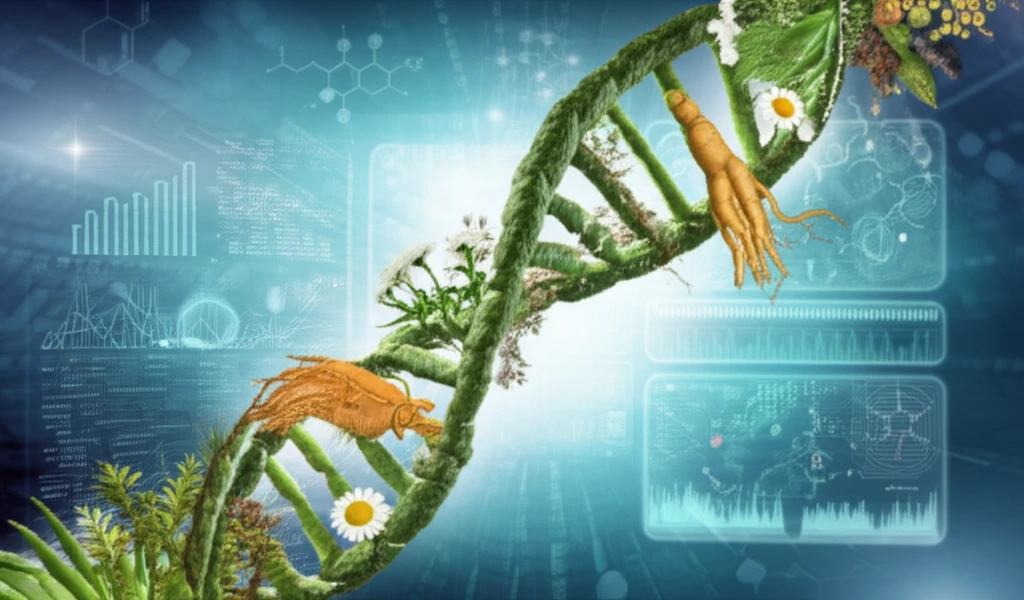
Unlock the Secrets of Herbal Medicine: A Modern DNA Barcode Database

"How cutting-edge technology is revolutionizing authentication and quality control in traditional medicine."
For centuries, cultures worldwide have relied on herbal remedies. Today, with a resurgence in natural living, these materials are gaining even greater popularity as medicines and dietary supplements. This growth underscores the critical need to verify the identity of these materials to ensure both safety and effectiveness.
Misidentification or adulteration of herbs can lead to serious health consequences, including liver injury and other forms of poisoning. Ensuring what you're consuming is precisely what you intend is paramount.
Enter DNA barcoding, a revolutionary technique transforming botanical identification. By analyzing short DNA segments, scientists can accurately differentiate between species. The Medicinal Materials DNA Barcode Database (MMDBD) is at the forefront of this effort, providing a comprehensive resource for authenticating medicinal plants.
Why Authentication Matters
Herbal medicine quality can be affected by uncertainty about the identity and composition of plant materials. DNA-based identification offers a modern way to support more reliable authentication, although its practical impact depends on how it is integrated into quality-control systems. The broader significance lies in helping connect botanical identity with safer and more consistent herbal products.
Current Authentication Methods
The 2023 review of DNA barcoding in herbal medicine evaluates the history, advantages, limitations, and application prospects of plant barcodes. Reviews of DNA barcoding and DNA metabarcoding describe both methods as useful for biological identification and authentication, while emphasizing that they complement rather than replace existing quality-control procedures. These sources recommend combining DNA barcoding with metabolomics and, when needed, transcriptomics and proteomics to address authentication challenges in the herbal market.
The Development of Plant Barcodes
The history of plant barcodes provides the foundation for applying DNA barcoding to herbal medicine. Over time, researchers have evaluated different barcode strategies and their advantages and limitations for identifying plant material. This historical development has supported broader interest in DNA-based authentication, although the available source material does not establish a single definitive milestone or discovery.
MMDBD: A One-Stop Solution for Herbal Authentication
The MMDBD, now in version 1.5, represents a significant advancement in the application of DNA barcoding to medicinal materials. This database archives DNA sequences from a wide array of medicinal plants and related species, serving as a crucial tool in the fight against herbal adulteration and misidentification.
- Sequence Access: Easily retrieve DNA sequences for thousands of medicinal materials.
- BLAST Search: Quickly identify unknown samples by comparing their DNA to known sequences.
- Clustal Omega Alignment: Compare multiple sequences to identify unique markers.
- Primer3 Integration: Design custom primers for targeted DNA amplification.
Recent Research Directions
Recent reviews describe DNA barcoding as important for addressing herbal-medicine adulteration through species identification, detection of adulterants in raw or processed materials, database creation, and research and surveillance. A 2024 review identifies DNA barcoding combined with an orthogonal approach using multiple testing methods as an emerging trend in plant authentication. Other work highlights chemoprofiling alongside DNA barcoding as a way to identify plant species and standardize phytochemical composition.
Limits of DNA-Only Authentication
DNA barcoding is not presented as a complete solution to every herbal-authentication problem. Its limitations and the continuing need for complementary methods indicate that identification results should be interpreted within a broader quality-assurance process. In particular, DNA-based evidence may need to be combined with chemical and other analytical information before conclusions about an herbal product are considered sufficiently comprehensive.
Comparing DNA-Based Approaches
Recent reviews distinguish among species-specific PCR, DNA barcoding, metabarcoding, minibarcoding, and digital PCR as different DNA-based approaches for herbal-product authentication. DNA barcoding, metabarcoding, and minibarcoding have enhanced authentication of herbal materials and botanical dietary supplements, but critical challenges persist. A 2024 review likewise presents these methods, including species-specific PCR and digital PCR, as tools for addressing the complexities of quality control and safety assurance.
Empowering a Future of Safe Herbal Medicine
The MMDBD version 1.5 marks a significant leap forward in ensuring the quality and authenticity of medicinal materials. By integrating essential bioinformatics tools and expanding its database, MMDBD empowers stakeholders to confidently navigate the complex world of herbal medicine.
An Integrated Evidence Base
Taken together, the available material supports viewing DNA barcoding as one component of herbal authentication rather than an isolated answer. Its value is strongest when botanical identification is considered alongside other forms of quality evidence. A balanced synthesis therefore recognizes both the promise of DNA-based tools and the need for careful interpretation.
Building Better Authentication Systems
Future progress will likely depend on improving how DNA-based identification is incorporated into broader herbal-medicine quality systems. Further development may clarify how databases, laboratory methods, and complementary analytical approaches can work together. The available source material supports this direction but does not establish specific future dates, performance targets, or market projections.
Challenges Beyond the Laboratory
Herbal-product authentication involves more than selecting a DNA marker or running a test. Reliable quality assurance also depends on suitable procedures for interpreting results and connecting botanical identification with other evidence about the material. This broader perspective helps explain why DNA barcoding is generally discussed as part of an integrated approach.
From Research to Practice
The 2023 review summarized on ResearchGate describes recent progress in DNA barcoding for herbal medicine and aims to provide ideas for the technology's further development and application. That emphasis connects technical research with the practical task of applying authentication methods to real herbal materials and products. Its real-world contribution therefore depends on translating research progress into usable quality-control practice.
As the demand for natural remedies continues to grow, resources like MMDBD become increasingly vital. They bridge the gap between traditional knowledge and modern science, paving the way for a future where herbal medicine is both safe and effective.
Explore the MMDBD today and join the movement towards a more transparent and trustworthy herbal industry: http://rdccm.cuhk.edu.hk/mherbsdb/