
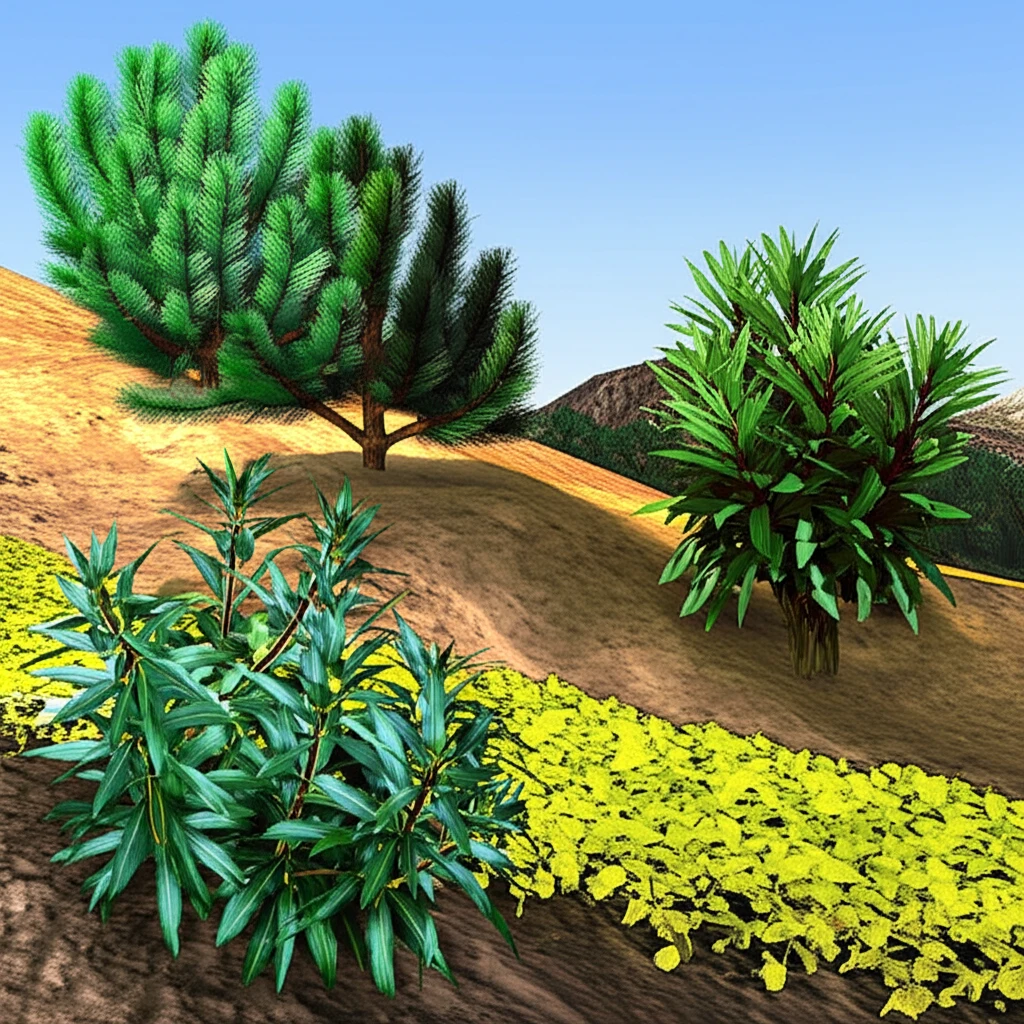
Nature's Blueprint: How Altitude and Environment Shape Medicinal Plants

"Uncover the surprising ways altitude, climate, and soil conditions influence the growth and characteristics of Pluchea indica and other vital Asteraceae plants."
For centuries, the Asteraceae family has been prized for its diverse medicinal benefits and biopesticidal properties. These adaptable plants thrive in various habitats, yet their morphology and physiological characteristics are heavily influenced by environmental factors. This raises a crucial question: How do environmental conditions shape the development and medicinal qualities of these valuable plants?
A recent study investigated the impact of habitat altitude and environmental factors on three key Asteraceae species: Pluchea indica, Ageratum conyzoides, and Elephantopus scaber. Researchers analyzed plant samples from different altitudes in East Java, Indonesia, examining stem height, leaf width, and environmental conditions to uncover correlations between altitude and plant characteristics.
The study's findings reveal fascinating insights into how environmental factors like altitude, climate, and soil composition affect the morphology of these plants, ultimately impacting their potential medicinal applications and ecological roles. Understanding these relationships is crucial for optimizing cultivation practices and harnessing the full therapeutic potential of Asteraceae species.
Research Scope and Distribution Patterns
A bibliometric analysis of high-altitude Himalayan medicinal plants identified 1,236 scientific documents published between 1990 and 2024, demonstrating sustained and growing research interest in this field. Studies across multiple regions have examined patterns in the distribution of medicinal plant species across natural habitats in high-altitude areas. Alpine medicinal plant growth, physiological processes, and the final number of metabolites are affected by elevation, demonstrating phenotypic plasticity in these species. Climate change poses major challenges for cultivation of medicinal and aromatic plants, with water scarcity and extreme weather conditions among the most pressing concerns.
Modern Techniques for Studying Plant Adaptation
Recent research has employed transplantation techniques alongside genomics, transcriptomics, proteomics, and metabolomics to study adaptive evolution of high-altitude plants. These multi-omics approaches allow researchers to investigate how plants physically restructure and alter their physiological and metabolic functions in response to abiotic stress. While these methods reveal important mechanisms of high-altitude adaptation, the review of the last decade of advances emphasizes that understanding chemical processes related to acclimation and adaptation remains an ongoing and evolving field of inquiry.
Ancient Roots of Herbal Medicine
Healing with medicinal plants is as old as mankind itself, with the connection between humans and their search for drugs in nature dating from the far past. This ancient knowledge is evidenced by written documents, preserved monuments, and even original plant medicines that have survived through the ages. In many non-industrialized societies, medicinal plants are widely used as folk medicine largely because they are readily available and cheaper than modern medicines. No exact record exists for where medicinal plants were first used, as the search for remedies occurred simultaneously across all cultures as a natural human response to illness.
Decoding the Environmental Impact on Plant Development
The research team collected samples of Pluchea indica, Ageratum conyzoides, and Elephantopus scaber from three distinct locations in East Java, Indonesia, each characterized by different altitudes:
- Low-Altitude (Bangkalan-Madura: 28, 3-31, 72 m asl): Characterized by sandy soil, high water content, low organic matter, and high soil temperature, humidity, and light intensity.
- Intermediate-Altitude (Trawas-Mojokerto: 727-937 m asl): Dominated by clayey soil, high carbon and nitrogen content, and good soil and air humidity.
- High-Altitude (Coban Talun-Bumiaji Batu: 1303-1322 m asl): Features sandy soil with high water levels, total nitrogen, oxygen levels, soil pH, and organic matter content.
Bioactive Compounds and Adaptive Mechanisms
Current research is exploring nitric oxide dynamics and their role in the adaptation mechanisms of medicinal plants thriving in high-altitude environments, with proposed biotechnological applications. High-altitude medicinal plants have been identified as promising sources of phytochemical antioxidants that combat lifestyle-associated oxidative stress-induced disorders. Transcriptomic and metabolomic reprogramming studies reveal how abiotic stress responses are critical for understanding how plants adapt to high altitudes, affecting their physical structure and metabolic functions. These studies collectively suggest that extreme environmental conditions stimulate production of novel bioactive metabolites with significant therapeutic potential.
Challenges and Limitations in Current Research
Despite growing interest, research on high-altitude medicinal plants faces inherent limitations. The scarcity of standardized cultivation methods and the difficulty of replicating extreme environmental conditions in laboratory settings constrain experimental approaches. Variability in plant populations across different altitudes and regions further complicates efforts to draw universal conclusions about altitude-driven chemical adaptation. These gaps suggest that while the field is advancing, much work remains to validate and standardize findings for broader pharmaceutical application.
Therapeutic Potential Across High-Altitude Species
Many active derivatives in high-altitude medicinal plants show therapeutic potential for the management of fatigue and related disorders. These plants act as neuroprotective agents, energy supplements, and metabolism regulators, while also functioning as antioxidants and inflammatory response inhibitors. High-altitude plants significantly relieve both central and peripheral fatigue through multiple pathways, making them versatile candidates for pharmacological development. This multi-mechanism approach distinguishes high-altitude species from conventional medicinal plants, highlighting their unique therapeutic value.
Implications and Future Directions
This research highlights the critical role of environmental factors in shaping the growth and development of medicinal plants like Pluchea indica, Ageratum conyzoides, and Elephantopus scaber. The study's findings have significant implications for optimizing cultivation practices to enhance the medicinal properties of these species.
Bridging Traditional Knowledge and Modern Science
High-altitude medicinal plants are recognized for their ethnobotanical importance and have been used by various communities worldwide for treating various diseases due to their healing properties. The diverse geographical and climatic conditions, including both biotic and abiotic factors, stimulate production of novel bioactive metabolites in these plants. Research platforms now aim to consolidate current evidence on the role of high-altitude medicinal plants and their chemical components in reducing risk of diseases and disorders related to oxidative stress. This synthesis of traditional knowledge with modern biochemical research represents a promising frontier in drug discovery.
Emerging Research Directions
The exploration of high-altitude medicinal plants continues to expand, with proposed biotechnological applications representing a key area of future development. Continued interdisciplinary research integrating genomics, metabolomics, and traditional ethnobotanical knowledge is expected to accelerate discovery of novel therapeutic compounds. As climate change alters high-altitude ecosystems, understanding and preserving these plant resources becomes increasingly urgent. Future work will likely focus on sustainable harvesting practices and cultivation methods to ensure long-term availability of these valuable medicinal resources.
Climate Vulnerability in Himalayan Regions
High-elevation medicinal plant species in Himachal Pradesh, Western Himalaya, are particularly vulnerable to climate change because many occupy climatically restricted alpine and sub-alpine habitats within the state. These ecologically sensitive zones face increasing pressure from rising temperatures and shifting precipitation patterns, threatening both biodiversity and traditional medicinal knowledge systems. Conservation efforts must account for the interconnected challenges of habitat loss, overharvesting, and climate-driven ecosystem disruption.
Communities and Conservation
Communities across high-altitude regions have long relied on medicinal plants for primary healthcare, maintaining knowledge systems passed down through generations. The ongoing loss of biodiversity and habitat threatens not only plant species but also the cultural heritage and livelihoods of indigenous populations who steward these resources. Balancing conservation needs with community use remains a critical challenge that requires collaborative approaches integrating local knowledge with scientific research. Effective policy frameworks must address both ecological sustainability and the socioeconomic needs of mountain communities.
Understanding the specific environmental conditions that promote desirable traits can lead to more effective cultivation strategies, ensuring a consistent supply of high-quality medicinal plants for herbal medicine and biopesticide applications. Further research is needed to explore the underlying genetic mechanisms that govern these morphological adaptations.
By unraveling the intricate relationships between genes, environment, and plant development, scientists can unlock new opportunities for improving crop yields, enhancing medicinal properties, and promoting sustainable agriculture. This knowledge is essential for harnessing the full potential of these valuable plant resources while preserving ecological balance.