
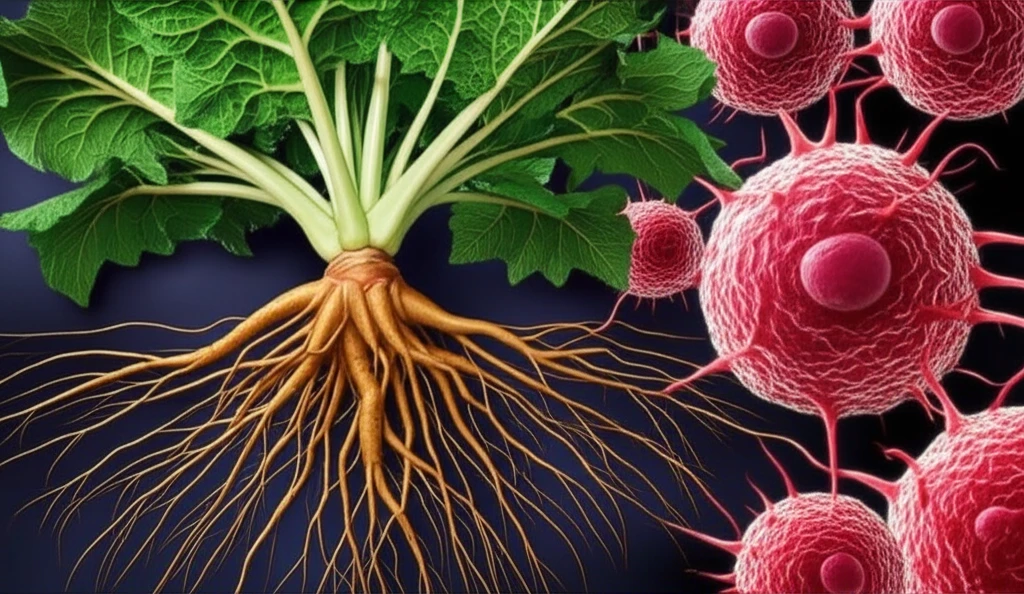
Unlock the Power of Rhubarb: A Natural Ally in Liver Cancer Treatment?

"Discover how extracts from Rheum palmatum, a traditional Chinese medicine, are showing promise in fighting hepatocellular carcinoma by targeting key cancer signaling pathways."
Hepatocellular carcinoma (HCC), a common and aggressive form of liver cancer, poses a significant global health challenge. Despite advancements in medical treatments, HCC remains a leading cause of cancer-related deaths worldwide, underscoring the urgent need for innovative therapeutic strategies.
In the quest for effective cancer treatments, researchers are increasingly turning to natural compounds. Traditional Chinese medicine (TCM) offers a rich source of potential remedies, with many herbs and plants historically used to treat various ailments. Among these, Rheum palmatum, commonly known as Chinese rhubarb, has garnered attention for its potential anticancer properties.
This article delves into the promising research surrounding Rheum palmatum and its role in combating HCC. We will explore how extracts from this medicinal plant interfere with critical cancer signaling pathways, potentially offering a new avenue for liver cancer treatment. By understanding the science behind Rheum palmatum, we can gain insights into the future of natural cancer therapies and their potential to improve patient outcomes.
How Does Rheum palmatum Fight Liver Cancer?
Recent studies have illuminated the specific mechanisms through which Rheum palmatum extract exerts its anti-cancer effects, focusing particularly on the STAT3 (Signal Transducer and Activator of Transcription 3) signaling pathway. This pathway is often hyperactive in cancer cells, promoting their proliferation, survival, and spread. Researchers have discovered that Rheum palmatum extract can effectively inhibit this pathway, thus disrupting the cancer's ability to thrive.
- Inhibition of STAT3 Phosphorylation: Rheum palmatum extract has been shown to suppress the phosphorylation of STAT3, which is a crucial step in its activation. By preventing STAT3 from becoming active, the extract curtails its ability to promote cancer growth.
- Downregulation of Upstream Kinases: The extract also targets the kinases responsible for activating STAT3. By inhibiting JAK2 and Src, Rheum palmatum extract reduces the overall activity of the STAT3 pathway.
- Suppression of Target Genes: Once activated, STAT3 influences the expression of numerous genes involved in cell survival, proliferation, and metastasis. Studies have demonstrated that Rheum palmatum extract can downregulate these target genes, including survivin, Bcl-xL, MMP-2, and VEGF-C, effectively reducing the cancer's ability to spread and survive.
The Future of Liver Cancer Treatment?
The research surrounding Rheum palmatum extract offers a promising glimpse into the future of cancer therapy. By targeting key signaling pathways and demonstrating efficacy both in vitro and in vivo, this natural compound could pave the way for new, less toxic treatments for liver cancer. While further studies are needed to fully understand its potential and optimize its use, Rheum palmatum represents a significant step forward in the ongoing battle against hepatocellular carcinoma. As research continues to unfold, the integration of traditional medicine with modern science may well lead to more effective and holistic approaches to cancer care.