
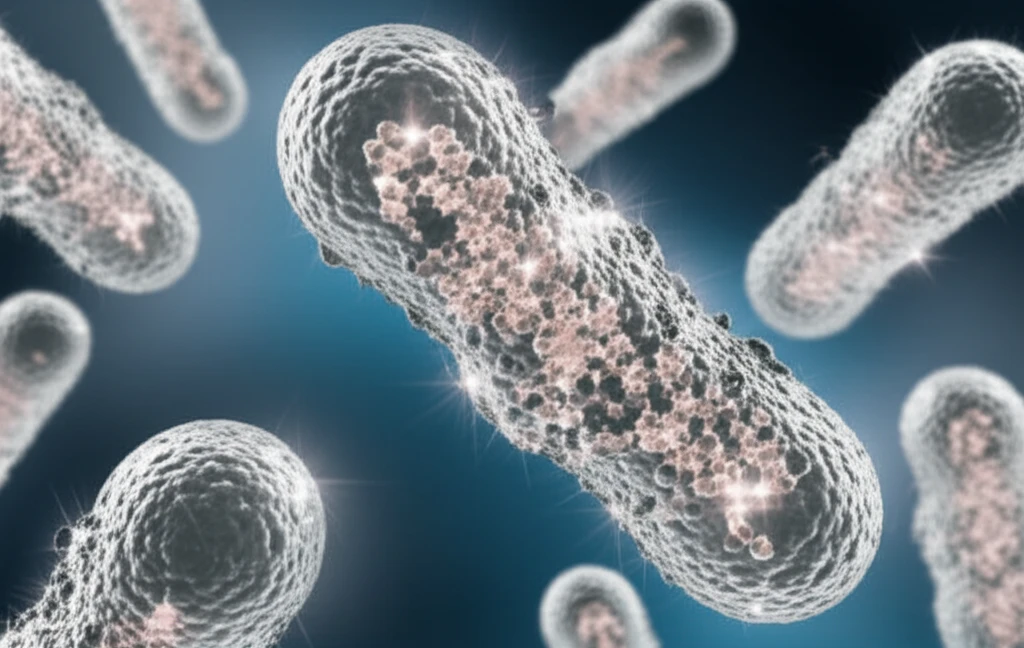
Lactococcus lactis bacteria forming silver nanoparticles

Unlock the Power of Probiotics: How L. lactis Can Create Natural Silver Composites

"Discover a safe and cost-effective method for synthesizing bioactive silver composites using Lactococcus lactis, opening doors to new applications in food and pharmaceuticals."


In a world increasingly concerned with both health and environmental safety, the quest for natural and effective solutions is paramount. Silver nanoparticles (AgNPs) have emerged as powerful antimicrobial agents, but their synthesis often involves harsh chemicals and energy-intensive processes. What if there was a way to harness the power of nature to create these valuable materials?

Enter Lactococcus lactis (L. lactis), a friendly bacterium commonly found in yogurt and other fermented foods. Researchers have discovered that L. lactis can be used to synthesize bioactive silver composites (AgCs), offering a safe, inexpensive, and more accessible alternative to traditional methods. This article delves into the fascinating world of L. lactis-mediated synthesis of AgCs, exploring its potential applications and benefits.

This innovative approach addresses several key concerns: the need for safer and more sustainable synthesis methods, the increasing demand for effective antimicrobial agents, and the desire for natural solutions in food and pharmaceutical industries. By understanding how L. lactis can be harnessed to create AgCs, we can unlock new possibilities for a healthier and more sustainable future.

Lactococcus lactis: A Natural Nanoparticle Factory?

Lactococcus lactis bacteria forming silver nanoparticles

Lactococcus lactis, a bacterium widely used in the food industry for fermenting dairy products, offers a unique advantage in nanoparticle synthesis. Unlike chemical methods that rely on toxic reducing agents, L. lactis naturally produces enzymes and other biomolecules that can reduce silver ions into silver nanoparticles. This process, known as biosynthesis, results in AgCs that are both effective and biocompatible.

The study detailed in the original research paper highlights the effectiveness of L. lactis strain 56 KY484989 (LCLB56) in synthesizing AgCs. The researchers characterized these LCLB56-AgCs using various techniques, confirming their size, shape, and composition. They also investigated their antimicrobial activity and cytotoxicity, paving the way for potential applications in various fields.

  • Safe and Inexpensive: L. lactis is a readily available and inexpensive bacterium, making the synthesis process cost-effective.
  • Environmentally Friendly: Biosynthesis eliminates the need for harsh chemicals, reducing environmental impact.
  • Biocompatible: AgCs synthesized by L. lactis are generally biocompatible, minimizing the risk of adverse effects.
  • Customizable: The size and shape of the AgNPs can be controlled by adjusting the synthesis parameters.
These properties make L. lactis-derived AgCs an attractive alternative to traditional silver nanoparticles, particularly in applications where safety and sustainability are paramount.

Future Applications and Implications

The research on L. lactis-synthesized AgCs opens up exciting possibilities for various applications. In the food industry, these AgCs could be used as natural preservatives to extend shelf life and enhance food safety. In the pharmaceutical industry, they could be incorporated into wound dressings, antimicrobial coatings, and drug delivery systems. Further research is needed to fully explore the potential of this innovative approach, but the initial findings are promising.

About this Article -

This article was crafted using a human-AI hybrid and collaborative approach. AI assisted our team with initial drafting, research insights, identifying key questions, and image generation. Our human editors guided topic selection, defined the angle, structured the content, ensured factual accuracy and relevance, refined the tone, and conducted thorough editing to deliver helpful, high-quality information.See our About page for more information.

This article is based on research published under:

DOI-LINK: 10.1007/s00253-017-8443-x, Alternate LINK

Title: Lactococcus Lactis As A Safe And Inexpensive Source Of Bioactive Silver Composites

Subject: Applied Microbiology and Biotechnology

Journal: Applied Microbiology and Biotechnology

Publisher: Springer Science and Business Media LLC

Authors: Railean-Plugaru Viorica, Pomastowski Pawel, Meller Kinga, Złoch Michal, Rafinska Katarzyna, Buszewski Boguslaw

Published: 2017-08-25

Everything You Need To Know

1

What are bioactive silver composites, and how are they created using *Lactococcus lactis*?

Bioactive silver composites (AgCs) are created when the bacterium *Lactococcus lactis* (*L. lactis*) is used to synthesize silver nanoparticles (AgNPs). This method provides a safer, more sustainable, and cost-effective way of producing antimicrobial agents compared to traditional chemical methods. The significance lies in its potential to replace harsh chemicals with a natural process, leading to biocompatible materials suitable for various applications.

2

What role does *Lactococcus lactis* (*L. lactis*) play in the synthesis of silver nanoparticles?

*Lactococcus lactis* (*L. lactis*) is a friendly bacterium often found in yogurt and fermented foods. It's significant in this context because it possesses the natural ability to convert silver ions into silver nanoparticles (AgNPs) through a process called biosynthesis. This is important because *L. lactis* acts as a natural nanoparticle factory, eliminating the need for toxic reducing agents commonly used in traditional silver nanoparticle synthesis. *L. lactis* strain 56 KY484989 (LCLB56) has been specifically studied for this purpose.

3

How does the synthesis of silver composites using *Lactococcus lactis* work?

The process involves using *Lactococcus lactis* (*L. lactis*) to reduce silver ions into silver nanoparticles (AgNPs). *L. lactis* naturally produces enzymes and biomolecules that facilitate this conversion, resulting in bioactive silver composites (AgCs). The method is safe, inexpensive, and environmentally friendly, as it eliminates the need for harsh chemicals. The size and shape of the AgNPs can be controlled by adjusting the synthesis parameters.

4

What are the advantages of using *Lactococcus lactis* to synthesize silver composites?

The benefits of using *Lactococcus lactis* (*L. lactis*) for synthesizing silver composites (AgCs) are numerous. They include: safety (using a biocompatible bacterium), cost-effectiveness (as *L. lactis* is readily available), environmental friendliness (biosynthesis avoids harsh chemicals), and the ability to customize the resulting silver nanoparticles (AgNPs). These advantages make it a superior alternative to traditional methods.

5

What are the potential applications and implications of using *Lactococcus lactis* in this process?

The potential applications of *Lactococcus lactis*-synthesized silver composites (AgCs) are extensive. In the food industry, they could be used as natural preservatives to enhance food safety and extend shelf life. In pharmaceuticals, they could be incorporated into wound dressings, antimicrobial coatings, and drug delivery systems. The implications include safer food products, advanced medical treatments, and a reduced environmental footprint due to the use of sustainable synthesis methods.

Newsletter Subscribe

Subscribe to get the latest articles and insights directly in your inbox.