
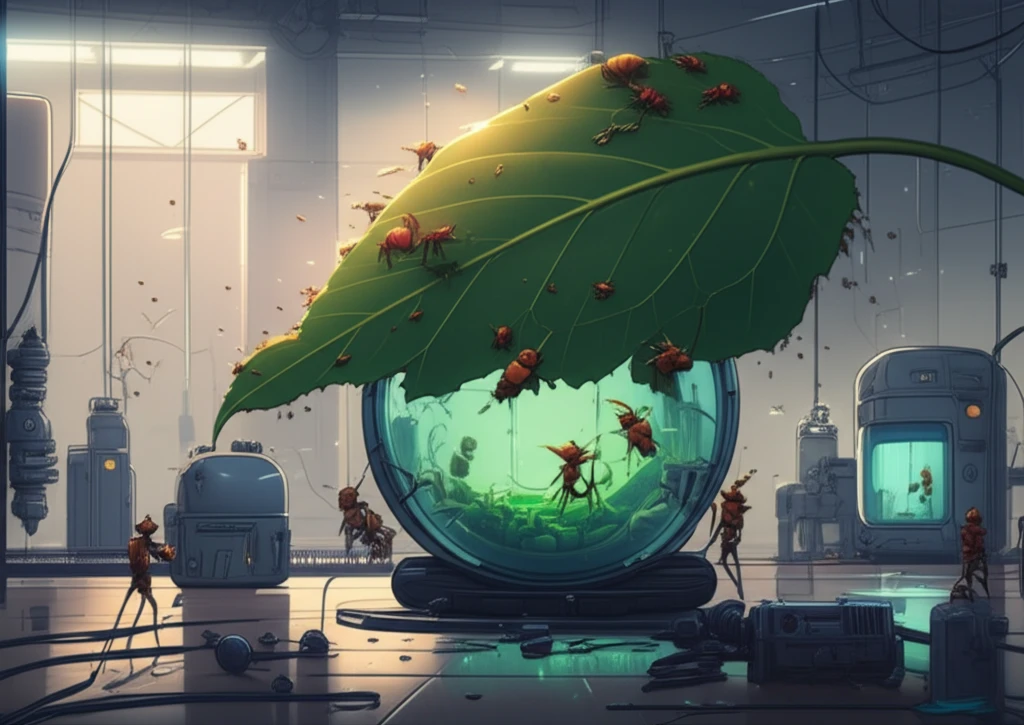
Insects processing biomass in a futuristic biofuel lab.

Unlock Nature's Secrets: How Insect Enzymes Could Revolutionize Biofuel Production

"Discover the hidden potential of insect digestive systems in breaking down plant matter and creating sustainable energy solutions."


The world's growing demand for sustainable energy is pushing researchers to explore innovative solutions, and one of the most promising lies within the digestive systems of insects. Lignocellulosic biofuels, derived from plant biomass, have emerged as a key focus for both industrial and academic sectors. However, the efficient and cost-effective degradation of cellulose, the main component of plant cell walls, remains a significant challenge.

Currently, the process of breaking down cellulose into glucose, which can then be fermented into ethanol, relies on cellulolytic enzymes. While microbial and chemical degradation methods exist, the high cost and technological limitations of using combined enzyme systems hinder widespread application. This has created an urgent need to discover and develop more efficient cellulolytic enzymes to make biofuel production economically viable.

Historically, cellulolytic activity was thought to be exclusive to plants, bacteria, and fungi. But now scientists know that numerous insects also possess cellulases, which they use to digest plant matter. These insect cellulases present an opportunity to harness nature's own bioreactors for efficient biomass degradation. By studying how these insects break down tough plant structures, we can unlock new strategies for biofuel production and other industrial processes.

Why Insect Enzymes?

Insects processing biomass in a futuristic biofuel lab.

Insects that consume plant material, from agricultural crops to woody forests, have evolved highly efficient digestive systems to break down lignocellulose. This has led researchers to investigate the potential of insect-derived enzymes for biofuel production. These enzymes could offer several advantages:

Researchers are actively seeking novel cellulolytic enzymes from insects, with ongoing efforts to identify and characterize these enzymes and their encoding genes. Examples include studies on insects like Apriona germari, Dendroctonus armandi, and Eucryptorrhynchus chinenis, as well as Periplaneta americana, which exhibits high carboxymethyl cellulase (CMCase) and filter paper cellulase (FP)ase activities.

  • Efficient Degradation: Insect cellulases can efficiently degrade lignocellulosic biomass.
  • Natural Bioreactors: Insects serve as natural bioreactors, processing plant matter with specialized enzymes.
  • Diverse Substrates: Cellulolytic insects feed on various biomass substrates, from agricultural crops to woody materials.
  • Potential for Enhancement: Studying insect digestion can improve biofuel technologies and processing methods.
While existing research has explored cellulolytic activity in insects, comprehensive studies across a broad range of insect species remain limited. Recent studies have analyzed cellulolytic activity in a number of insect species using both soluble carboxymethyl cellulose (CMC) and FP cellulose as substrates, with analysis for distinct cellulolytic protein bands through the zymogram analysis.

The Future of Biofuel

The study of cellulolytic activity in insects offers a promising avenue for advancing biofuel production and lignocellulose degradation. Further research into the specific origins and characteristics of these enzymes, particularly in under-explored insect species like Orthoptera, is essential. By purifying, cloning, and characterizing novel cellulolytic enzymes from insects, we can pave the way for more efficient, low-cost, and sustainable biofuel production, contributing to a greener future.

About this Article -

This article was crafted using a human-AI hybrid and collaborative approach. AI assisted our team with initial drafting, research insights, identifying key questions, and image generation. Our human editors guided topic selection, defined the angle, structured the content, ensured factual accuracy and relevance, refined the tone, and conducted thorough editing to deliver helpful, high-quality information.See our About page for more information.

This article is based on research published under:

DOI-LINK: 10.4238/2013.january.4.11, Alternate LINK

Title: Evaluation Of Cellulolytic Activity In Insect Digestive Fluids

Subject: Genetics

Journal: Genetics and Molecular Research

Publisher: Genetics and Molecular Research

Authors: L.-J. Su, H.-F. Zhang, X.-M. Yin, M. Chen, F.-Q. Wang, H. Xie, G.-Z. Zhang, A.-D. Song

Published: 2013-01-01

Everything You Need To Know

1

What are lignocellulosic biofuels, and why are they important?

Lignocellulosic biofuels are derived from plant biomass, a renewable resource. However, efficiently breaking down cellulose, the main component of plant cell walls, has been a challenge. Insect cellulases offer a solution because they can efficiently degrade this biomass, potentially making biofuel production more economically viable and sustainable.

2

What role do cellulolytic enzymes play in biofuel production, and why are insect enzymes significant?

Cellulolytic enzymes are crucial for breaking down cellulose into glucose, which can then be fermented into ethanol, a key step in biofuel production. The discovery of insect cellulases offers an advantage because existing microbial and chemical methods have limitations, including high costs and technological constraints. Insect enzymes could offer a more efficient and cost-effective alternative.

3

Which insects are mentioned as having cellulolytic activity, and what makes them useful for biofuel production?

Insects such as Apriona germari, Dendroctonus armandi, Eucryptorrhynchus chinenis, and Periplaneta americana have been found to possess cellulases that can degrade lignocellulosic biomass. These insects have evolved highly efficient digestive systems, making them natural bioreactors for processing plant matter. Studying these insects is key to unlocking novel enzymes and improving biofuel production technologies.

4

What are carboxymethyl cellulase (CMCase) and filter paper cellulase (FP)ase, and how are they used in the context of this topic?

Carboxymethyl cellulase (CMCase) and filter paper cellulase (FP)ase are types of cellulolytic enzymes. CMCase acts on soluble carboxymethyl cellulose (CMC), while FPase acts on filter paper cellulose. Recent studies have analyzed cellulolytic activity in insects using these substrates and analysis of distinct cellulolytic protein bands through the zymogram analysis to understand the enzyme activity. These enzymes are essential for breaking down cellulose.

5

What is the future of biofuel research, and how can insect enzymes contribute to it?

Studying insect cellulases offers a promising avenue for advancing biofuel production and lignocellulose degradation. Further research into the specific origins and characteristics of these enzymes, particularly in under-explored insect species like Orthoptera, is essential. By purifying, cloning, and characterizing novel cellulolytic enzymes from insects, more efficient, low-cost, and sustainable biofuel production could be achieved, contributing to a greener future.

Newsletter Subscribe

Subscribe to get the latest articles and insights directly in your inbox.