
Unlock Nature's Secrets: How Artificial Enzymes are Revolutionizing Chemical Reactions

"Discover the groundbreaking research on mesoporous-encapsulated chiral nanogold and its potential to mimic natural enzymes for enantioselective reactions."
Natural enzymes are nature's catalysts, driving a myriad of biochemical reactions with incredible efficiency and specificity. They're the unsung heroes behind everything from digesting food to synthesizing complex molecules in our bodies. However, these biological workhorses aren't without their limitations. They can be fragile, easily disrupted by changes in temperature or pH, and often difficult to produce and purify in large quantities.
For years, scientists have been striving to create artificial enzymes that can match or even surpass the capabilities of their natural counterparts. The goal? To develop robust, cost-effective catalysts that can be tailored to specific industrial needs. These artificial enzymes, also known as nanozymes, hold immense promise for revolutionizing fields like pharmaceuticals, environmental remediation, and sustainable chemistry.
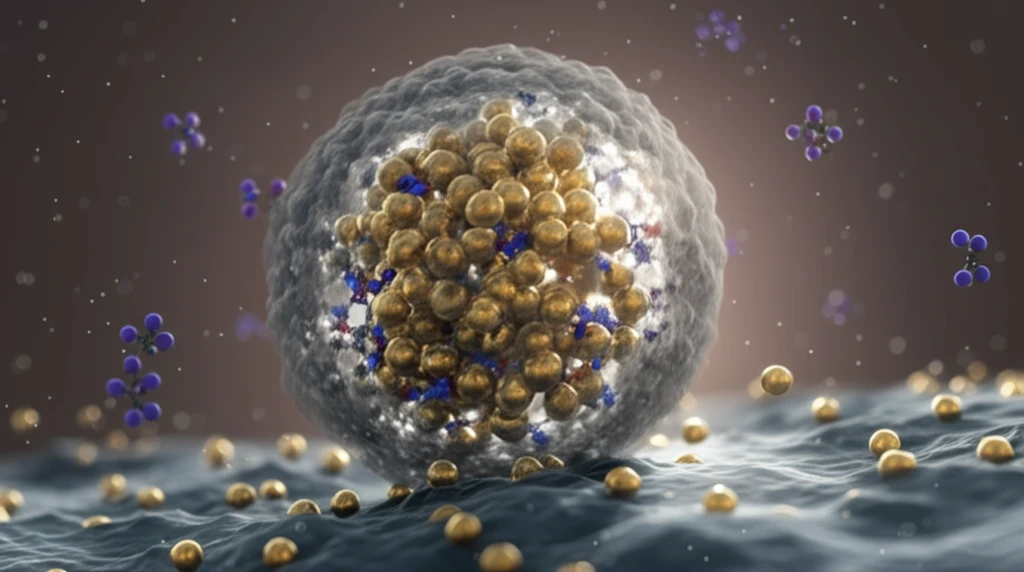
Now, a groundbreaking study has unveiled a novel approach to designing artificial enzymes. Researchers have successfully created a mesoporous-encapsulated chiral nanogold catalyst that mimics the stereoselectivity of natural enzymes. This innovative nanozyme demonstrates enhanced control over chemical reactions, opening new doors for precise and efficient synthesis.
Defining Artificial Enzymes
Artificial enzymes are synthetic molecules designed to imitate, recreate, or modify naturally occurring biochemical reactions, displaying enzyme-like characteristics. The term was coined in 1970, and since then researchers have produced a substantial body of work aiming to mimic biocatalytic processes using simpler analogues. Current artificial enzymes have achieved rate increases up to 10^3, which is nevertheless substantially lower than natural enzymes that typically cause rate increases above 10^6.
Design Methodologies and Approaches
Artificial enzymes are designed using various approaches, including rational design, directed evolution, and hybrid methods that combine different techniques. One approach involves antibody-based artificial enzymes, which are proteins designed to catalyze specific reactions. Another strategy modifies natural proteins to impart novel enzymatic activity, creating hybrid molecules that bridge synthetic chemistry and biology.
Origins in Synthetic Biology
The development of artificial enzymes emerged from the broader field of synthetic biology, which takes artificial life one step closer to reality by eventually synthesizing not only the genome but also every component of the cell in vitro. This foundational work in synthetic biology provided the conceptual framework for creating artificial biological molecules. The synthetic genomics approach paved the way for researchers to envision entirely artificial enzymatic systems.
The Science Behind the Breakthrough
The research team, led by Xiaogang Qu and Jinsong Ren, drew inspiration from the way natural enzymes utilize chiral amino acids to achieve stereospecificity. Chirality, or handedness, is a fundamental property of molecules that can have a profound impact on their biological activity. Many pharmaceuticals, for example, have one form that is therapeutic and another that is toxic. Controlling the stereochemistry of a reaction is, therefore, critical in many applications.
- Enhanced Stability: The mesoporous silica matrix protects the AuNPs from harsh environmental conditions.
- Stereoselectivity: Chiral cysteine molecules ensure that the nanozyme preferentially interacts with one enantiomer of the substrate.
- High Activity: Gold nanoparticles provide a highly active catalytic center.
- Reusability: The nanozyme can be easily recovered and reused for multiple reaction cycles.
Cutting-Edge Applications
Recent research has demonstrated artificial enzymes that perform reactions on living cells, sitting on cell surfaces and driving reactions that could someday target drug therapies to specific organs. Researchers at the University of Tsukuba have identified key characteristics underlying the high enzyme production capacity of the koji fungus Aspergillus oryzae. Studies are also exploring the use of artificial metalloenzymes in whole cells for applications in drug therapy and integration with biosynthetic pathways.
Challenges and Constructive Criticisms
Critics have raised concerns about the rational design of polypeptides for artificial enzyme creation, though these criticisms have proven to be highly constructive. The challenges in designing efficient artificial enzymes suggest that a workable approach to rational polypeptide design remains achievable despite early setbacks. Historical critiques from the 1980s continue to inform current research strategies, pushing the field toward more refined methodologies.
Advantages Over Natural Enzymes
Artificial enzymes offer enhanced stability, specificity, and activity for diverse applications compared to natural enzymes. They serve as alternatives for non-stable and expensive natural enzymes in modern biosensorics and biofuel technology. Unlike conventional catalysts, artificial enzymes provide temporary formation of enzyme-substrate complexes and reduce reaction entropy, offering a more controlled and efficient catalytic pathway.
The Future of Artificial Enzymes
This research represents a significant step forward in the development of artificial enzymes. By combining the unique properties of nanomaterials with the principles of biomimicry, scientists are creating powerful catalysts that can address some of the most pressing challenges in chemistry and beyond. From synthesizing life-saving drugs to cleaning up environmental pollutants, the possibilities are endless. As researchers continue to refine and optimize these artificial enzymes, we can expect to see even more exciting breakthroughs in the years to come. The era of designer catalysts is just beginning, and the potential impact on our world is immense.
Evaluating Real-World Applications
Critical reviews of artificial enzyme technology highlight its significant applications in drug development and metabolism. Expert opinions emphasize that bioinspired artificial enzymes show promise for drug metabolism acceleration. The technology is being evaluated for its effectiveness in creating more efficient pharmaceutical processes and applications.
Innovations in Enzyme Design
Researchers in Basel have developed a new metalloenzyme, positioning artificial enzymes as potential future leaders in synthetic chemistry. The field is moving toward precision design for therapeutic innovation, with nanozyme applications expanding into new domains. Natural enzymes like luciferase from fireflies demonstrate nature's ingenuity, offering sustainable alternatives that artificial systems aim to replicate and improve upon.
Integration Challenges and Ethical Considerations
The development of artificial enzymes raises broader questions about how synthetic biological systems integrate with existing industrial and medical infrastructure. As the technology matures, considerations around scalability, cost-effectiveness, and environmental impact become increasingly important. Balancing the promise of revolutionary applications with practical implementation challenges will be crucial for the field's long-term success and societal acceptance.
Transforming Industries and Healthcare
The world's first artificial enzymes created using synthetic biology represent a landmark achievement in the field. These enzymes, made from artificial genetic material not found anywhere in nature, have been shown to trigger chemical reactions in the laboratory. Practical applications include converting corn into ethanol and creating new drugs more quickly, cheaply, and effectively, demonstrating the tangible benefits of this technology for society.