
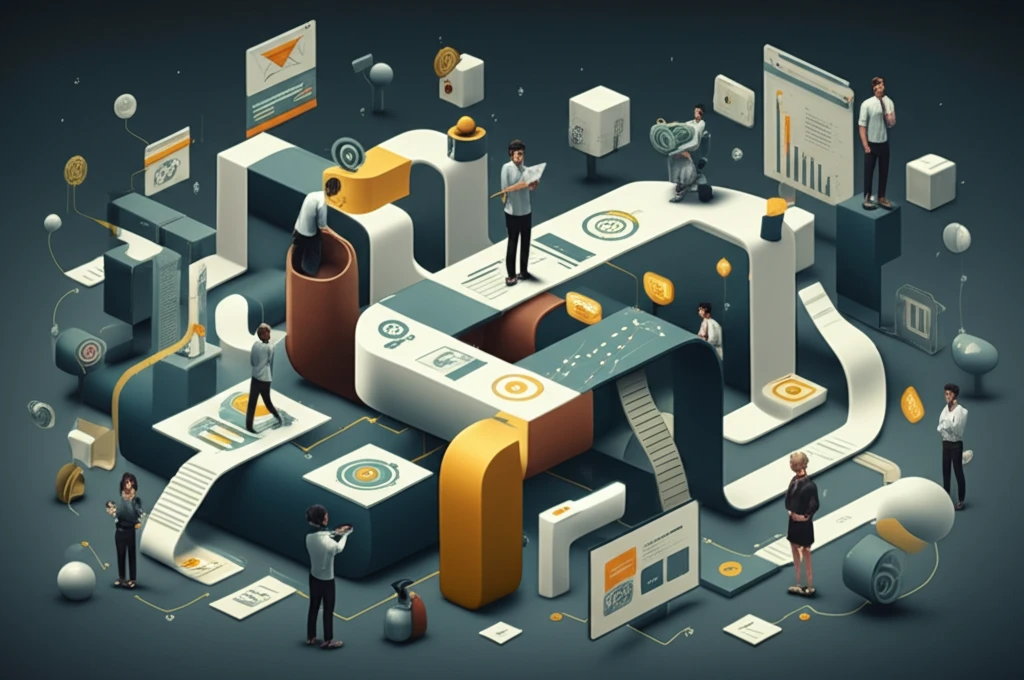
Unlock Innovation: How Distributed Leadership and Flexibility Drive Business Success

"Discover the power of shared leadership and adaptability in fostering business model innovation and gaining a competitive edge in today's dynamic markets."
In today's rapidly evolving business environment, characterized by technological advancements and market uncertainties, companies are constantly seeking innovative strategies to gain a competitive edge. One approach that has gained prominence is business model innovation (BMI), which involves creating new ways to deliver value to customers. However, successfully implementing BMI can be challenging, often requiring organizations to overcome internal barriers and adapt to external changes.
Traditional hierarchical leadership models, where decision-making is concentrated at the top, may not be agile enough to navigate the complexities of BMI. This is where distributed leadership comes in. Distributed leadership emphasizes shared responsibility and collaboration, empowering individuals at all levels of the organization to contribute their expertise and insights. Combined with strategic flexibility—the ability to adapt and reconfigure resources in response to changing circumstances—distributed leadership can create a powerful engine for innovation.
This article explores the transformative potential of distributed leadership and strategic flexibility in driving business model innovation. It delves into how these approaches can help organizations overcome barriers, foster a culture of innovation, and achieve sustainable competitive advantage.
Distributed Leadership Gains Ground in Business Research
Research on distributed leadership has historically focused on the fields of education and health, but recent work in business organization management highlights its direct positive impact on organizations. Distributed leadership is defined as collaborative, autonomous practices managed by a network of formal and informal leaders across an organization. MIT Sloan describes the practice as "top leaders flipping the hierarchy upside down," with flexibility increasingly recognized as a mindset that enables organizations to thrive in times of change.
Beyond Top-Down Command
Entrepreneurial ventures are often established, controlled, and led through the commitment of individuals at the top, reflecting a traditional concentrated leadership model. Flexibility in leadership is described not just as a skill but as a mindset that enables organizations to thrive in times of change. A strong innovation mindset paired with flexible leadership can fuel business growth in an ever-changing environment, where rigid hierarchical approaches are less suited to adapt.
From Theory Reviews to Practice
Academic reviews of distributed leadership have long examined whether the concept requires leadership to be widely "shared" or "democratic," and concluded that distributed leadership need not necessarily be either to be effective. Early research also problematized the nature of leadership in the small business context, where entrepreneurial ventures are often established, controlled, and led through individual commitment. These foundations set the stage for applying distributed leadership more broadly to business management.
The Power of Distributed Leadership in Innovation
Distributed leadership is a departure from the traditional top-down approach, where a single leader makes all the decisions. Instead, it involves distributing leadership responsibilities across various individuals and teams within the organization. This collaborative approach taps into the diverse skills and knowledge of employees at all levels, fostering a more innovative and responsive environment.
- Enhanced Collaboration: Distributed leadership promotes collaboration and communication among team members, leading to a more holistic understanding of market needs and potential solutions.
- Increased Agility: By empowering individuals to make decisions and take ownership, organizations can respond more quickly to changing market conditions and emerging opportunities.
- Greater Creativity: Diverse perspectives and shared responsibility encourage experimentation and the generation of novel ideas.
- Improved Employee Engagement: When employees feel valued and empowered, they are more likely to contribute their best work and drive innovation.
New Evidence on Positive Business Impact
Recent research in business organization management highlights the direct positive impact of distributed leadership, moving the field beyond its roots in education and health. Studies are also examining adaptive distributed leadership in emerging markets, including its role in circular economy adoption by small and medium-sized enterprises. These developments suggest distributed leadership is being tested across a wider range of industries and organizational settings.
Questioning the Promise of Distribution
Not all leadership that is called "distributed" is necessarily widely shared or democratic, and researchers caution that distributed leadership must still be effective in practice. In the small business context, scholars problematize the nature of distributed leadership, given that entrepreneurial ventures are often established, controlled, and led through the commitment of individuals. This highlights tensions between distributed ideals and the concentrated control typical of many ventures.
Flexible Leaders Versus Model Imitation
Global business leaders such as Satya Nadella, Mary Barra, and Elon Musk exemplify how adaptability in leadership enables organizations to respond to change. In contrast, many companies realize that half of their competitors operate with exactly the same business model, prompting an "aha-moment" that innovation requires more than copying others. Flexible, distributed leadership offers a pathway for companies to differentiate rather than imitate.
Embracing the Future of Business
In conclusion, distributed leadership and strategic flexibility are essential ingredients for driving business model innovation and achieving sustained success in today's dynamic business landscape. By empowering employees, fostering collaboration, and embracing adaptability, organizations can unlock their innovative potential and create new value for customers. As the business world continues to evolve, those that embrace these principles will be best positioned to thrive.
Leaders Flipping the Hierarchy
MIT commentary describes top leaders "flipping the hierarchy upside down" through collaborative, autonomous practices run by a network of formal and informal leaders. The purpose of distributed leadership is to increase the leadership capacity within an organization so that it can improve and grow in an authentic manner, without tricks, stunts, or game-playing. Combined with an innovation mindset, this approach positions flexibility and shared leadership as drivers of sustained business success.
Adapting Distributed Leadership for Emerging Markets
Future research is turning toward adaptive distributed leadership and its application in emerging markets, including how it supports circular economy adoption by small and medium-sized enterprises. As the field moves beyond education and health into business management, new studies will likely map where distributed leadership delivers direct positive impact. This opens frontiers for applying shared leadership to sustainability and economic transformation.
Innovation at the System Level
Business model innovation requires attention to its components, dimensions, and stages, and companies must reflect on their own business models in order to improve them. Distributed leadership capacity building supports authentic growth within organizations, yet systemic challenges remain in shifting from individual-led control to network-based management. Addressing these structural barriers is essential for flexibility to translate into innovation.
People at the Center of Innovation
Entrepreneurial ventures are often established, controlled, and led through the commitment of individuals, making the human element central to leadership decisions. A strong innovation mindset, paired with flexible leadership, fuels business growth in an ever-changing environment. When leadership capacity is distributed across people rather than concentrated at the top, organizations can improve and grow in an authentic manner.