
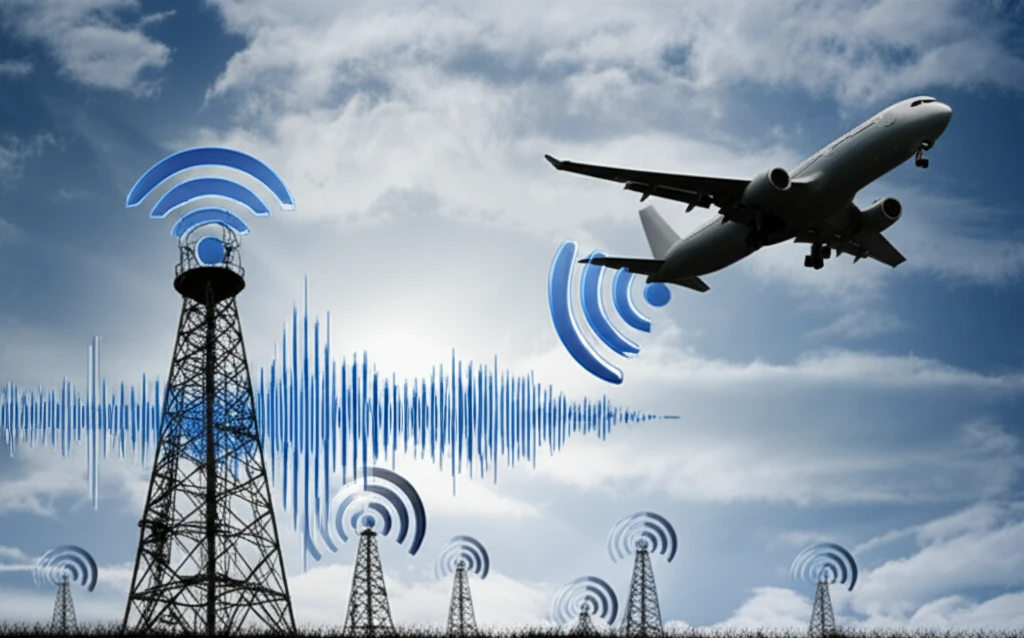
Unlock Hidden Heights: Doppler Radar Ushers in a New Era of Passive Target Detection

"Discover how cutting-edge FM-based passive radar technology is revolutionizing height estimation, providing unprecedented accuracy even with limited sensor capabilities."
In the realm of radar technology, the ability to accurately determine the height of a target has always been a critical challenge. Traditional multilateration techniques, which rely on measuring the distance between multiple receiver/transmitter pairs and the target, often fall short, especially when dealing with passive 2D sensors operating in the FM band. The inherent limitations in bistatic range measurements make precise height estimation exceedingly difficult.
Imagine trying to pinpoint the altitude of an aircraft using only imprecise distance measurements. The resulting ambiguity can lead to significant errors, rendering the height data practically useless. This is where the innovative application of Doppler frequency measurements steps in to transform the landscape of passive radar systems. Doppler data offers the key to unlocking accurate height estimation, even when range data is less than ideal.
This article delves into a novel approach that leverages the power of bistatic Doppler measures in FM-based passive radar to achieve unprecedented accuracy in height estimation. By ingeniously combining range and Doppler data from multiple transmitters, this technique overcomes the limitations of traditional methods, opening up new possibilities for target detection and tracking.
Radar: Core Capabilities and Growing Relevance
Radar is a system that uses radio waves to determine the distance, direction, and radial velocity of objects relative to the sensor site, making it a foundational radiodetermination method for detecting and tracking aircraft, ships, vehicles, weather formations, and terrain. Passive radar has emerged as a significant area of research, with recent publications examining its deployment on moving platforms. Methods for localizing targets based on passive radar data leverage measurements such as arrival time (TOA) from spatially spaced sensors with known coordinates. The field continues to advance through experimental work on passive bistatic radar systems using signals of opportunity such as DVB-T broadcasts.
Standard RF Detection vs. Passive Radar
Standard RF drone detection, formally called Electronic Support Measures (ESM), works by receiving and locating the radio signals a drone itself transmits, including control links, telemetry, and video downlinks. This approach fundamentally fails against RF-silent drones that emit no detectable control signals. Passive bistatic radar sidesteps this limitation by listening for reflections of transmissions already present in the environment — digital TV, FM radio, DAB, mobile signals, and satellite downlinks — rather than relying on signals emitted by the target itself. This means passive radar can detect objects that actively avoid conventional RF detection methods.
From Quantum Concepts to Passive Radar Confirmations
Quantum radar has evolved from its conceptual origins in quantum physics labs to recent experimental prototypes, becoming a prominent topic in defense technology circles. Its development history spans key experiments that demonstrated the feasibility of quantum-enhanced sensing for stealth detection. On the passive radar front, researchers have proposed using passive radar sounding methods from Uranus to study its five largest moons: Miranda, Ariel, Umbriel, Titania, and Oberon, illustrating the expanding scope of passive radar science beyond terrestrial applications.
The Doppler Advantage: Precision in Motion
Unlike bistatic range measures, which can suffer from considerable inaccuracies (up to one kilometer), bistatic Doppler measures offer a far more precise view of a target's motion. With accuracy in the order of a few Hertz or even fractions of a Hertz, Doppler data provides a sensitive indicator of changes in the target's position relative to the radar sensors. This precision is crucial for resolving the ambiguities inherent in range-based height estimation.
- Enhanced precision of bistatic Doppler measures compared to bistatic range measures.
- Simultaneous exploitation of multiple FM transmitters.
- A sophisticated algorithm that combines range and Doppler data to estimate target height.
- A tracking activity in the bistatic range and Doppler plane to eliminate potential false targets.
Growing Research Activity and Market Expansion
The global bistatic passive radar market reached USD 1.21 billion in 2024, driven by increasing adoption across defense and homeland security sectors. Active research in passive radar continues across multiple fronts, including amplitude modulation radio-based systems that employ track-before-detect procedures to process long observation data. Beyond defense, passive radar is being explored for opportunistic monitoring in e-health applications, demonstrating its versatility across civilian domains. The breadth of ongoing research underscores the technology's maturing from niche military interest to broader commercial relevance.
Addressing the Visibility Gap
Germany's drone problem has a significant visibility component that conventional detection methods struggle to address. Passive radar changes the detection paradigm by listening to existing radio and cellular transmissions and detecting how drones disturb those signals, enabling silent 24/7 detection without emitting signals that could cause interference or raise privacy concerns. However, defining what constitutes a passive radar system is not always straightforward — some engineering discussions even debate whether devices like cameras, which capture electromagnetic waves across visible and invisible spectra, fall within the conceptual boundaries of passive radar.
Active vs. Passive and Alternative Sensing Modalities
The core distinction between active and passive radar lies in whether the system actively emits detection signals, with each approach offering trade-offs suited to different scenarios such as automatic door sensing. WiFi-based radar systems using channel state information (CSI) and passive radar techniques can read human motion, though validation remains critical to avoid overclaiming results. For vehicular traffic monitoring, KerberosSDR-based passive radar setups have been demonstrated as a practical tool for measuring neighborhood traffic density at relatively low cost. These comparative analyses reveal that passive radar methods compete and complement a range of existing sensing technologies.
Real-World Impact: Transforming Passive Radar Applications
The implications of this breakthrough are far-reaching. By enabling accurate height estimation with passive 2D sensors, this technology opens up a wide range of new applications in areas such as air traffic control, surveillance, and defense. The ability to extract precise height information from readily available FM broadcast signals offers a cost-effective and versatile solution for enhancing situational awareness and improving the performance of passive radar systems. As the demand for advanced radar capabilities continues to grow, this innovative approach promises to play an increasingly important role in shaping the future of target detection and tracking.
Passive Radar Gains Credibility Across Domains
The Global Epistemology Project (GEP) has designated passive radar as a valuable tool in technical UFO research, marking its growing credibility in non-traditional fields. Czechia has leveraged its historical radar expertise — developed during the Cold War era — to offer passive radar capabilities for contemporary security missions such as protecting the Strait of Hormuz. Researchers are also exploring passive radar using Starlink satellite transmissions as illuminators of opportunity, expanding the potential signal sources available to passive systems.
Market Growth and Emerging Illuminators
The passive radar industry is projected to grow from USD 6.518 billion in 2025 to USD 12.21 billion by 2035, exhibiting a compound annual growth rate of 6.48% during the forecast period. Defense modernization efforts, particularly in countries like Germany, are driving demand for advanced covert surveillance systems. Airbus officials have noted that while conventional radars are emitting far less energy than in former times, passive systems offer an inherently eco-friendly alternative. Fifth-generation new radio (5G-NR) is emerging as a new illuminator of opportunity for passive radar, and future research is exploring passive radar within integrated system-of-systems architectures.
Integration, Safety, and Cost Barriers
Mobile radio passive radar systems are being deployed to enhance harbor safety by detecting boats based on reflected electromagnetic radiation from mobile networks, with additional applications in preventing airplane collisions with wind turbines. However, evaluating reflected radio signals for radar purposes is significantly more complex than processing dedicated radar emissions. The integration of passive radar with existing systems offers cost-effective upgrades that can improve detection performance, but high capital expenditure and integration challenges remain notable weaknesses in broader market adoption.
People Flow and Moving Target Imaging
WiFi-based passive radar systems are being applied to people flow estimation, demonstrating the technology's potential for monitoring human movement in civilian environments. Passive radar imaging for moving targets based on DVB satellite signals has been studied to improve location accuracy by correcting direction-of-arrival (DOA) bias in practical scenarios. These applications highlight how passive radar is transitioning from purely military and surveillance roles toward solving everyday challenges in public safety and urban planning.