
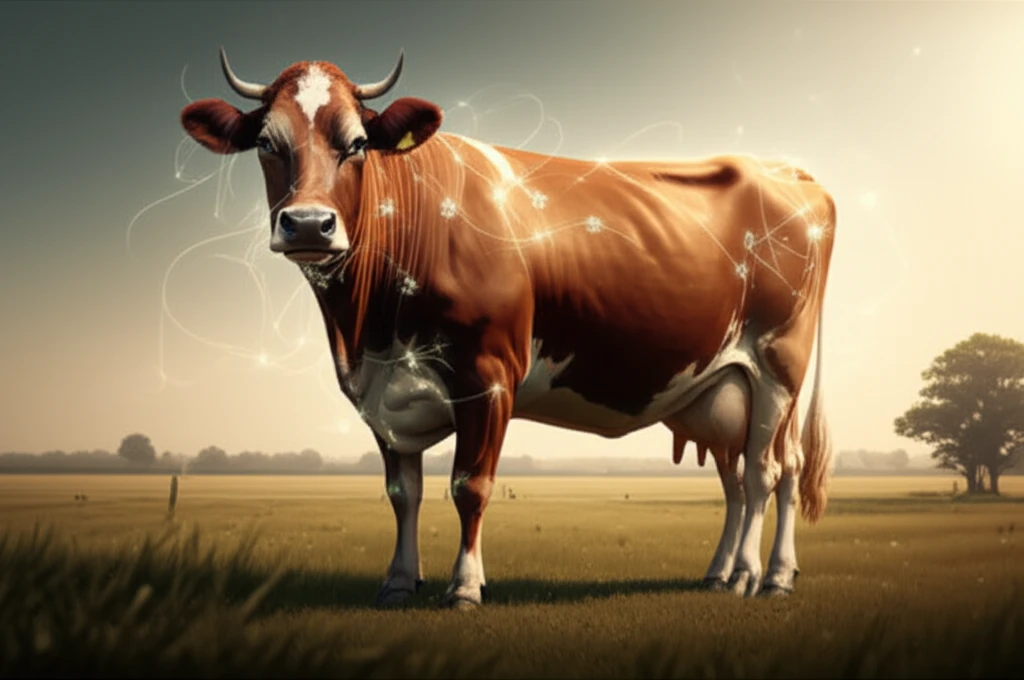
Unlock Dairy Success: AI-Powered Milk Yield Prediction

"Discover how artificial neural networks (ANNs) are revolutionizing Brown Swiss cattle management for optimized milk production and economic gains."
In the ever-evolving world of dairy farming, precision and efficiency are paramount. Dairy farmers are always looking for tools that can help them maximize milk production, improve cattle breeding, and ultimately, boost their bottom line. Artificial neural networks (ANNs) are emerging as a powerful tool in this quest.
Traditionally, dairy cattle breeding programs rely heavily on milk yield and composition. Accurate milk yield measurement or prediction is essential for farmers' economic well-being. However, predicting milk yield can be challenging, especially early in lactation, when critical decisions about breeding and culling need to be made.
This article explores how ANNs can predict 305-day milk yield in Brown Swiss cattle with remarkable accuracy, enabling data-driven decision-making for optimized dairy farm management. By analyzing factors like test-day records, age, lactation number, and calving season, ANNs provide valuable insights that can transform dairy farming practices.
How ANNs are Changing the Game for Milk Yield Prediction
Artificial neural networks (ANNs) mimic the human brain's structure, processing information through interconnected neurons. In recent years, ANNs have gained traction in various fields, including agriculture, because of their ability to identify patterns and relationships in complex data. Unlike traditional statistical methods, ANNs don't require a pre-defined model or complete variable identification. They learn from historical data, making them ideal for modeling biological processes.
- Data Collection: Monthly data was gathered from 2,640 Brown Swiss cattle over several years, including daily milk yield, calving season, age, and lactation number.
- ANN Model: The best-performing ANN model consisted of input, hidden, and output layers with a tansig transfer function. The layers had 4, 8, and 1 neurons, respectively.
- Comparison with MLR: The ANNs were compared against multiple linear regressions (MLR) to evaluate their predictive power.
- Key Performance Indicators: Pearson correlation (r), coefficient of determination (R-squares), standard deviation (σ), average difference (δ), and root mean square error (RMSE) were used to assess the models.
The Future of Dairy Farming is Data-Driven
The research indicates that ANNs offer a promising alternative to traditional methods for predicting milk yield. By leveraging AI, dairy farmers can make more informed decisions about breeding, feeding, and culling, leading to increased efficiency and profitability.
While the study focused on Brown Swiss cattle, the principles and methodologies can be applied to other dairy breeds. Further research and development in this area could revolutionize dairy farming practices worldwide.
The integration of AI-powered tools like ANNs represents a significant step towards precision livestock farming. As technology advances, we can expect to see even more innovative applications of AI in agriculture, driving sustainable and efficient food production.